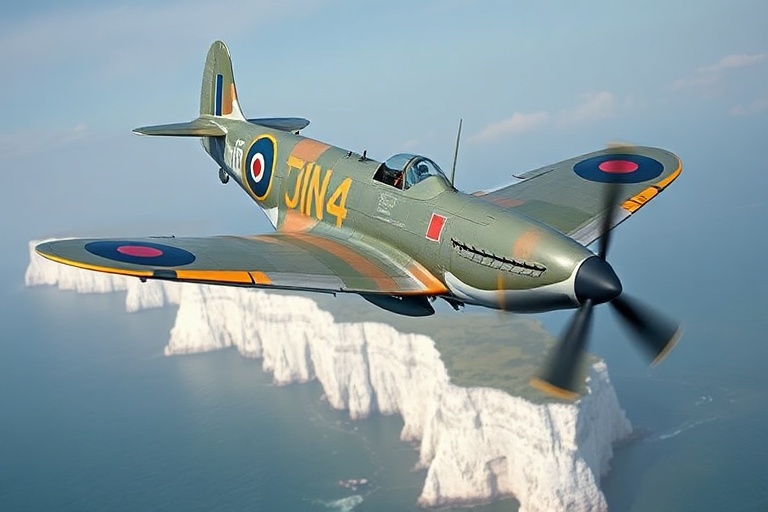
supermarine spitfire
The Supermarine Spitfire remains one of the most recognizable aircraft in history, not just for its distinctive elliptical wings but for its pivotal role in defending British skies during World War II. Designed by Reginald Mitchell and produced by Supermarine Aviation Works, the Spitfire became synonymous with the Royal Air Force’s (RAF) resilience and ingenuity. Its sleek design and adaptability allowed it to evolve alongside the demands of aerial combat, securing its place as a symbol of British engineering and wartime heroism.
The Origins and Design Evolution of the Spitfire
The Spitfire’s development began in the early 1930s as part of Britain’s urgent rearmament program in response to rising tensions in Europe. The Air Ministry issued Specification F.7/30, calling for a modern fighter capable of high speeds and exceptional maneuverability. Supermarine’s entry, initially designated the Type 224, was a radical departure from existing biplanes. Its all-metal monocoque fuselage and innovative elliptical wing design set it apart, offering reduced drag and superior lift.
Reginald Mitchell’s team refined the design, incorporating the new Rolls-Royce Merlin engine, which became the Spitfire’s beating heart. The Merlin’s liquid-cooled V12 configuration provided the power needed to achieve speeds of up to 360 mph—unheard of at the time. The aircraft’s armament evolved as well, transitioning from early models equipped with four .303 Browning machine guns to later variants featuring eight machine guns and eventually two 20mm Hispano cannons. This adaptability ensured the Spitfire could meet the challenges of aerial warfare as they changed.
The Spitfire’s elliptical wings were not just an aesthetic choice; they were a masterstroke of aerodynamic efficiency. While more complex to manufacture, the wing’s shape allowed for a thinner profile, reducing drag and enabling higher speeds without sacrificing structural integrity. This design choice gave the Spitfire a distinct advantage in dogfights, where speed and agility often decided the outcome.
The Spitfire’s Role in the Battle of Britain
When the Battle of Britain erupted in the summer of 1940, the Spitfire became the RAF’s frontline defender against the German Luftwaffe. Alongside the Hawker Hurricane, it bore the brunt of the aerial assault, challenging the numerical superiority of the German forces. The Spitfire’s ability to intercept high-flying German bombers, such as the Heinkel He 111 and Dornier Do 17, made it indispensable. Its performance at altitude, where the Merlin engine performed optimally, was particularly crucial.
The Spitfire’s role extended beyond pure interception. It was also tasked with escorting bombers on daylight raids, protecting vulnerable targets such as airfields, factories, and ports. Pilots quickly learned to exploit the Spitfire’s strengths—its tight turning radius and rapid acceleration—to outmaneuver enemy fighters like the Messerschmitt Bf 109. However, the Bf 109’s superior roll rate at high speeds meant that Spitfire pilots had to rely on their aircraft’s other attributes, such as its stability in a dive, to gain an advantage.
The psychological impact of the Spitfire cannot be overstated. Its presence over British skies became a symbol of defiance against the Luftwaffe’s relentless bombing campaigns. The aircraft’s sleek silhouette and the distinctive sound of its Merlin engine boosted morale not just among RAF pilots but also among civilians enduring the Blitz. The Spitfire embodied the RAF’s determination to hold the line, no matter the odds.
Key Contributions During the Battle
- High-altitude interception: The Spitfire’s superior performance at altitude allowed it to engage high-flying German bombers before they could reach their targets.
- Escort missions: It provided vital protection for RAF bombers conducting daylight raids over occupied Europe.
- Dogfighting prowess: Its agility and firepower made it a formidable adversary in close-quarters combat.
- Morale boost: The Spitfire’s iconic status rallied both military and civilian spirits during the darkest days of the war.
Variants and Adaptations: The Spitfire’s Evolution
The Spitfire’s legacy is defined not just by its wartime service but by its remarkable adaptability. Over 20,000 Spitfires were built in more than 20 variants, each tailored to specific roles or technological advancements. The early Mk I and Mk II models were the backbone of RAF Fighter Command during the Battle of Britain, but subsequent variants pushed the boundaries of what the aircraft could achieve.
The Mk V, introduced in 1941, was the most produced variant and became the RAF’s primary fighter in the Mediterranean and North African theaters. It featured a more powerful Merlin 45 engine and could be equipped with either the standard eight machine guns or a combination of cannons and machine guns. The Mk V’s versatility made it a favorite among pilots operating in diverse environments, from the deserts of North Africa to the skies over Malta.
As the war progressed, the Spitfire continued to evolve. The Mk IX, introduced in 1942, was a stopgap measure to counter the threat posed by the German Focke-Wulf Fw 190. By fitting the Merlin 61 engine with a two-stage supercharger, the Mk IX achieved performance parity with the Fw 190, restoring the RAF’s qualitative edge. Later variants, such as the Mk XIV with its Griffon engine, pushed speeds beyond 400 mph, making the Spitfire one of the fastest piston-engine fighters of the war.
The Spitfire’s adaptability extended beyond pure fighter roles. The PR (Photographic Reconnaissance) variants, stripped of armament and fitted with cameras, provided critical intelligence-gathering capabilities. These aircraft flew unarmed missions deep into enemy territory, capturing vital information about German defenses and troop movements. The Spitfire’s high-altitude performance made it ideal for these dangerous missions.
Legacy and Cultural Impact
Decades after the war’s end, the Spitfire’s legacy endures. It remains a symbol of British resilience and ingenuity, celebrated in museums, documentaries, and popular culture. The aircraft’s distinctive silhouette is instantly recognizable, evoking images of dogfights over the English Channel and the unyielding defense of British skies. For many, the Spitfire represents more than just a machine; it embodies the spirit of a nation standing firm against overwhelming odds.
Restoration projects and flying displays keep the Spitfire in the public eye. Organizations such as the RAF Museum and the Battle of Britain Memorial Flight (BBMF) work tirelessly to preserve these historic aircraft, ensuring future generations can witness the Spitfire in flight. The BBMF’s Spitfires, often seen at airshows across the UK, serve as a living tribute to the pilots who flew them in combat. These displays are not merely nostalgic; they are a testament to the enduring craftsmanship and engineering that went into creating one of history’s most iconic aircraft.
The Spitfire’s influence extends beyond aviation. It has inspired countless books, films, and even video games, cementing its place in the cultural lexicon. From the 1942 film The First of the Few, which dramatized Reginald Mitchell’s life and the Spitfire’s development, to modern titles like War Thunder, the aircraft continues to captivate audiences. Its story is one of innovation, courage, and triumph, a narrative that resonates with people across generations.
For aviation enthusiasts and historians, the Spitfire offers a window into the technological and tactical advancements of World War II. It highlights the importance of adaptability in warfare, as designers and pilots continually pushed the aircraft to its limits. The Spitfire’s ability to evolve in response to new challenges underscores the dynamic nature of aerial combat during the war.
Today, surviving Spitfires are highly prized among collectors and museums. A pristine example can fetch millions at auction, reflecting not just its historical significance but also its enduring appeal. These aircraft serve as tangible connections to the past, allowing us to reflect on the sacrifices made by those who flew them and the impact they had on the outcome of the war.
To learn more about the technological advancements that shaped World War II aviation, visit our Technology section. For deeper insights into the strategic battles of the war, explore our History category.
Conclusion: A Lasting Tribute to Innovation and Courage
The Supermarine Spitfire stands as a monument to human ingenuity and the indomitable spirit of those who flew it. From its origins as a response to the threat of war to its role as the RAF’s stalwart defender, the Spitfire embodies the best of what aviation technology could achieve in its time. Its story is one of constant evolution, as designers and engineers refined and adapted the aircraft to meet the ever-changing demands of aerial warfare.
Beyond its technical achievements, the Spitfire is a symbol of resilience. It represents the courage of the pilots who flew into battle, often outnumbered but never outmatched. Their skill and determination, combined with the Spitfire’s exceptional performance, helped turn the tide in some of the war’s most critical moments. The aircraft’s legacy is a reminder of what can be accomplished when innovation is paired with resolve.
As we look back on the Spitfire’s storied history, it is clear that its impact extends far beyond the skies of World War II. It is a testament to the power of design and engineering, a source of inspiration for future generations, and a lasting tribute to the bravery of those who fought to defend freedom. The Spitfire’s wings may no longer darken the skies in combat, but its spirit lives on in the hearts of those who remember its legacy.