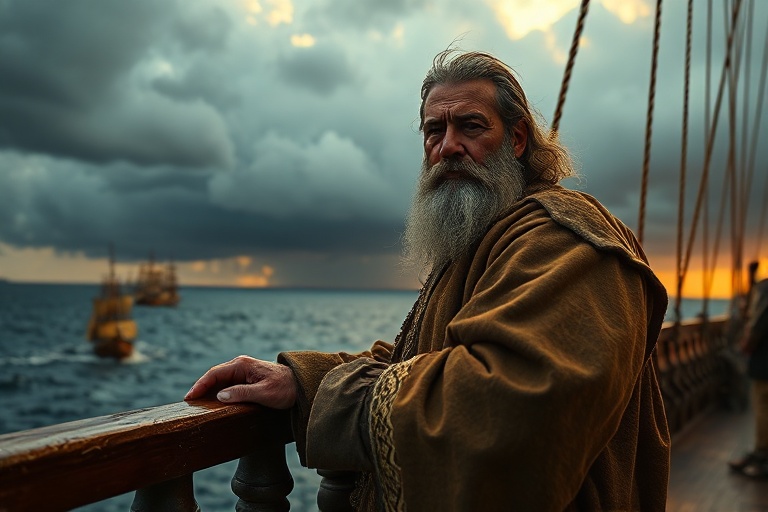
Few names in maritime history carry the weight of Vasco da Gama. His 1497 voyage from Portugal to India not only redefined global trade routes but also marked the beginning of Europe’s direct engagement with Asia. Born into a noble family in Sines, Portugal, around 1460, da Gama was chosen by King Manuel I to lead an expedition that would bypass the Venetian and Ottoman monopolies on spice trade.
The son of Estevao da Gama, a minor nobleman and explorer, Vasco inherited both ambition and navigational insight. His appointment came after years of Portuguese experimentation with Atlantic navigation, including Bartolomeu Dias’ 1488 discovery of the Cape of Good Hope. Da Gama’s mission was clear: find a sea route to India and secure Portugal’s dominance in the spice trade.
The Voyage That Changed History
On July 8, 1497, da Gama set sail from Lisbon with four ships: São Gabriel, São Rafael, Berrio, and a supply vessel. His fleet carried about 170 men. Unlike Christopher Columbus, who sought a westward route to Asia, da Gama followed the path south along the African coast, rounding the Cape of Good Hope—a feat still uncertain after Dias’ return.
The journey was grueling. Scurvy and hunger ravaged the crew. One ship, the São Rafael, was burned due to dwindling supplies. After nearly four months at sea, the expedition reached the East African coast, where da Gama established temporary alliances with local rulers. He hired an experienced Arab navigator, Ahmad ibn Majid, to guide the fleet across the Indian Ocean—a decision that proved critical.
On May 20, 1498, after 23 days at sea from East Africa, da Gama arrived in Calicut (modern-day Kozhikode), India. He presented letters from King Manuel to the local ruler, the Zamorin, and attempted to negotiate trade agreements. Though initially rebuffed, da Gama returned to Portugal in September 1499 with a cargo of pepper and cinnamon worth sixty times the cost of the expedition—securing Portugal’s future as a global power.
The Human Cost of Exploration
Da Gama’s success came at a staggering human cost. Of the 170 men who set sail, only 55 returned. Many perished from disease, starvation, or drowning. The return voyage was particularly brutal, with storms and mutinies threatening the expedition’s survival. Yet, the financial return transformed Portugal’s economy and justified further voyages.
His actions also set a precedent for colonial exploitation. Upon his second voyage in 1502, da Gama resorted to violence, bombarding Calicut and seizing merchant ships. His brutality foreshadowed centuries of European domination in Asia, trade wars, and cultural disruption. While hailed as a hero in Portugal, in India and the wider East, he is remembered as a symbol of imperial aggression.
Legacy: Visionary or Villain?
The debate over da Gama’s legacy remains complex. To Portugal, he is a national icon—a navigator who opened the door to a global empire. His achievements earned him titles such as Admiral of the Indian Ocean and Viceroy of India. He was later appointed as the second Viceroy of Portuguese India in 1524, though he died shortly after arriving in Cochin.
To the people of Asia, however, he represents the beginning of foreign domination. His voyages disrupted local economies, weakened indigenous rulers, and introduced a system of exploitation that lasted until the 20th century. In India, he is often depicted in textbooks as a symbol of colonial intrusion rather than discovery.
In 2014, a statue of da Gama in Lisbon was vandalized during anti-colonial protests. The act underscored the enduring tension between admiration for navigational achievement and recognition of its human and cultural toll. Historians continue to debate whether da Gama was a visionary or an agent of empire—likely, he was both.
Beyond the Myth: Reassessing a Complex Figure
Modern scholarship encourages a more nuanced view of da Gama. He was not the first European to reach India—Arab and Chinese traders had long established maritime routes. But he was the first to create a sustainable sea link that bypassed the overland Silk Road, controlled by middlemen who inflated prices.
His navigational skills, though impressive, were built on generations of Portuguese innovation. Prince Henry the Navigator’s school at Sagres had trained generations of sailors, including Dias. Da Gama’s real genius lay in synthesis: combining Portuguese shipbuilding, Arab navigation, and European ambition into a single, transformative journey.
Yet, his legacy is stained by violence. During his second voyage, he ordered the massacre of hundreds of Muslim pilgrims aboard a ship off the coast of India—a moment that revealed the darker side of European expansion. This act foreshadowed the brutal tactics that would define colonialism for centuries.
Key Contributions to Global History
- Established the first European sea route to India, reducing reliance on overland trade and Venetian merchants.
- Laid the foundation for the Portuguese Empire in Asia, which lasted until 1999 in Macau.
- Triggered the Age of Exploration, inspiring Ferdinand Magellan and others to seek new routes and territories.
- Demonstrated the power of naval technology in shaping global trade and politics.
Da Gama’s impact extended beyond trade. His voyages accelerated the exchange of goods, ideas, and diseases between Europe and Asia. The Columbian Exchange, often associated with Columbus, actually began with da Gama’s return. Pepper, cinnamon, and other spices transformed European cuisine, while European firearms and Christianity spread eastward.
However, this exchange was not mutual. While Europe gained wealth and knowledge, Asian societies faced exploitation, cultural erasure, and long-term subjugation. The ecological impact—such as the introduction of invasive species and deforestation for spice cultivation—also left deep scars.
Remembering Vasco da Gama Today
In Portugal, da Gama remains a celebrated figure. His name adorns streets, schools, and monuments, including the Vasco da Gama Bridge in Lisbon, one of Europe’s longest. The Portuguese navy has honored him through ships and naval traditions. His legacy is embedded in national identity as a symbol of courage and discovery.
In India, however, public memory is more conflicted. While some acknowledge his navigational prowess, others emphasize the violence and inequality that followed. The 500th anniversary of his arrival in 1998 was marked by protests and calls for historical accountability.
For historians and students of global history, da Gama serves as a case study in the intersection of exploration, trade, and empire. His story invites reflection on how exploration shapes—and is shaped by—power, greed, and cultural exchange.
As the world grapples with the legacies of colonialism, da Gama’s life offers a cautionary tale. It reminds us that progress often comes at a cost, and that the heroes of one era may be the oppressors of another. His voyages connected two worlds—but not always in ways that honored both.
To understand the modern global economy, one must begin with da Gama. From the spice markets of Kochi to the financial centers of Lisbon, his shadow endures—complex, enduring, and impossible to ignore.
For more on historical explorers and their global impact, visit our History category, or explore Culture insights on how exploration shaped societies.