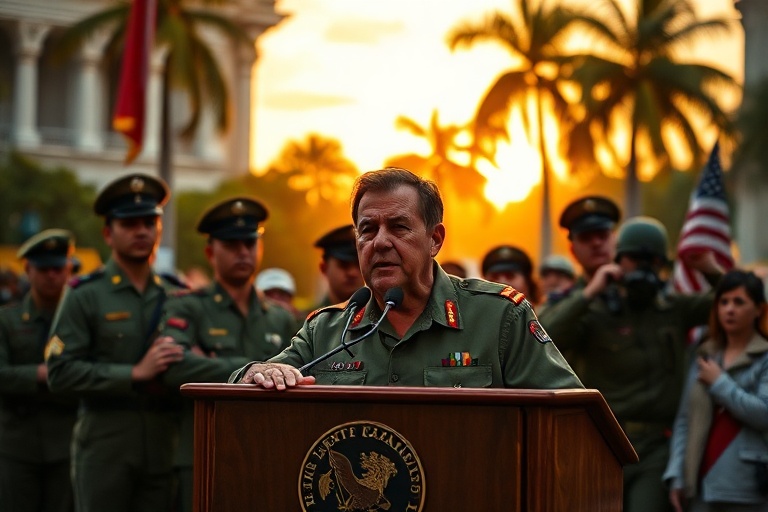
In a rare and pointed address to the United Nations General Assembly, Cuban President Miguel Díaz-Canel delivered a stark warning to the United States: any military intervention against Cuba would result in a bloodbath. The statement, delivered amid rising tensions between the two nations, underscores the fragile state of relations and the potential consequences of renewed hostilities.
The Cuban leader’s remarks come at a time when geopolitical tensions are escalating globally. With conflicts raging in Ukraine and the Middle East, the specter of another military confrontation in the Caribbean has raised concerns among diplomats and analysts alike. Díaz-Canel’s warning was not just a rhetorical flourish but a reflection of Cuba’s historical resistance to external pressures, particularly from its powerful northern neighbor.
Historical Context: A Long-Standing Rivalry
The relationship between Cuba and the United States has been fraught with tension since the 1959 Cuban Revolution, which brought Fidel Castro to power and established a socialist state. The United States responded with a trade embargo, diplomatic isolation, and multiple attempts to destabilize the Cuban government, including the failed Bay of Pigs invasion in 1961.
Decades later, despite the easing of restrictions under the Obama administration and a brief thaw in relations, the embargo remains largely in place. The Trump administration tightened sanctions, and the Biden administration has so far maintained a hardline stance, particularly on issues like human rights and Cuba’s alignment with countries like Russia and Venezuela.
Cuba’s government has consistently framed itself as a defender of sovereignty against imperialist aggression. Díaz-Canel’s warning at the UN is a continuation of this narrative, positioning Cuba as a nation prepared to defend itself against any perceived threat.
Regional Implications: A Domino Effect of Conflict
The potential for military action against Cuba is not just a bilateral issue—it carries significant regional implications. The Caribbean has long been a flashpoint for Cold War-era conflicts, and a renewed US military presence in the region could destabilize neighboring countries.
- Venezuela: Cuba’s closest ally in the region, Venezuela, has been under intense pressure from the US, which has imposed sanctions and supported opposition groups. A military confrontation involving Cuba could draw Venezuela deeper into the conflict, exacerbating an already dire humanitarian crisis.
- Mexico: The Mexican government has historically opposed US interventionism in Latin America. A military strike on Cuba could strain US-Mexico relations, particularly as Mexico seeks to position itself as a leader in regional diplomacy.
- Caribbean Nations: Countries like Jamaica, Trinidad and Tobago, and the Bahamas have expressed concerns about the potential for US military action to spill over into their territories. The region’s economies, heavily reliant on tourism, could face severe disruptions.
Analysts warn that a military confrontation in Cuba could trigger a broader regional crisis, drawing in other Latin American nations and even global powers like China and Russia, which have economic and strategic interests in the Caribbean.
The Humanitarian Cost: Who Would Bear the Brunt?
Beyond geopolitical considerations, the human cost of military action against Cuba cannot be ignored. The island nation has a population of over 11 million people, many of whom already face economic hardship due to the US embargo and the global pandemic.
An armed conflict would likely result in significant civilian casualties, displacement, and a humanitarian crisis. Cuba’s healthcare system, once a point of pride for the socialist government, could be overwhelmed by the needs of the population. The country’s aging infrastructure, already strained by decades of sanctions, would struggle to cope with the demands of war.
Moreover, the Cuban diaspora, particularly in the United States, would be deeply affected. Families separated by decades of political division would face further uncertainty, and the possibility of mass migration could emerge as a critical issue for neighboring countries.
Diplomatic Pathways: Is There Room for Negotiation?
Despite the escalating rhetoric, there are still diplomatic channels that could prevent a catastrophic outcome. The UN, regional organizations like the Organization of American States (OAS), and even informal backchannel negotiations could play a role in de-escalating tensions.
Cuba has historically sought to engage in dialogue with the US, even under the most difficult circumstances. The 2014-2016 thaw in relations, which led to the restoration of diplomatic ties, demonstrated that progress is possible. However, the current political climate in both countries makes such engagement difficult.
The Biden administration faces domestic pressures, including a vocal Cuban-American lobby in Florida that has historically opposed any normalization of relations. Meanwhile, Cuba’s government must balance its commitment to sovereignty with the need to address the economic and social needs of its people.
For now, Díaz-Canel’s warning serves as a reminder of the stakes involved. The international community must act swiftly to ensure that diplomacy prevails over military action, lest the Caribbean become the site of yet another avoidable conflict.
Looking Ahead: What’s Next for Cuba and the US?
The coming months will be critical in determining whether the US and Cuba can find a path away from confrontation. Potential steps could include:
- Resuming Dialogue: Even low-level diplomatic engagement could help reduce tensions and build trust between the two nations.
- Easing Sanctions: The US could take incremental steps to relax the embargo, particularly in areas like healthcare and agriculture, which directly impact the Cuban people.
- Regional Mediation: Countries like Mexico, Canada, or even the European Union could offer to facilitate talks between the US and Cuba.
- Addressing Humanitarian Concerns: Focused efforts to alleviate the suffering of the Cuban people, such as expanding medical aid or supporting food security, could help ease the humanitarian crisis.
Ultimately, the choice between dialogue and military action will define the future of US-Cuba relations. The cost of getting it wrong is too high to ignore.
As Díaz-Canel’s warning resonates in diplomatic circles, the world watches with bated breath. The stakes are too high for complacency, and the time to act is now.