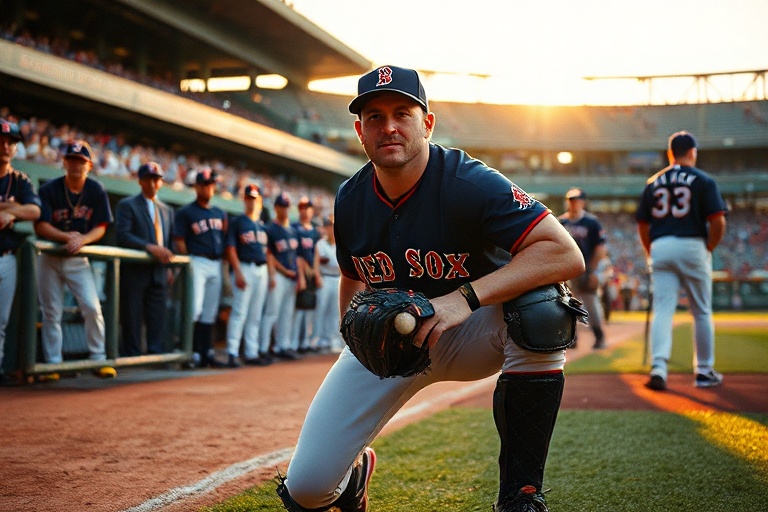
Jason Varitek: The Captain Who Defined a Franchise and a Generation
Jason Varitek’s name resonates not just as a player, but as a symbol of leadership, resilience, and quiet excellence in Major League Baseball. Over 15 seasons with the Boston Red Sox, Varitek became more than a catcher—he became the heartbeat of a franchise that transformed from underdog to dynasty. His journey from a college standout at Georgia Tech to a World Series champion and three-time All-Star reflects a career built on consistency and character.
Varitek’s influence extended beyond statistics. He was the first player in MLB history to win both the Golden Spikes Award (college baseball’s highest honor) and a World Series ring. That rare combination of collegiate dominance and professional triumph set the tone for a career that would leave an indelible mark on the game. His legacy is not just measured in awards, but in the way he shaped Red Sox culture and inspired a new generation of players.
The Making of a Leader: From Georgia Tech to Fenway Park
Born on April 11, 1972, in Rochester, Michigan, Varitek grew up playing multiple sports but excelled in baseball. His standout performances at Michigan State University caught the attention of scouts, but it was his final season at Georgia Tech in 1994 that cemented his place in baseball history. As a member of the USA Baseball National Team, he helped lead the squad to a gold medal in the World University Games, showcasing his defensive prowess and leadership early on.
Drafted 21st overall by the Minnesota Twins in the 1993 MLB Draft, Varitek was part of a blockbuster trade in 1997 that sent him, along with Derek Lowe and pitcher Heathcliff Slocumb, to the Boston Red Sox. That deal would prove transformative—not just for Varitek, but for the franchise. By the late 1990s, the Red Sox were searching for identity. Varitek arrived as a highly touted prospect, but few could have predicted the depth of his impact.
The transition from prospect to leader was not immediate. Varitek spent parts of five seasons refining his game in the minors and as a platoon catcher. But his dedication and baseball IQ were undeniable. By 2001, he had earned the starting job and, more importantly, the trust of his teammates and manager. That year, he threw out 45% of attempted base stealers, a staggering rate that highlighted his defensive dominance behind the plate.
Captain Clutch: The Heart of the 2004 and 2007 World Series Teams
Varitek’s defining moment came on June 24, 2001, in a game against the New York Yankees. In the bottom of the ninth inning, with the bases loaded and the Red Sox trailing by one run, Varitek launched a walk-off grand slam off Yankees reliever Mariano Rivera. The blast not only handed Boston a dramatic victory, but it announced Varitek as a player capable of rising to any occasion. The moment became part of Fenway lore and set the stage for what was to come.
By 2004, Varitek was named team captain—a rare honor in baseball, and the first for the Red Sox in 60 years. He led by example: with a bat, a glove, and a voice. That season, he batted .293 with 20 home runs and 78 RBI, helping Boston overcome a 3-0 deficit to the Yankees in the ALCS, a comeback that remains one of the most legendary in postseason history. The Red Sox went on to sweep the St. Louis Cardinals in the World Series, ending an 86-year championship drought.
Varitek’s leadership was not just symbolic. In Game 1 of the 2004 ALCS against the Yankees, he delivered a two-run homer off Javier Vázquez, a moment that shifted momentum. But it was his defensive skill—particularly his ability to handle a pitching staff featuring Curt Schilling, Pedro Martínez, and Derek Lowe—that truly defined his value. His pitch-framing, game-calling, and ability to calm nerves made him the backbone of one of the greatest teams in modern baseball.
The 2007 season saw another championship, this time against the Colorado Rockies. Varitek, now 35, remained a steady presence. Though his offensive numbers declined, his leadership only grew. He mentored young players like Dustin Pedroia and Jacoby Ellsbury, helping them navigate their first taste of playoff baseball. His final World Series ring came in the clinching Game 4, where he caught the last out, capping a dominant series.
Beyond the Diamond: Varitek’s Global Influence and Post-Playing Legacy
Varitek’s impact extended far beyond Boston. He was a key figure in USA Baseball, playing for the national team in the 2006 World Baseball Classic. His experience and professionalism made him a natural leader in international competition. While Team USA did not medal, Varitek’s presence underscored his reputation as a player who thrived under pressure on the biggest stages.
After retiring in 2011, Varitek transitioned into coaching and front-office roles. He served as a special assistant to the general manager with the Red Sox and later became a roving catching instructor in their minor league system. His focus on player development reflected his belief in fundamentals, preparation, and respect for the game—values he carried throughout his career.
Varitek’s influence is also felt in baseball culture globally. In countries like Japan, South Korea, and throughout the Americas, his reputation as a captain and champion resonated with fans who admired his work ethic and humility. Baseball, often called America’s pastime, has a global following, and Varitek’s career exemplified the sport’s international appeal. He represented a bridge between eras—a player who respected tradition while adapting to modern demands.
Legacy in Numbers and Leadership
While Varitek’s offensive career (109 home runs, 568 RBI, .256 batting average) may not place him among the game’s all-time greats, his value is better measured in intangibles. Consider these highlights:
- Three-time All-Star (2003, 2005, 2008)
- Two-time World Series champion (2004, 2007)
- Gold Glove winner (2005)
- First player to win Golden Spikes Award and World Series
- 2,488 career games played—all with the Red Sox
- Caught four no-hitters, including a perfect game by Jon Lester in 2008
His durability and consistency were unmatched. He caught over 130 games in a season five times, a testament to his stamina and reliability. And though he never led the league in any major offensive category, his clutch performances—especially in the postseason—cemented his status as one of the most respected players of his generation.
Varitek’s leadership style was quiet but powerful. He didn’t give fiery speeches or seek the spotlight. Instead, he led through preparation, accountability, and respect. His famous “passion” moment—when he confronted Alex Rodriguez in a 2004 brawl—wasn’t about anger; it was about protecting his team and the game’s integrity. That moment became a symbol of his commitment to standards and his refusal to tolerate disrespect.
A Model for the Modern Athlete
In an era where athletes are often judged by social media presence or off-field controversies, Varitek stood out as a model of professionalism. He avoided unnecessary drama, focused on performance, and treated teammates with dignity. His career offers a counter-narrative to the flashy, headline-driven athlete—one rooted in quiet excellence and sustained effort.
For young players aspiring to leadership roles, Varitek’s career is a masterclass. He proved that leadership isn’t about being the loudest voice in the room, but the most consistent one. His ability to communicate with pitchers, mentor rookies, and perform under pressure set a standard that transcends baseball.
Conclusion: The Captain’s Lasting Imprint
Jason Varitek retired in 2012, ending a career that redefined what it meant to be a catcher in the modern game. His two World Series titles, his defensive brilliance, and his role as the Red Sox’s first captain in decades ensured his place in franchise history. But more importantly, he left a cultural legacy—a reminder that greatness is often measured not in flash, but in fidelity to craft and commitment to team.
Today, Varitek remains involved in baseball, but his influence extends beyond the diamond. He represents a generation of athletes who played with heart, humility, and an unshakable belief in the power of teamwork. In a sport often dominated by individualism, he showed that leadership can be both a role and a responsibility—one that shapes not just a team, but an entire organization’s identity.
He may not be a household name outside of Boston, but within baseball circles, Jason Varitek is revered. His jersey number, 33, has not been reissued by the Red Sox. That alone speaks volumes. It’s not just a number retired. It’s a legacy honored.
For fans of sports and anyone who values quiet leadership, Jason Varitek’s story is a reminder: sometimes, the greatest impact is made not by the player who shines brightest, but by the one who holds everything together.