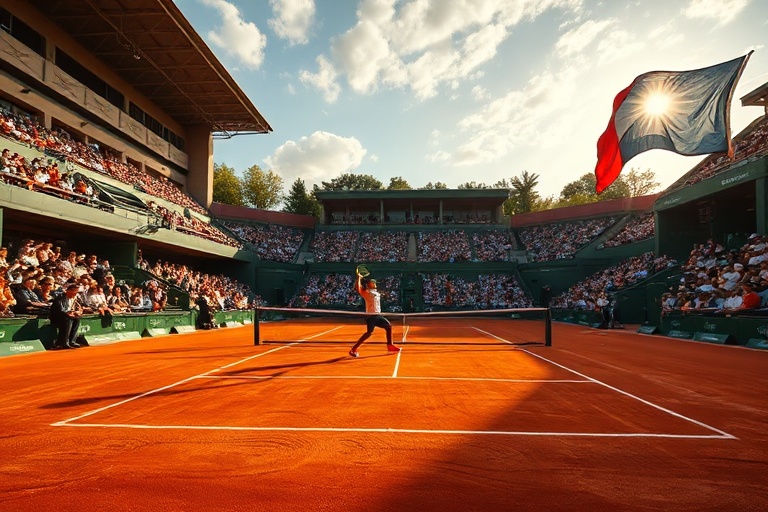
The countdown to the French Open 2026 has already begun. With the tournament’s storied history and evolving dynamics, this year promises to be more than just another Grand Slam event. The clay courts of Roland-Garros will once again test the limits of endurance, strategy, and mental fortitude. Yet beneath the surface, subtle shifts in player demographics and tournament structure are reshaping what we expect from the tournament.
The Rise of Next-Gen Clay Specialists
Traditionally, the French Open has been a proving ground for veteran players who mastered the slow, grueling nature of clay. However, the 2026 edition may signal a generational handoff. A crop of young players—many of whom grew up training extensively on clay—are beginning to dominate junior circuits and Challenger events. Names like Giovanni Mpetshi Perricard, Alexander Blockx, and Clara Burel have already shown flashes of brilliance, hinting at a future where clay mastery is cultivated from an early age rather than learned through years of trial and error.
This shift is not happening in a vacuum. The ATP and WTA tours have expanded their clay-court swing in recent years, offering more early-season preparation. The increased exposure has allowed younger players to develop their games in conditions that closely mirror Roland-Garros. As a result, the 2026 French Open could feature a semifinal lineup where half the field is under 23 years old—a stark contrast to the veteran-dominated era of just a decade ago.
- Early specialization: More players now focus exclusively on clay during their formative years, mirroring the approach seen in countries like Spain and Argentina.
- Expanded prep tournaments: Events like the Madrid Open and Rome Masters now serve as critical stepping stones, with younger players using them to hone their clay-court skills.
- Technology and data: Advances in court analysis and player tracking are helping young athletes refine their movement and shot selection with unprecedented precision.
Tournament Innovations: What’s Changing in 2026?
Roland-Garros has always been a bastion of tradition, but the 2026 edition will introduce several notable changes. The most significant is the expansion of the tournament schedule, which now includes an additional day of play. This adjustment aims to alleviate scheduling conflicts with other major events and provide players with more recovery time between matches—a critical factor given the physical demands of clay.
The tournament’s organizers have also announced a new initiative to enhance fan engagement. For the first time, spectators will have access to real-time data on ball speed, spin rates, and player movement via an augmented reality app. While this technology has been tested in limited capacities before, the 2026 French Open will be the first Grand Slam to integrate it comprehensively across all courts.
Another notable change is the introduction of a “Clay Court Excellence” program, designed to recognize and reward players who excel on the surface. The program will track performance across multiple clay-court tournaments leading up to the French Open, with the top performers receiving direct entry into the main draw. This move is seen as a way to incentivize players to focus on clay preparation, further elevating the level of competition.
Broader Implications: The French Open’s Evolving Role in Tennis
The French Open’s influence extends far beyond its two weeks of competition. As the only Grand Slam played on clay, it plays a unique role in shaping the careers of players and the direction of the sport. The 2026 edition will likely underscore this influence in several ways. First, the tournament’s ability to identify and nurture young talent could redefine the power dynamics of men’s and women’s tennis. With the ATP and WTA tours increasingly emphasizing surface diversity, the French Open will remain the ultimate test for those who prioritize clay.
Second, the tournament’s innovations could set a new standard for fan engagement and technological integration in tennis. If the augmented reality app proves successful, other Grand Slams may follow suit, transforming how audiences interact with the sport. This shift aligns with broader trends in sports entertainment, where immersive experiences are becoming a key differentiator.
Finally, the French Open’s role as a cultural touchstone cannot be overstated. For decades, it has been a stage where legends are made and rivalries are forged. The 2026 edition will likely continue this tradition, but with a fresh cast of characters. The emergence of a new generation of clay-court specialists could spark rivalries that define the next decade of tennis, much like the battles between Nadal and Djokovic did in the 2010s.
Key Storylines to Watch
As the French Open approaches, several narratives are poised to captivate audiences. Below are the most compelling storylines to follow:
- The Next Nadal: With Rafael Nadal’s career winding down, the 2026 French Open could be the stage where a new king of clay emerges. Players like Carlos Alcaraz and Jannik Sinner have already shown they can compete on the surface, but who will rise to the occasion when it matters most?
- Women’s Field: A New Era? The women’s draw is brimming with young talent, including Iga Świątek, Coco Gauff, and Aryna Sabalenka. Will a new champion emerge, or will one of the current stars solidify their dominance on clay?
- Surface Debate Resurfaces: As the French Open remains the only Grand Slam on clay, discussions about the future of the surface will intensify. Could the 2026 tournament be the last stand for clay as the preferred surface, or will it continue to hold its place as tennis’s ultimate challenge?
- Fan Experience Revolution: With the introduction of augmented reality and other technological enhancements, the 2026 French Open could redefine how fans engage with the tournament. Will this set a new benchmark for Grand Slam events?
Conclusion: A Tournament at a Crossroads
The French Open 2026 stands at a fascinating intersection. It is a celebration of tradition, a testing ground for innovation, and a window into the future of tennis. The emergence of a new generation of players, the introduction of groundbreaking technology, and the ongoing evolution of the tournament’s role in the sport all contribute to a sense of anticipation. While the outcomes are uncertain, one thing is clear: the clay courts of Roland-Garros will once again demand excellence, creativity, and resilience from those who dare to compete.
For fans and players alike, the 2026 French Open offers more than just a spectacle—it provides a glimpse into where tennis is headed. Whether it’s the rise of a new clay-court maestro, the impact of technological advancements, or the continued debate over the surface itself, the tournament will undoubtedly leave a lasting mark on the sport.
As the countdown continues, the tennis world will be watching closely. The stage is set, the players are preparing, and Roland-Garros is ready to make history once again.
Explore more sports coverage on Dave’s Locker or dive into in-depth analysis pieces for additional context on tennis and beyond.