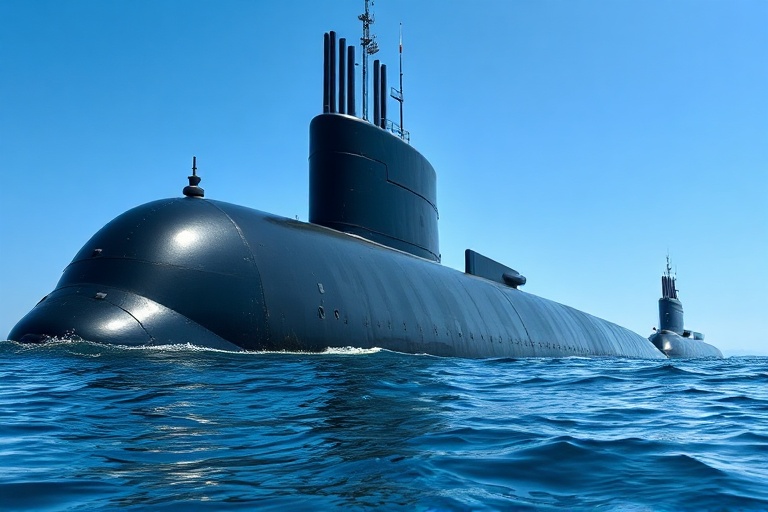
The Ghadir-class submarine represents a cornerstone of Iran’s naval modernization efforts, blending tactical innovation with strategic deterrence in one of the world’s most geopolitically sensitive maritime regions. Introduced in 2007 and named after Imam Ali, the first Shia Imam, this class of midget submarines has become a symbol of Iran’s indigenous defense capabilities and its ability to project power despite international sanctions and technological isolation.
Unlike larger attack submarines designed for blue-water operations, the Ghadir-class falls into the category of coastal or midget submarines—compact, stealthy vessels built for shallow waters, covert missions, and asymmetric warfare. Its design reflects a clear focus: to operate undetected in the Persian Gulf, Strait of Hormuz, and Caspian Sea, where geography and geopolitical tensions create constant flashpoints.
This article explores the technical specifications, operational role, and geopolitical significance of the Ghadir-class, situating it within the broader context of Iran’s naval strategy and its evolving relationship with global powers.
The Origins and Design Philosophy of the Ghadir-Class
The Ghadir-class submarine was developed as part of Iran’s self-sufficiency drive in defense technology, catalyzed by the Iran-Iraq War (1980–1988) and the subsequent arms embargoes that limited access to foreign military hardware. By the late 1990s, Iran began investing in domestic shipbuilding and submarine programs, culminating in the launch of the first Ghadir-class vessel in 2007.
Designed and built by the Iranian Defense Ministry’s Marine Industries Organization (MIO), the Ghadir is a diesel-electric submarine measuring approximately 29 meters in length with a displacement of around 120 tons when submerged. Its compact size allows it to navigate the shallow, congested waters of the Persian Gulf, where depths rarely exceed 50 meters and navigation is complicated by oil platforms, shipping lanes, and military patrols.
- Length: ~29 meters
- Displacement: ~120 tons (submerged)
- Propulsion: Diesel-electric
- Crew: 8–12 personnel
- Range: Limited by fuel capacity, optimized for coastal operations
The submarine’s hull is reinforced for shallow-water operations, and its propulsion system is designed for near-silent movement—critical for evading detection by sonar in noisy littoral environments. While exact specifications remain classified, analysts believe the Ghadir-class incorporates advanced acoustic damping materials and possibly magnetically quiet propulsion to reduce its acoustic signature.
Notably, the Ghadir-class is often compared to other midget submarines like North Korea’s Yono-class or Russia’s Project 865 “Piranha,” though Iran emphasizes its indigenous design and modular capabilities. Iranian officials have claimed the submarine can carry torpedoes, lay mines, and conduct reconnaissance missions, though the extent of its combat readiness remains a subject of debate.
Operational Role: Stealth, Deterrence, and Asymmetric Warfare
The primary mission of the Ghadir-class is not to challenge major naval powers in open ocean warfare, but to operate as a silent disruptor in Iran’s immediate maritime domain. Its small size and low acoustic profile make it nearly undetectable to conventional anti-submarine warfare (ASW) systems, particularly in the cluttered acoustic environment of the Persian Gulf.
This stealth advantage allows Iran to maintain a credible deterrent against potential blockades or amphibious assaults—a recurring concern given historical tensions with the United States and regional rivals. The Strait of Hormuz, through which approximately 20% of the world’s oil passes, is a particularly sensitive chokepoint. The presence of Ghadir-class submarines in these waters serves as a reminder of Iran’s ability to disrupt shipping if threatened.
In addition to deterrence, the Ghadir-class is believed to support covert operations, including intelligence gathering, special forces insertion, and mine-laying. Its shallow draft enables it to approach coastlines undetected, while its modular payload bays allow for rapid reconfiguration depending on mission requirements.
Iran has repeatedly showcased the Ghadir-class in military parades and naval exercises, often alongside larger domestically produced submarines like the Fateh-class. These displays are not merely symbolic; they are part of a broader strategy to project technological competence and operational readiness to both domestic and international audiences.
Geopolitical Implications: A Tool of Influence in a Fragmented Region
The emergence of the Ghadir-class must be understood within the context of Iran’s broader military doctrine, which prioritizes asymmetric capabilities over conventional parity. In a region where Iran faces a coalition of regional and international actors—including Saudi Arabia, Israel, and the United States—submarine technology provides a low-cost, high-impact means of maintaining strategic balance.
Analysts note that Iran’s submarine program, including the Ghadir-class, has evolved in tandem with its ballistic missile and drone programs, forming a triad of deterrence capabilities. This “axis of resistance” narrative is reinforced by Iran’s support for allied groups such as Hezbollah and the Houthis, who operate in maritime domains as well.
The presence of Ghadir-class submarines in the Red Sea and Gulf of Aden—reportedly deployed to support Houthi operations in Yemen—has raised concerns in Western capitals about Iran’s expanding maritime footprint. While Iran denies direct involvement in Houthi naval attacks, the deployment of such assets underscores the interconnected nature of its defense strategy across multiple conflict zones.
International responses have been mixed. While some analysts view the Ghadir-class as a stabilizing factor—deterring aggression through denial of access—others see it as a destabilizing element that increases the risk of miscalculation in already volatile waters. The U.S. Navy, which conducts frequent freedom-of-navigation operations in the region, has invested in enhanced ASW capabilities in response to Iran’s submarine developments.
Meanwhile, neighboring states such as the United Arab Emirates and Oman have expressed concern over Iran’s submarine activities, particularly in the Strait of Hormuz. These concerns have driven increased defense cooperation with the U.S. and the deployment of advanced sonar and patrol vessels to monitor submarine movements.
Future Prospects: Evolution and Expansion of Iran’s Submarine Fleet
Since the introduction of the Ghadir-class, Iran has continued to expand and modernize its submarine fleet. The Fateh-class, a larger diesel-electric submarine launched in 2013, offers greater endurance and payload capacity, while the recently unveiled Besat-class represents an attempt to develop air-independent propulsion (AIP) technology domestically.
Reports suggest that Iran is also exploring unmanned underwater vehicles (UUVs) and autonomous systems, which could complement the Ghadir-class in mine countermeasures and surveillance roles. Such developments indicate a long-term vision for a more networked and distributed naval force.
However, challenges remain. International sanctions have limited access to advanced materials and electronics, forcing Iran to rely on reverse engineering and domestic innovation. While this has fostered resilience, it has also constrained performance in areas like sensor accuracy, communications, and endurance.
Despite these limitations, the Ghadir-class remains a testament to Iran’s ability to adapt and innovate under pressure. Its continued deployment sends a clear message: Iran is not merely a regional actor with land-based capabilities, but a maritime power capable of exerting influence beneath the waves.
As geopolitical tensions in the Middle East show no signs of abating, the Ghadir-class—and Iran’s broader submarine program—will likely remain central to the calculus of deterrence, crisis management, and power projection in the years ahead.
Conclusion
The Ghadir-class submarine is more than a technological artifact; it is a strategic instrument that embodies Iran’s doctrine of asymmetric defense and its determination to maintain operational autonomy in the face of external pressures. In the confined, contested waters of the Persian Gulf, a single Ghadir-class vessel can alter the calculus of any potential adversary.
As Iran continues to refine its submarine capabilities, the international community will need to adapt its naval strategies accordingly. Whether viewed as a tool of deterrence or a catalyst for escalation, the Ghadir-class ensures that Iran’s silent presence will be felt across the region’s maritime landscape for years to come.
Explore more on naval technology or regional defense strategies.