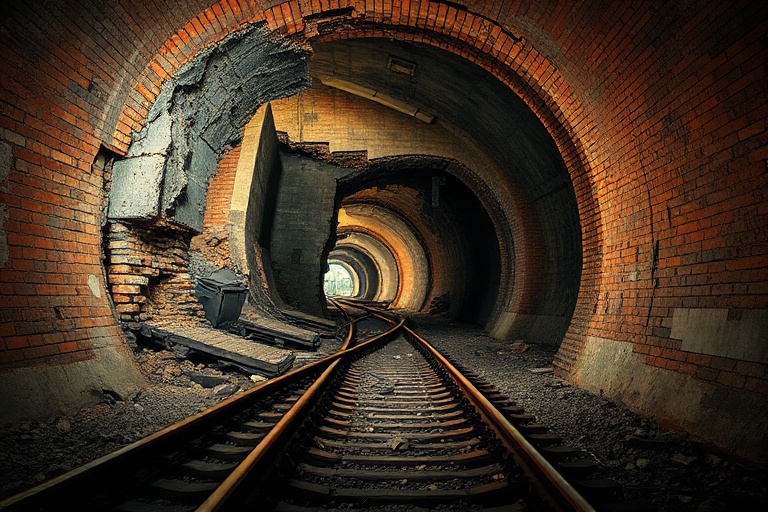
South Tunnel Damage Forces Extended Closure of Critical Rail Line
The recent discovery of structural damage within the South Tunnel has led to an indefinite closure of one of the region’s most vital rail connections. Engineers first identified cracks in the tunnel’s lining during a routine inspection last month, prompting immediate action from transportation authorities. The closure affects thousands of daily commuters and freight operations that rely on this artery of regional mobility.
According to a statement from Metro Rail Services, preliminary assessments suggest the damage is concentrated in a 200-foot section near the tunnel’s midpoint. The cracks vary in width, with the largest measuring over two inches—raising concerns about long-term stability. “While we have not detected any immediate risk of collapse,” said Chief Engineer Lisa Chen, “the integrity of the structure cannot be guaranteed under current conditions.”
Impact on Commuters and Regional Commerce
The closure has disrupted the routines of approximately 12,000 daily riders who depend on the line for travel between the downtown business district and suburban hubs. Local transit agencies have arranged replacement bus services, but delays are averaging 45 minutes per trip due to traffic and limited stop accessibility. Commuters like Daniel Ruiz, a software developer from Oakdale, described the situation as “a logistical nightmare.”
Beyond passenger inconvenience, the shutdown is disrupting freight logistics. The affected corridor carries nearly 30% of the region’s intermodal cargo, including perishable goods and industrial supplies. Several logistics companies have rerouted shipments via longer, costlier routes, leading to delayed deliveries and increased operational expenses. A representative from Greenway Transport noted, “Every day this line stays closed, we’re losing thousands in rerouting fees and customer penalties.”
Repair Timeline and Engineering Challenges
Metro Rail Services has not yet announced a firm repair timeline, citing the complexity of the damage and the need for specialized materials. Engineers are currently evaluating two repair methods: full tunnel lining replacement or targeted patching with reinforced concrete. The first option could take up to six months, while the latter might allow partial reopening within eight weeks.
Environmental and logistical hurdles further complicate the process. The tunnel passes beneath a protected wetland area, requiring permits from the Department of Environmental Conservation. Additionally, nighttime closures are limited due to noise restrictions in nearby residential zones. “We’re working within a narrow window of opportunity,” said Chen. “Every hour of access counts.”
In the meantime, Metro has increased service on parallel lines, including the North Corridor Transit Hub, though capacity remains insufficient for the displaced ridership. The agency has also launched a mobile app to help commuters plan alternative routes in real time.
Public Reaction and Political Response
Public frustration is growing, particularly among residents in outer neighborhoods who feel underserved by current transit options. A community meeting last week drew over 200 attendees, many expressing anger over what they perceive as chronic underinvestment in infrastructure. “This isn’t just about a tunnel,” said local advocate Maria Ortiz. “It’s about whether our leaders prioritize people over politics.”
Political leaders have responded with cautious statements. State Senator James Holloway called for an emergency funding allocation, while the governor’s office emphasized the need for a long-term capital plan. “We cannot continue to react to crises,” Holloway stated. “We need a vision that ensures reliability and safety for decades to come.”
The closure has also sparked debate over the age and condition of the region’s rail tunnels. Many date back to the early 20th century and were not designed for current ridership or freight loads. A recent report from the Regional Planning Commission highlighted that 63% of the tunnel network requires significant upgrades within the next 15 years.
Looking Ahead: Lessons and Next Steps
As repairs progress, several key questions remain unanswered. Will the tunnel be restored to its original capacity, or will future service be reduced to minimize stress on the structure? How will the delay affect regional economic growth, particularly in sectors dependent on just-in-time logistics?
Metro Rail Services has committed to transparency, promising weekly updates on the repair process and public forums to address concerns. Meanwhile, advocacy groups are calling for a regional summit to discuss broader transit resilience. “This is not just a tunnel issue,” said Ortiz. “It’s a test of our ability to plan for the future.”
The closure may last months, but its ripple effects will likely be felt for years. For now, riders and businesses alike are adapting to a new normal—one defined by uncertainty, patience, and a shared hope for restored connections.
How to Stay Informed
For the latest updates on the South Tunnel repairs and alternative transit options, visit:
The situation remains fluid, and further developments are expected as engineers refine their repair strategy and public pressure mounts for accountability and progress.