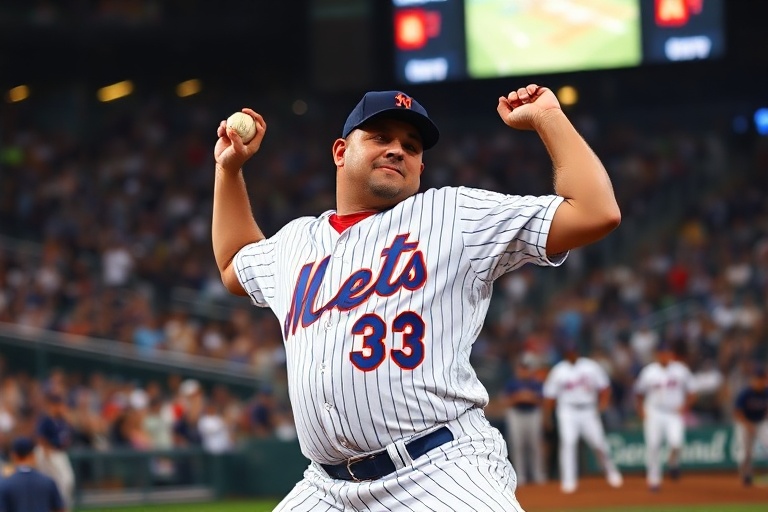
Bartolo Colón’s career spanned 21 seasons in Major League Baseball, yet his longevity wasn’t just a product of endurance—it was a testament to adaptability, resilience, and an unshakable belief in his craft. The right-handed pitcher, affectionately nicknamed “Big Sexy,” became a cultural touchstone not only for his on-field performances but also for his ability to transcend generational gaps in the sport.
Colón’s journey from a raw talent in the Dominican Republic to a Cy Young Award winner and a late-career renaissance is one of the most compelling narratives in modern baseball. His story challenges conventional notions of aging in professional sports, proving that skill, determination, and a willingness to evolve can rewrite the rules of possibility.
The Early Years: Raw Talent Meets Unconventional Path
Born on May 24, 1973, in Altamira, Dominican Republic, Colón signed with the Cleveland Indians as an amateur free agent in 1993 at the age of 20. From the outset, his fastball sat in the mid-90s, and his fast-track development through the minors suggested a future as a frontline starter. By 1997, he had already made his major league debut, but it wasn’t until 1998—his first full season—that he announced himself as a force to be reckoned with.
That year, Colón went 15–11 with a 3.71 ERA and 161 strikeouts in 193.2 innings. His combination of power, poise, and athleticism caught the attention of scouts and fans alike. By 2000, he had become the Indians’ ace, posting a 18–5 record and helping Cleveland reach the playoffs. His breakout performance earned him a spot in the All-Star Game and set the stage for a career that would see him don the uniforms of eight different major league teams.
The Cy Young Season and Peak Dominance
Colón’s peak came in 2005 with the Los Angeles Angels of Anaheim. That season, he posted a 21–8 record, a 3.48 ERA, and 1.17 WHIP—numbers that reflected both consistency and dominance. He led the American League in wins and innings pitched (222.2), while his 213 strikeouts were second only to Johan Santana.
His ability to command multiple pitches—including a lively fastball, a sharp slider, and an improving changeup—made him a nightmare for opposing hitters. Colón’s 2005 campaign culminated in a Cy Young Award, cementing his legacy as one of the game’s elite pitchers during the steroid era. Yet, despite the accolades, his time as a top-tier starter would prove fleeting, as injuries and diminished velocity began to reshape his career trajectory.
The Comeback: Reinvention in the Twilight of a Career
After a series of arm injuries and surgeries in the late 2000s, Colón’s fastball lost several ticks off its velocity. By 2011, he was out of baseball entirely. But rather than accept retirement, he sought a second act—one that would redefine both his career and the perception of aging athletes in professional sports.
In 2013, Colón signed a minor league deal with the Oakland Athletics and, against all odds, re-emerged as a productive major league pitcher. He went 11–6 with a 2.65 ERA and 1.16 WHIP, proving that durability and pitchability could offset diminished velocity. The following year, he signed with the New York Mets and continued to defy expectations. In 2016, at age 42, he posted a 15–8 record with a 3.43 ERA, becoming the oldest pitcher in modern MLB history to win 15 games in a season.
His resurgence wasn’t just statistical—it was cultural. Colón became a symbol of perseverance, embraced by younger teammates and revered by fans who saw in him a reminder that passion and preparation matter more than raw physical gifts. His presence in the clubhouse, often cracking jokes and offering advice, bridged generational divides and made him a beloved figure across the league.
Key Factors Behind Colón’s Late-Career Success
Colón’s ability to extend his career wasn’t accidental. Several key elements contributed to his sustained success:
- Pitching Arsenal: While his fastball lost velocity, Colón refined his off-speed offerings—particularly his changeup and cutter—which allowed him to induce weak contact and ground balls.
- Mechanical Adjustments: Working with pitching coaches, Colón modified his delivery to reduce stress on his arm and improve command, enabling him to locate pitches with precision.
- Work Ethic and Adaptability: Colón’s dedication to conditioning and film study allowed him to stay ahead of hitters even as his physical tools declined.
- Mental Toughness: His unshakable confidence and competitive fire enabled him to embrace a new role as a crafty veteran rather than clinging to past glory.
- Team Culture: Organizations like the Mets and Braves valued Colón not only for his performance but also for his leadership and ability to mentor younger pitchers.
Legacy Beyond the Box Score: The Man Behind the Mound
Colón’s impact extended far beyond statistics. He became a bridge between eras, connecting fans of the power-pitching 1990s and early 2000s with the analytics-driven, youth-centric culture of the 2010s and beyond. His playful personality—exemplified by viral moments like his goofy batting practice sessions and interviews—made him a fan favorite and a social media darling.
In 2023, Colón was inducted into the New York Mets Hall of Fame, a fitting tribute to a player who played five seasons with the team and left an indelible mark on the franchise. His career totals—247 wins, 2,535 strikeouts, and a 4.12 ERA over 3,461.2 innings—paint the picture of a durable, impactful pitcher. But his real legacy lies in his ability to inspire.
Colón’s story challenges the narrative that athletes have a finite shelf life. It demonstrates that longevity in sports isn’t about defying biology but about leveraging experience, adaptability, and passion. In an era obsessed with youth and peak performance metrics, Colón’s career serves as a reminder that greatness isn’t measured solely in velocity or strikeouts—it’s measured in resilience, reinvention, and respect for the game.
What Colón’s Career Teaches Aspiring Athletes
Colón’s journey offers several lessons for athletes at all levels:
- Embrace Adaptability: Success in sports often hinges on the ability to adjust to changing circumstances, whether it’s a loss of velocity, a shift in role, or a new coaching philosophy.
- Mental Resilience Matters: Physical decline is inevitable, but mental toughness can extend careers and elevate performance even in less-than-ideal conditions.
- Leadership Transcends Performance: Colón’s influence in the clubhouse highlights how veteran players can shape team culture and mentor younger athletes.
- Legacy is Multi-Dimensional: While statistics immortalize players, character and charisma often define their cultural impact and lasting memory.
For aspiring pitchers, Colón’s career is a masterclass in pitching with purpose. His ability to win without overpowering hitters underscores the importance of command, pitch sequencing, and mental acuity.
Baseball purists often romanticize the idea of the dominant ace who strikes out 15 batters a night. But Colón’s story reminds us that the art of pitching is as much about deception, strategy, and heart as it is about raw stuff. In an era where velocity charts dominate scouting reports, his career is a testament to the enduring value of craftsmanship.
Conclusion: A Pitcher for the Ages
Bartolo Colón’s career defies easy categorization. He wasn’t just a pitcher who hung on—he was a pitcher who thrived, evolved, and inspired. His journey from Cy Young winner to late-career renaissance artist challenges our assumptions about aging, performance, and the limits of human potential.
In the end, Colón’s legacy isn’t confined to wins, ERA, or highlight-reel strikeouts. It’s found in the smiles he brought to fans, the wisdom he shared with teammates, and the joy he brought to a game that often takes itself too seriously. He proved that greatness isn’t about how long you last—it’s about how well you adapt, how deeply you care, and how fully you embrace the journey.
Baseball will always celebrate the home run hitters and the flamethrowers. But it’s players like Colón—who remind us that the soul of the game lives in the grind, the guile, and the sheer love of playing—that truly endure.
“You don’t have to be the fastest or the strongest to be great. You just have to be smart, stay disciplined, and love the game enough to keep coming back.” — Bartolo Colón