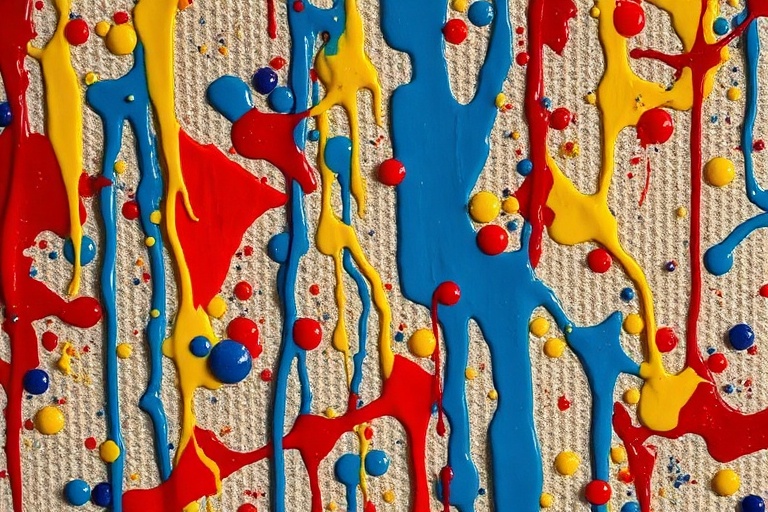
Few artists have reshaped the trajectory of modern art quite like Jackson Pollock. His drip paintings of the late 1940s and early 1950s didn’t just challenge conventions—they obliterated them. Born in 1912 in Cody, Wyoming, Pollock emerged from humble beginnings to become the most iconic figure of the Abstract Expressionist movement. His work, characterized by rhythmic splatters, coils, and chaotic yet deliberate lines, invited viewers into a raw, unfiltered dialogue with the canvas. Pollock didn’t just paint; he performed, moving around the canvas on the floor, dripping and flinging paint with controlled abandon.
The Rise of a Radical Visionary
Pollock’s artistic evolution was marked by experimentation and a relentless search for authenticity. After studying under Thomas Hart Benton at the Art Students League of New York, he initially worked in a regionalist style, influenced by Mexican muralists like José Clemente Orozco and David Alfaro Siqueiros. By the mid-1940s, however, his style began to shift. He abandoned brushes almost entirely, opting instead for sticks, knives, and even syringes to apply paint. The result was a radical departure from traditional composition—his canvases became fields of energy, where paint seemed to dance across the surface.
His breakthrough came in 1947 when he began creating what he called “pourings” or “drip paintings.” These works, such as Number 1A, 1948 and Autumn Rhythm (Number 30), defied the idea of a focal point. Instead, they demanded immersion, pulling the viewer into a labyrinth of color and motion. Critics were divided. Some dismissed his work as mere chaos, while others hailed it as a revelation. The influential critic Harold Rosenberg famously described Pollock’s canvases as “an arena in which to act,” emphasizing the performative nature of his process.
The Technique That Defined a Movement
Pollock’s technique was as much about movement as it was about paint. He laid his canvases flat on the floor, a method that allowed him to navigate the surface from all angles. This “action painting” approach blurred the line between artist and artwork. His physical engagement with the material—his entire body became an instrument—challenged the passive role of the painter. The viscosity of the paint, the speed of his gestures, and the gravity-defying arcs of pigment all contributed to a sense of spontaneity, though Pollock insisted his work was far from random.
- Unprimed canvas: Pollock often used raw, unprimed canvas, which absorbed paint differently than traditional gessoed surfaces. This created a matte, uneven texture that enhanced the organic feel of his work.
- Household and industrial paints: He frequently used commercial-grade enamel paints, which had a higher gloss and richer color saturation compared to traditional oil paints.
- Synthetic media: By incorporating materials like aluminum paint and commercial varnishes, Pollock expanded the visual vocabulary of his compositions.
- Layering and density: His process involved multiple layers of paint, some applied in quick succession, others allowed to dry before additional applications. This created a sense of depth and complexity.
The critic Clement Greenberg championed Pollock as the pinnacle of modernist painting, arguing that his work represented the culmination of the medium’s self-reflexive potential. For Greenberg, Pollock’s drips and splatters weren’t just decorative—they were a meditation on the flatness of the picture plane, stripping away illusionism to reveal painting’s essential properties.
Legacy and Influence: Beyond the Canvas
Pollock’s impact extended far beyond the art world. His life and work became emblematic of the post-war American spirit—bold, uncompromising, and fiercely individualistic. In 1949, Life magazine famously asked, “Is he the greatest living painter in the United States?” The question cemented his status as a cultural icon, even as it oversimplified the depth of his contributions. His celebrity status, however, came at a cost. The pressure of fame, combined with his struggles with alcoholism, took a toll on his mental and physical health.
Tragically, Pollock died in a car accident in 1956 at the age of 44, leaving behind a body of work that continues to inspire and provoke. His later paintings, such as Blue Poles (Number 11, 1952), showcased a shift toward more controlled, linear compositions, yet retained his signature intensity. Today, his works hang in museums worldwide, from the Museum of Modern Art in New York to the Tate Modern in London. They command prices in the hundreds of millions at auction, a testament to their enduring allure.
Pollock’s influence can be seen across disciplines. In music, composers like John Cage drew parallels between Pollock’s improvisational techniques and their own experimental approaches. Filmmakers and writers, from Hans Namuth’s 1951 documentary Jackson Pollock to Don DeLillo’s novel Underworld, have explored the mythos surrounding his life. Even contemporary street artists and digital creators cite his work as a touchstone for breaking boundaries.
Controversies and Criticisms
Despite his acclaim, Pollock’s work has never been without detractors. Some critics argue that his paintings lack the emotional depth or intellectual rigor of his peers. Others suggest that his fame was inflated by a combination of Cold War politics and the machinations of the art market. The CIA’s covert promotion of Abstract Expressionism during the 1950s as a symbol of American freedom and creativity has further complicated the narrative, raising questions about the intersection of art, propaganda, and capitalism.
There’s also the issue of authorship. In 2016, a team of researchers used fractal analysis to compare Pollock’s drip paintings with those of his assistants and followers. While the study didn’t definitively resolve debates about his techniques, it underscored the collaborative and experimental nature of his studio practice. Pollock’s wife, artist Lee Krasner, played a crucial role in managing his career and preserving his legacy, often editing and even destroying some of his works to shape his posthumous reputation.
Yet, these controversies only underscore the complexity of Pollock’s legacy. They remind us that art is never created in a vacuum. It is shaped by personal demons, cultural currents, and historical forces. Pollock’s ability to channel his inner turmoil into something visually transcendent is what makes his work so compelling. As Krasner once noted, “He broke the ice for the rest of us.”
The Enduring Power of Pollock’s Vision
Visiting a Pollock painting in person is a visceral experience. The scale alone—One: Number 31, 1950 measures over 8 by 17 feet—immerses the viewer in a world of relentless energy. The paint, thick and viscous in places, thins into delicate webs in others, creating a dynamic interplay of texture and depth. There’s a sense of motion, as if the painting is still in the process of being made. It’s easy to understand why some viewers feel overwhelmed; Pollock’s work doesn’t just hang on a wall—it engulfs.
For many, Pollock represents the ultimate rebellion against artistic norms. His rejection of the easel, the brush, and even the idea of a single viewpoint was radical in its time. Yet, his work also speaks to something deeply human—the desire to create order from chaos, to find meaning in the seemingly random. In an era where digital tools allow for infinite manipulation and replication, Pollock’s handmade chaos feels more vital than ever.
As we grapple with the role of art in an increasingly fragmented world, Pollock’s paintings offer a reminder of the power of authenticity. They challenge us to look closer, to engage more deeply, and to embrace the unknown. Whether viewed as masterpieces or as provocations, his works refuse to be ignored. They demand our attention, our interpretation, and, perhaps most importantly, our presence.
In the end, Jackson Pollock wasn’t just a painter. He was a force of nature—a man who turned his struggles, his obsessions, and his relentless energy into something that continues to captivate the world. His legacy isn’t confined to the canvas; it lives in the way we create, the way we challenge, and the way we see.
For more on the evolution of modern art movements, explore our Culture section. To dive deeper into the lives of influential artists, visit our Entertainment category.