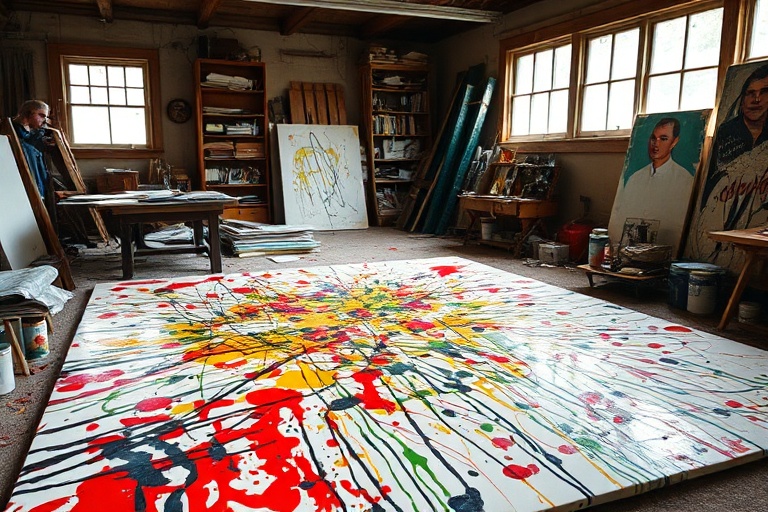
jackson pollock
“`html
Jackson Pollock: The Revolutionary Brushstrokes That Redefined Art
In the annals of 20th-century art, few names carry as much weight as Jackson Pollock. His drip paintings, created in the late 1940s and early 1950s, shattered conventions and redefined what it meant to create art. Born in Cody, Wyoming, in 1912, Pollock rose from a troubled childhood to become a central figure in the Abstract Expressionist movement, a global phenomenon that shifted the center of the art world from Paris to New York.
The son of a farmer and surveyor, Pollock moved with his family to Arizona and later California before settling in New York in his teens. His artistic journey began at the Manual Arts High School in Los Angeles, where he studied under Frederick John de St. Vildé, a former student of the Art Students League of New York. By the 1930s, Pollock was working for the Federal Art Project, a New Deal initiative that provided work for artists during the Great Depression. These early experiences laid the groundwork for his later innovations.
The Birth of a Movement: Abstract Expressionism
Abstract Expressionism emerged in the post-World War II era as a powerful response to the trauma and disillusionment of global conflict. The movement was less about a unified style and more about a shared spirit—a desire to express raw emotion, spontaneity, and individual freedom. Pollock’s work became emblematic of this ethos, particularly his “drip paintings,” which he created by flinging, pouring, and dripping paint onto large canvases laid flat on the floor.
This technique, which Pollock called “action painting,” emphasized the physicality of the artistic process. The artist’s movements became part of the artwork itself, with each splatter and drip recording a moment in time. The canvas was no longer a passive surface but an arena for dynamic, almost ritualistic creation. Critics and artists alike were captivated by this radical departure from traditional methods, where brushstrokes and composition gave way to pure, unfiltered expression.
The movement’s roots extended beyond America’s borders, drawing inspiration from European modernism, Surrealism, and the automatism of artists like Joan Miró. However, Pollock and his contemporaries—including Willem de Kooning, Mark Rothko, and Franz Kline—transformed these influences into something distinctly American. Their work reflected the country’s growing cultural confidence in the aftermath of war, positioning New York as the new epicenter of the art world.
Key Influences on Pollock’s Work
- Native American Art: Pollock’s childhood in the American West exposed him to Native American sand paintings and rituals, which influenced his embrace of fluid, organic forms.
- Psychoanalysis: After undergoing Jungian therapy in the late 1930s, Pollock explored the subconscious as a source of creativity, a concept that aligned with the Surrealist idea of automatism.
- Mexican Muralists: Artists like José Clemente Orozco and David Alfaro Siqueiros, who emphasized large-scale, emotionally charged works, resonated with Pollock’s ambition to create monumental art.
- Cubism and Picasso: While Pollock rejected Cubism’s structured fragmentation, he admired Picasso’s ability to break from tradition, a quality he sought in his own work.
Pollock’s Technique: A Radical Departure from Tradition
Pollock’s drip paintings were not merely a stylistic choice; they were a philosophical statement. By abandoning the easel and working on the floor, he dissolved the hierarchy between artist and canvas. The paint’s viscosity, the artist’s physical exertion, and the randomness of gravity all played roles in the final composition. This approach blurred the line between control and chaos, a tension that became a hallmark of his work.
The materials he used were unconventional for the time. Instead of traditional oil paints, Pollock often employed commercial-grade enamel paints, which flowed more freely and dried quickly. He also experimented with sticks, trowels, and even syringes to manipulate the paint, further emphasizing the physicality of his process. The result was a surface teeming with energy, where drips and splatters created a web of interconnected lines and forms.
Critics were initially divided. Some dismissed his work as mere chaos, while others saw it as a revelation. In 1949, Life magazine posed the question, “Is he the greatest living painter in the United States?” The article, though skeptical, catapulted Pollock into the public eye. His fame grew alongside his reputation as a rebellious, almost mythic figure—a cowboy-turned-artist whose life mirrored the wild, untamed nature of his paintings.
Global Impact and Legacy
Pollock’s influence extended far beyond the confines of the art world. His work became a symbol of American individualism during the Cold War, often cited in cultural diplomacy initiatives as evidence of the United States’ creative and intellectual freedom. In 1958, his painting Number 1A, 1948 was included in a traveling exhibition organized by the Museum of Modern Art (MoMA) that toured Europe, solidifying his status as a global icon.
In Japan, Pollock’s work resonated with Gutai, a post-war avant-garde movement that emphasized performance and materiality in art. Artists like Kazuo Shiraga, who created paintings by wrestling with paint-covered canvases, drew direct inspiration from Pollock’s rejection of traditional techniques. Similarly, in Europe, the Informel movement—championed by artists like Georges Mathieu and Lucio Fontana—shared Pollock’s disregard for compositional rules, favoring instead the raw, gestural mark.
Pollock’s legacy also permeated popular culture. His image as the “bad boy” of art—fueled by his struggles with alcoholism and tumultuous personal life—became a template for the tortured artist. Films like Pollock (2000), starring Ed Harris, and documentaries like Jackson Pollock: Love and Death on Long Island (1999) cemented his mythos. Meanwhile, his paintings became coveted by collectors, fetching astronomical sums at auction. In 2012, Number 5, 1948 sold for $140 million, a record at the time.
The Controversies and Criticisms
Despite his acclaim, Pollock’s work has always been a lightning rod for debate. Some critics argue that his paintings lack depth, dismissing them as random splatters devoid of meaning. Others contend that his reliance on chance and spontaneity undermined the skill and intention behind traditional art-making.
In the 1950s, Clement Greenberg, a prominent art critic and Pollock’s champion, praised his work for its purity and flatness, arguing that it distilled painting to its essential elements. However, Greenberg’s formalist approach was later challenged by scholars who sought to contextualize Pollock’s work within broader cultural and psychological frameworks. Feminist critics, for instance, highlighted the gendered language often used to describe his art—terms like “virile” and “aggressive” that framed his work as a masculine assertion of power.
Pollock’s personal life further complicated his legacy. His struggles with alcoholism and violent outbursts, including a 1956 car accident that killed a friend and fellow artist, Edith Metzger, cast a shadow over his achievements. Yet, these very struggles also fueled the romanticized image of the artist as a tortured genius, a narrative that continues to shape public perception.
Pollock’s Enduring Influence on Contemporary Art
Today, Pollock’s impact can be seen across disciplines, from street art to digital media. Artists like Jean-Michel Basquiat and Cy Twombly have cited him as a major influence, while contemporary painters continue to explore the boundaries between control and spontaneity. Even in fields like sports, where athletes often describe their peak performances as “being in the zone,” the language mirrors Pollock’s idea of losing oneself in the act of creation.
Pollock’s work also raises questions about the role of the artist in society. In an era where authenticity is often commodified, his insistence on raw, unfiltered expression feels both radical and prescient. His paintings invite viewers to project their own emotions and interpretations onto the canvas, a testament to the power of art to transcend its creator.
As the art world evolves, Pollock’s legacy endures not just as a relic of mid-century modernism, but as a reminder of the transformative potential of art. His paintings challenge us to see beyond the surface, to find meaning in the chaos, and to embrace the unknown. In doing so, they continue to inspire artists and audiences around the world.
Where to See Pollock’s Work Today
For those looking to experience Pollock’s art firsthand, several institutions house his most significant pieces:
- MoMA (New York): Home to Autumn Rhythm (Number 30) and Number 1A, 1948.
- Guggenheim Museum (New York): Features Composition with Pouring II and other early works.
- Tate Modern (London): Showcases Yellow Islands and The Key.
- Peggy Guggenheim Collection (Venice): Includes The Moon-Woman Cuts the Circle.
Conclusion: The Man Who Changed Art Forever
Jackson Pollock’s life and work embody the tension between chaos and control, freedom and discipline, destruction and creation. He was a man of contradictions—both a rebel and a traditionalist, a genius and a tormented soul. Yet, it is this very complexity that makes his art so compelling.
Pollock’s paintings are not just objects; they are records of a moment, a movement, a mindset. They remind us that art is not about perfection, but about presence—the artist’s, the viewer’s, and the world’s. In an age where art is often reduced to Instagram filters and viral trends, Poll