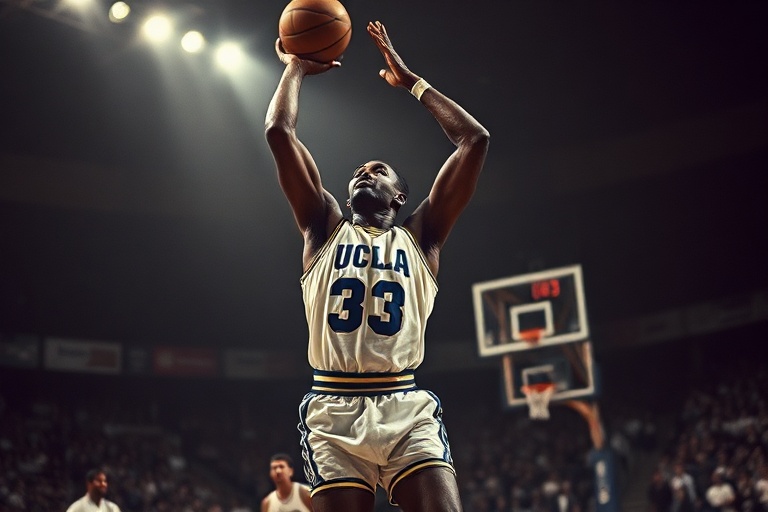
Kareem Abdul-Jabbar: A Legacy Beyond Basketball
Kareem Abdul-Jabbar stands as one of the most influential figures in sports history, not just for his dominance on the basketball court but for his intellectual contributions off it. Born Ferdinand Lewis Alcindor Jr. in 1947, he transformed his name after converting to Islam in 1971, reflecting his evolving identity and beliefs. His career spanned two decades with the Milwaukee Bucks and Los Angeles Lakers, where he set records that still resonate today. Yet his influence extends far beyond statistics, shaping conversations about race, social justice, and education.
The Rise of a Legend
Abdul-Jabbar’s journey began in New York City, where he emerged as a basketball prodigy at Power Memorial Academy. His towering 7’2” frame and unmatched skill made him a high school sensation, leading his team to three consecutive city championships. Colleges clamored for his talent, but he chose UCLA under coach John Wooden, where he became a three-time NCAA champion and three-time Most Outstanding Player. His dominance was such that the NCAA even banned dunking—a rule colloquially called the “Lew Alcindor Rule”—to curb his influence.
After being selected first overall in the 1969 NBA Draft by the Milwaukee Bucks, Abdul-Jabbar quickly proved his worth. In his rookie season, he averaged 28.8 points and 14.5 rebounds per game, earning Rookie of the Year honors. By his third season, he led the Bucks to their first NBA championship, defeating the Baltimore Bullets in a sweep. His pairing with Oscar Robertson created one of the most formidable duos in league history, setting the stage for a dynasty.
Revolutionizing the Game
Abdul-Jabbar’s signature move, the “Skyhook,” became synonymous with his unparalleled skill. Unblockable and nearly unstoppable, the shot frustrated opponents for years and cemented his status as a basketball innovator. His ability to dominate games without relying on athleticism alone showcased his mastery of fundamentals and intellect. Over his 20-year career, he amassed six MVP awards, six championships, and 38,387 points—a record that stood for nearly four decades.
Yet his impact wasn’t confined to the court. Abdul-Jabbar was a vocal advocate for civil rights and social justice, using his platform to challenge systemic racism. In the 1960s and 70s, he boycotted the 1968 Olympics to protest racial inequality and later criticized the NBA for its lack of diversity in coaching and executive roles. His 1981 book, Giant Steps, delved into these issues, blending personal narrative with broader social commentary. Decades later, his activism remains a blueprint for athletes seeking to leverage their influence for change.
From Athlete to Cultural Icon
Abdul-Jabbar’s transition from player to cultural figure was seamless. He dabbled in acting, appearing in films like Game of Death (1978) alongside Bruce Lee, and later in TV shows such as Diff’rent Strokes and Scrubs. His deep voice and intellectual demeanor made him a sought-after commentator, and he became a regular contributor to publications like The Washington Post and The Hollywood Reporter.
His intellectual pursuits extended to history and literature. A lifelong scholar, Abdul-Jabbar earned a bachelor’s degree in history from UCLA while playing professionally. He later pursued a master’s degree in teaching, reflecting his commitment to education. In 2016, he was awarded the Presidential Medal of Freedom by Barack Obama, recognizing his contributions to sports, activism, and scholarship. His 2015 book, Coach Wooden and Me, offered a poignant reflection on his relationship with his mentor and the lessons he carried into life after basketball.
A Global Perspective on Legacy
Abdul-Jabbar’s influence transcends American borders. In Africa, where basketball is growing rapidly, his activism resonates with a new generation of athletes who see sports as a vehicle for social change. In Europe, his strategic approach to the game is studied by coaches and players who admire his blend of skill and intellect. Even in Asia, where basketball has gained immense popularity, his name remains synonymous with excellence and integrity.
His work with organizations like the Skyhook Foundation, which he founded in 2009, underscores his dedication to education. The foundation partners with schools to bring STEM (Science, Technology, Engineering, and Mathematics) education to underserved communities, particularly in his native New York. Through initiatives like “STEM from the Hoop,” Abdul-Jabbar ensures that his legacy extends beyond the hardwood, empowering future generations to pursue knowledge and opportunity.
Abdul-Jabbar’s global perspective is also evident in his writing. His 2020 book, Becoming Kareem: Growing Up On and Off the Court, offers a nuanced look at his life, from his childhood in Harlem to his NBA career and beyond. The memoir highlights the cultural shifts he witnessed, from the Civil Rights Movement to the digital age, and his role in shaping—and being shaped by—them.
The Enduring Influence of a Modern Renaissance Man
Kareem Abdul-Jabbar’s career is a testament to the power of intellect, activism, and perseverance. He navigated a world where athletes were often expected to stay silent on social issues, yet he used his voice to challenge the status quo. His ability to excel in multiple arenas—sports, literature, acting, and activism—sets him apart as a true Renaissance man. Even today, at 77, he remains a sought-after voice on issues ranging from racial justice to education reform.
His legacy is a reminder that greatness isn’t measured solely by trophies or accolades. It’s measured by the lives you touch, the barriers you break, and the conversations you inspire. Whether through his Skyhook, his books, or his advocacy, Abdul-Jabbar has left an indelible mark on the world. For aspiring athletes and scholars alike, his story is a call to action: to strive for excellence in all endeavors and to use your platform for the greater good.
In an era where athletes are increasingly expected to be more than just players, Abdul-Jabbar’s journey offers a roadmap for how to leverage fame responsibly. His work with the Sports and Education communities continues to inspire, proving that true leadership extends far beyond the field of play.