May 9th on Red Square: The Moscow Victory Day Parade Through the Decades
The Moscow Victory Day Parade on May 9th is more than a military display—it is a living museum of Soviet and Russian history, a moment of national unity, and a global spectacle watched by millions. Each year, tens of thousands of troops, armored vehicles, and aircraft roll across Red Square to commemorate the Soviet Union’s victory over Nazi Germany in 1945. But the parade is also a mirror reflecting changing political narratives, technological progress, and Russia’s evolving role on the world stage.
The tradition began in 1945, when the first Victory Parade took place just months after the fall of Berlin. Joseph Stalin ordered the event to honor the Red Army’s triumph and solidify Soviet pride. For decades, the parade served as a propaganda tool during the Cold War, showcasing military might to both domestic and international audiences. Today, it remains a cornerstone of Russian identity, blending historical reverence with modern military display.
The Parade’s Historical Evolution: From 1945 to the Present
The first Moscow Victory Parade occurred on June 24, 1945, a rainy day that matched the somber mood of a nation that had lost over 27 million lives. Soviet soldiers marched in formation, while captured Nazi banners were thrown at the foot of Lenin’s Mausoleum—a symbolic gesture of unconditional surrender. This parade was raw, emotional, and deeply personal for a country still grieving.
During the Soviet era, the parade became an annual fixture, growing in scale and spectacle. In the 1960s and 1970s, it transformed into a Cold War showcase, featuring intercontinental ballistic missiles and formations of troops in synchronized drills. The message was clear: the USSR was a superpower to be reckoned with. These parades were broadcast across the Eastern Bloc, reinforcing ideological solidarity.
After the Soviet Union’s collapse in 1991, the parade was suspended until 1995, when President Boris Yeltsin revived it to commemorate the 50th anniversary of Victory Day. The event was scaled back due to economic constraints, but it signaled a renewed commitment to honoring wartime memory. Under Vladimir Putin, the parade has expanded dramatically, with increased military hardware, aerial flyovers, and an emphasis on continuity with the Soviet past.
What to Expect During the Modern Victory Day Parade
The Moscow Victory Day Parade is a meticulously choreographed event, divided into several key segments. The ceremony begins with a moment of silence, followed by the Russian national anthem and a speech from the president. Then, the parade commences with a march of the Immortal Regiment—a civilian procession carrying portraits of fallen soldiers. This segment has grown into a global phenomenon, with similar marches held in cities worldwide.
The military portion includes several distinct elements:
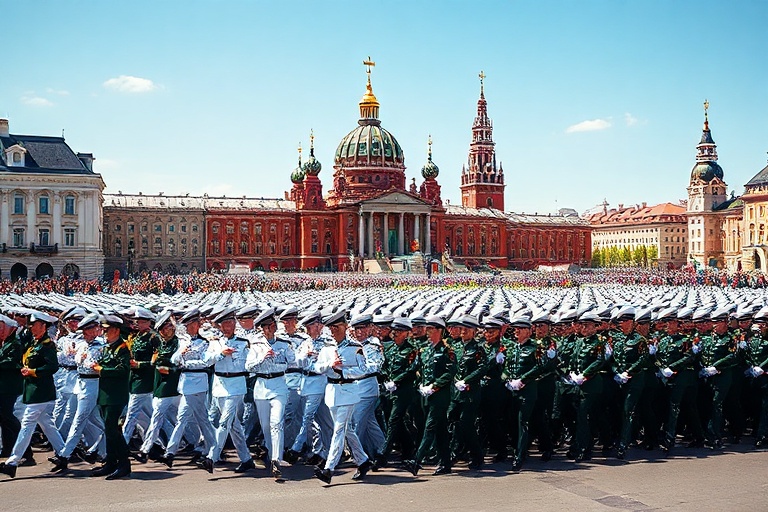
- Foot Drills: Precision marching by the Kremlin Regiment, the honor guard, and service academies. The synchronization and discipline reflect years of training.
- Historical Reenactments: Veterans or actors in period uniforms often participate, especially in anniversary years, to recreate iconic moments from 1945.
- Military Hardware: A display of tanks, missile systems, and armored vehicles, including the latest models like the T-14 Armata and the RS-28 Sarmat ICBM.
- Aerial Flyovers: Fighter jets, bombers, and helicopters perform complex maneuvers, often leaving trails of red, white, and blue smoke—the colors of the Russian flag.
- Veterans’ Procession: Aging war veterans, many in their late 90s, are honored with a special march, their presence a poignant reminder of the living link to history.
In recent years, the parade has also incorporated modern elements, such as robotic systems and drones, reflecting Russia’s investment in advanced military technology. The inclusion of these innovations underscores a broader narrative: while Victory Day is rooted in the past, Russia sees itself as a contemporary military power.
The Parade’s Cultural and Political Significance
Victory Day is Russia’s most sacred holiday, surpassing even New Year’s in cultural importance. It is a day of remembrance, but also of political messaging. For the Russian government, the parade reinforces national pride and justifies military expenditures. It serves as a reminder of Russia’s sacrifice during World War II—a conflict known in Russia as the Great Patriotic War—and frames the country as a defender against fascism.
Internationally, the parade is closely watched for signals of Russia’s military ambitions. The display of advanced weaponry, such as the hypersonic Kinzhal missile or the nuclear-capable Avangard glide vehicle, is often interpreted as a show of force. Western analysts see these parades as part of a broader strategy to project power and deter adversaries.
Yet, the parade also resonates beyond politics. For many Russians, it is a day of family, reflection, and gratitude. The Immortal Regiment movement, which began in 2012, has spread to over 50 countries, with participants carrying photos of relatives who fought in the war. This grassroots element highlights how Victory Day transcends state propaganda, becoming a personal and emotional experience for individuals worldwide.
The parade’s global reach is evident in the diverse audience it attracts. Diplomats, journalists, and tourists flock to Moscow each May 9th, while live broadcasts reach millions across Europe, Asia, and the Middle East. In countries with historical ties to the Soviet Union—such as Belarus, Kazakhstan, and Armenia—the parade is a symbol of shared heritage. Even in former Soviet republics like Ukraine, where Victory Day celebrations have become politically contentious, the event sparks debate about memory and national identity.
Challenges and Controversies
Despite its grandeur, the Moscow Victory Day Parade has faced criticism and challenges. The most significant is the ethical dilemma of honoring victory while glossing over the Soviet Union’s own wartime controversies. The USSR’s non-aggression pact with Nazi Germany in 1939, the deportation of entire ethnic groups, and Stalin’s repressive policies are often omitted from the official narrative. Critics argue that this selective memory distorts history, particularly for younger generations who may not fully understand the complexities of the war.
Another challenge is the parade’s cost. In a time of economic sanctions and domestic austerity, the multi-million-dollar event has drawn scrutiny. Some Russian opposition figures and economists question the prioritization of military spectacle over social welfare programs. Yet, for the Kremlin, the parade is non-negotiable—it is a tool of legitimacy and a unifying ritual.
Health concerns have also emerged, particularly after the COVID-19 pandemic disrupted the 2020 and 2021 parades. The 2020 event was canceled entirely, while the 2021 parade was held in a reduced format with limited spectators. These adjustments highlighted the parade’s vulnerability to external shocks, whether political or epidemiological.
A Lasting Legacy
The Moscow Victory Day Parade is more than a military event—it is a cultural institution, a political statement, and a global phenomenon. It bridges generations, connects diasporas, and projects power. As Russia navigates a world of shifting alliances and rising tensions, the parade remains a constant: a reaffirmation of a past victory and a promise of future strength.
For observers outside Russia, the parade offers a window into the country’s soul. It reveals a nation grappling with its history, its identity, and its place in the world. Whether seen through the lens of geopolitics, military strategy, or personal memory, the Moscow Victory Day Parade endures as a powerful symbol of resilience and remembrance.
As we watch the tanks roll past the Kremlin and the jets streak across the sky, we are not just witnessing a parade—we are witnessing history in motion.