Moscow Victory Day Parade: Russia’s Military Showcase and Historical Tribute
“`html
Moscow Victory Day Parade: A Display of Military Might and Historical Pride
The Moscow Victory Day Parade stands as one of the most significant military and cultural events in modern Russia. Held annually on May 9th, it commemorates the Soviet Union’s victory over Nazi Germany in World War II, a conflict that cost the lives of over 27 million Soviet citizens. The parade, which takes place on Red Square, is a carefully choreographed spectacle blending historical reverence with contemporary military showcases.
Beyond its symbolic importance, the event serves as a platform for Russia to project its military strength on the global stage. The parade features advanced weaponry, including intercontinental ballistic missiles and state-of-the-art aircraft, all designed to underscore Russia’s strategic capabilities. For spectators and viewers worldwide, the parade offers a rare glimpse into the evolving nature of modern warfare and the enduring legacy of Soviet valor.
Historical Roots and Evolution
The first Victory Day Parade occurred on June 24, 1945, shortly after Germany’s surrender. Soviet leader Joseph Stalin ordered the event as a grand celebration of the Red Army’s triumph, complete with captured Nazi banners tossed at the feet of the Kremlin. This inaugural parade set the tone for future commemorations, though it would be decades before the tradition became an annual fixture.
May 9th was not officially designated as Victory Day in the Soviet Union until 1965, under Leonid Brezhnev. The parade was revived that year after a two-decade hiatus, reintroducing military processions to Red Square. Over time, the event expanded to include not only military hardware but also flyovers by the Russian Air Force, transforming it into a multimedia spectacle.
Following the dissolution of the Soviet Union in 1991, the parade faced uncertainty. Russia initially scaled back celebrations due to financial constraints and shifting political priorities. However, under Vladimir Putin, the Victory Day Parade re-emerged as a cornerstone of national identity, particularly after 2008 when it was restored to its original May 9th date. Today, the parade is a non-negotiable fixture in Russia’s calendar, drawing hundreds of thousands of spectators and millions of television viewers.
The Parade’s Structure: A Blend of Tradition and Innovation
The Moscow Victory Day Parade is meticulously organized into distinct segments, each serving a specific purpose. The event typically begins with a moment of silence at 10:00 AM, followed by the national anthem. The parade then unfolds in a structured sequence:
- Marching Columns: Thousands of soldiers from various branches of the Russian Armed Forces march in precise formation. This segment includes the historic reenactment of the 1945 parade, with veterans and their descendants participating.
- Military Hardware Display: A procession of tanks, missile systems, and other advanced weaponry rolls through Red Square. Notable inclusions in recent years have been the T-14 Armata tank, the RS-24 Yars intercontinental ballistic missile, and the S-400 Triumf air defense system.
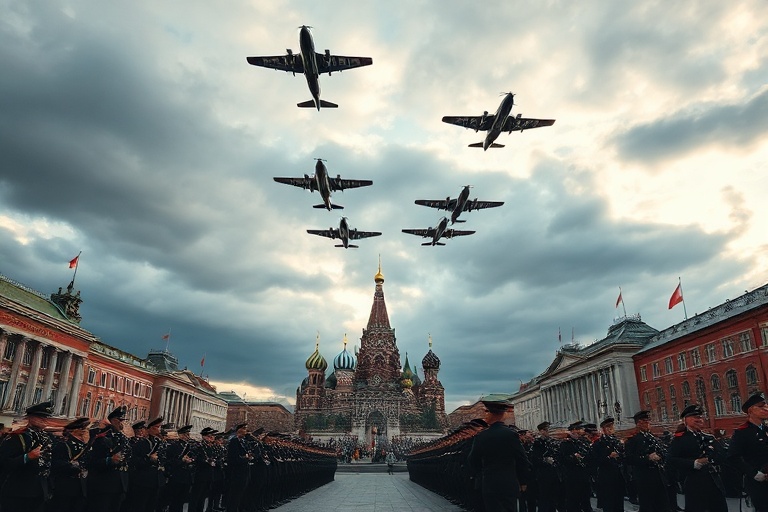
- Air Force Flyover: The Russian Air Force performs a breathtaking display of aerial prowess, featuring formations of fighter jets, bombers, and helicopters. The Su-57 stealth fighter and the Tu-160 strategic bomber are often highlights.
- Historical Tributes: Veterans of World War II, known as “The Immortal Regiment,” carry portraits of fallen soldiers during the parade. This segment pays homage to the personal sacrifices made during the war.
The inclusion of cutting-edge military technology alongside historical elements creates a unique juxtaposition. It reinforces the narrative that Russia’s military heritage remains a source of national pride while simultaneously projecting its future capabilities. The parade’s choreography is designed to evoke a sense of continuity, bridging the past with the present.
Geopolitical Significance and International Reactions
The Moscow Victory Day Parade is not merely a domestic event; it carries significant geopolitical weight. For Russia, it serves as a tool of soft power, reinforcing the country’s historical narrative and its claim to great-power status. The parade’s emphasis on military strength is particularly notable amid ongoing tensions with Western nations, including sanctions and diplomatic rifts.
Western observers often interpret the parade through the lens of military posturing. The display of advanced weaponry, such as hypersonic missiles and nuclear-capable systems, is seen as a deliberate signal to NATO and other adversaries. Analysts note that the parade’s timing—just weeks before Russia’s Victory Day—is no coincidence, as it aligns with efforts to rally domestic support and project an image of unwavering resolve.
In recent years, the parade has also become a focal point for international delegations. Leaders from countries such as China, India, and North Korea have attended, underscoring the event’s role in fostering diplomatic alliances. For these nations, the parade represents an opportunity to align with Russia’s narrative of resisting Western hegemony.
However, the parade has not been without controversy. Critics argue that it glorifies Soviet-era militarism while downplaying the complexities of World War II history. Others point to the Kremlin’s use of the event to stoke nationalist sentiment, particularly in the lead-up to elections or during periods of domestic unrest. Despite these criticisms, the parade remains a potent symbol for millions of Russians, who view it as a testament to their country’s resilience.
Cultural Impact and Public Participation
For many Russians, the Victory Day Parade is more than a military display; it is a deeply personal and emotional experience. The event is intertwined with family traditions, particularly the “Immortal Regiment” movement, which began in 2012. This grassroots initiative encourages people to carry photographs of their ancestors who fought in World War II, creating a living memorial that stretches across generations.
The parade also serves as a unifying force in Russian society. In a country with diverse ethnic and regional identities, the shared commemoration of Victory Day fosters a sense of collective memory. Schools, government offices, and private businesses close for the day, and streets fill with people waving red carnations, the traditional symbol of remembrance.
Media coverage of the parade is extensive, with state-controlled outlets devoting hours of programming to the event. Documentaries, interviews with veterans, and historical reenactments dominate television schedules, ensuring that the narrative of Soviet triumph is reinforced across the country. Social media platforms also play a role, with hashtags like #VictoryDay and #ImmortalRegiment trending annually.
Yet, the parade’s cultural impact extends beyond Russia’s borders. In former Soviet republics, Victory Day is observed with varying degrees of enthusiasm. While countries like Kazakhstan and Belarus embrace the commemoration as part of their shared history, others, such as the Baltic states, have distanced themselves from the event, viewing it as a relic of Soviet occupation.
The Role of Technology in Enhancing the Parade Experience
The Moscow Victory Day Parade has evolved with advancements in technology, both in its execution and its presentation. High-definition broadcasts, augmented reality applications, and drone light shows have become integral to the event’s modern appeal. For instance, in 2020, when the parade was scaled down due to the COVID-19 pandemic, organizers used drones to create a virtual flyover, projecting images of military equipment onto the sky above Red Square.
Military technology also takes center stage during the parade. The RS-28 Sarmat intercontinental ballistic missile, unveiled in 2022, and the Poseidon nuclear-powered underwater drone have been featured prominently in recent years. These systems are not merely props; they represent Russia’s ongoing efforts to modernize its arsenal and counter perceived threats from the United States and NATO.
Behind the scenes, the parade relies on advanced logistics and coordination. Thousands of participants, from soldiers to civilian volunteers, undergo rigorous training to ensure flawless execution. The use of GPS tracking, real-time data feeds, and precision timing systems underscores the technological sophistication that underpins this centuries-old tradition.
For spectators, the parade offers an immersive experience. Large screens broadcast close-up views of the military hardware, while synchronized music and pyrotechnics enhance the spectacle. The combination of raw power and meticulous choreography creates an unforgettable visual and emotional impact.
Conclusion: A Tradition That Endures
The Moscow Victory Day Parade is a testament to the enduring power of historical memory and the role of military displays in shaping national identity. For Russia, it is an opportunity to honor the past while projecting strength into the future. The parade’s blend of tradition, innovation, and geopolitical messaging ensures its continued relevance in an era of shifting global dynamics.
As the world watches, the parade serves as a reminder of the sacrifices made during World War II and the ongoing importance of remembrance. Whether viewed as a symbol of resilience, a tool of propaganda, or a celebration of military prowess, the Moscow Victory Day Parade remains one of the most compelling events on the global calendar.
For those interested in exploring more about military parades or historical commemorations, visit our News and Culture sections for additional insights and analysis.