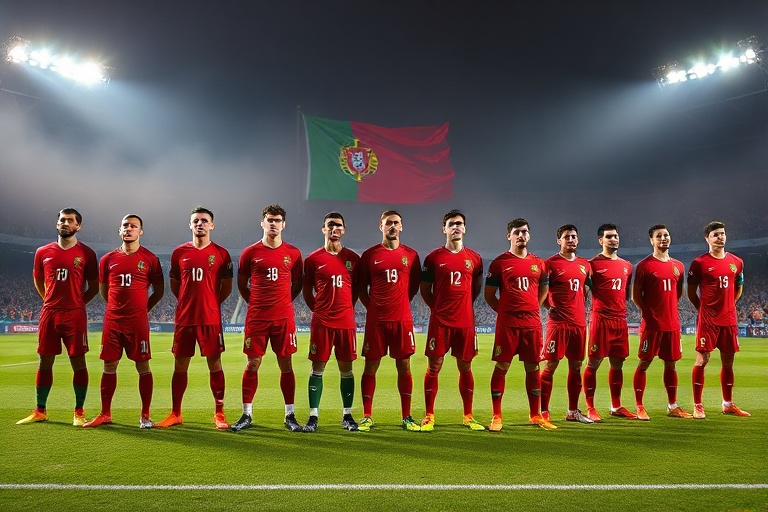
The Portugal national football team has long been a fixture among Europe’s elite, known for producing world-class talent while maintaining a disciplined tactical approach. As the squad prepares for the next World Cup cycle, the balance between seasoned veterans and emerging stars defines the current generation. This blend reflects Portugal’s evolving football identity, shaped by generations of players who have left their mark on the global stage.
From Cristiano Ronaldo’s leadership to the creative flair of younger talents, the squad embodies both tradition and innovation. The global football community watches closely as Portugal navigates transitions, aiming to build on past successes while embracing new ambitions. The blend of experience and potential sets the stage for an intriguing journey ahead.
The Core of Experience: Veteran Leaders
Portugal’s World Cup squad has always thrived on the presence of experienced players who provide stability and leadership. In the most recent tournaments, figures like Cristiano Ronaldo, Pepe, and Rui Patrício have anchored the team with their professionalism and competitive drive. These players represent the golden generation that delivered Portugal’s first major international trophy at Euro 2016 and the Nations League in 2019.
Ronaldo, despite his age, remains a focal point of the squad’s attacking strategy. His influence extends beyond goals—his work ethic, tactical awareness, and ability to elevate teammates remain invaluable. Pepe, now in his late 30s, continues to be a defensive rock, combining aggression with intelligent positioning. Meanwhile, Rui Patrício’s shot-stopping and command of the penalty area provide a sense of security between the posts.
Their presence ensures continuity for younger players, who benefit from training alongside legends of the game. This mentorship fosters a culture of excellence, where ambition is tempered by respect for the craft. The veterans’ commitment to the national team also reinforces Portugal’s reputation as a destination for players who prioritize international duty over club obligations.
A New Wave of Talent: The Future of Portuguese Football
Portugal’s footballing success is not solely built on past glories—it is also fueled by a steady stream of young talent emerging from academies like Sporting CP, FC Porto, and SL Benfica. Players such as João Félix, Rafael Leão, and Gonçalo Ramos have already demonstrated their potential on the global stage, offering a glimpse of the team’s future.
João Félix, despite facing challenges in adapting to top-level football, remains one of the most technically gifted players in Europe. His dribbling, vision, and creativity make him a constant threat in attacking transitions. Rafael Leão, with his blistering pace and direct style, provides width and unpredictability, while Gonçalo Ramos has shown composure and clinical finishing in high-pressure situations.
The emergence of these players reflects Portugal’s strong youth development system. Clubs invest heavily in academies, emphasizing technical skill, tactical intelligence, and mental resilience. This philosophy has paid dividends, ensuring that Portugal remains competitive even as its golden generation ages.
Additionally, the squad features promising midfielders like Matheus Nunes and João Palhinha, who offer a mix of defensive stability and progressive passing. Their inclusion highlights Portugal’s depth, allowing the team to adapt tactically without sacrificing quality.
Tactical Evolution: Adapting to Modern Football
Portugal’s approach to the World Cup has evolved under recent managers, moving away from a rigid 4-4-2 system to more flexible formations. The current setup often resembles a 4-3-3, allowing for greater fluidity in attack and defensive transitions. This shift reflects broader trends in modern football, where versatility and positional interchange are prized.
Fernando Santos, the former manager, emphasized defensive organization and quick counterattacks, a strategy that yielded success in major tournaments. His successor, Roberto Martínez, brought a more attacking mindset, prioritizing possession and pressing. The evolving tactical landscape demonstrates Portugal’s willingness to adapt while maintaining its core identity.
The squad’s tactical flexibility is further enhanced by the diversity of its players. Defenders like Danilo Pereira and Nuno Mendes offer different profiles—one a physical presence, the other a dynamic left-back. Midfielders such as Bruno Fernandes and Bernardo Silva provide creativity and work rate, ensuring the team can control games in multiple ways.
This adaptability is crucial in the World Cup, where opponents vary in style and strength. Whether facing possession-heavy teams or direct counterattacking sides, Portugal’s ability to adjust tactically will determine its success.
The Road to the World Cup: Challenges and Expectations
Qualifying for the World Cup is never guaranteed, especially in a competitive UEFA group. Portugal has navigated tough opponents, including Serbia, the Republic of Ireland, and Luxembourg, to secure its place. The journey highlighted both strengths and vulnerabilities, particularly in away matches where defensive discipline was tested.
Looking ahead, the team faces the challenge of balancing club and country commitments. Many players compete in top European leagues, where fixture congestion and fatigue are constant concerns. Managing workloads while maintaining sharpness will be critical in the lead-up to the tournament.
Expectations are high, as Portugal aims to build on its quarterfinal appearance in the 2022 World Cup. Fans and pundits alike anticipate a squad capable of challenging for the title, particularly with a blend of experienced leaders and emerging stars. The blend of Ronaldo’s leadership and the hunger of younger players creates a compelling narrative.
The team’s cultural impact extends beyond results. Portugal’s footballing philosophy emphasizes technical skill, tactical intelligence, and humility—qualities that resonate globally. The squad’s success is not just measured in trophies but in the inspiration it provides to aspiring players across the country.
Conclusion: A Legacy in the Making
Portugal’s World Cup squad stands at a crossroads, where tradition meets innovation. The veterans provide the foundation, while the rising stars offer hope for the future. This balance is the hallmark of Portugal’s footballing identity, one that has captivated fans worldwide.
The road to the World Cup is paved with challenges, but the squad’s depth and adaptability position it as a formidable contender. As the tournament approaches, the world will watch closely to see if this generation can add to Portugal’s rich footballing legacy.
For fans of sports and football enthusiasts, the journey promises drama, skill, and moments that will be remembered for years to come.