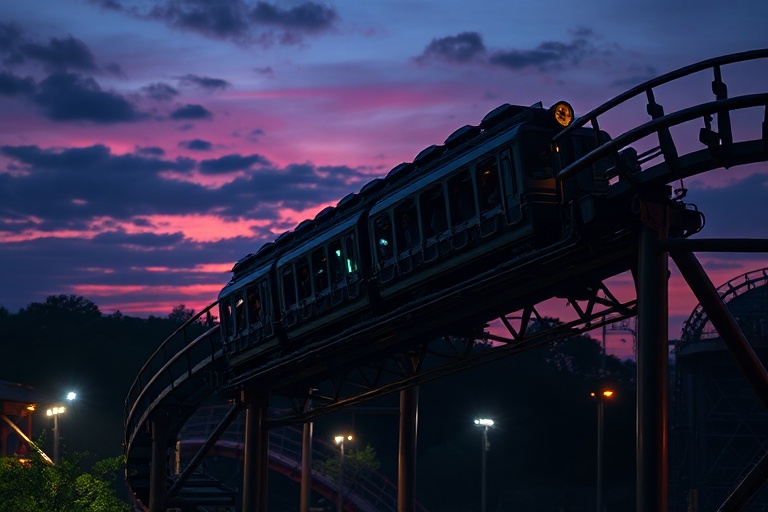
On a sweltering summer afternoon at Six Flags Over Texas, the park’s signature hyper-coaster Titan came to a sudden, jarring halt. Not from mechanical failure or weather conditions, but from an electrical power outage that plunged sections of the park into darkness and stranded hundreds of riders mid-ride. While incidents like these are rare, they are not uncommon in large amusement venues where infrastructure strains under peak demand. The Titan outage became more than a local incident—it highlighted how modern leisure infrastructure relies on fragile networks, and how global energy challenges are now reshaping even recreational experiences.
The Titan, one of the largest and most powerful roller coasters in the United States, is a marvel of engineering. Standing 245 feet tall and reaching speeds of 85 mph, it relies on a complex system of motors, sensors, and electrical grids. But when the power failed on July 12, 2024, the coaster wasn’t just stopped—it became a symbol of how dependent large-scale entertainment is on stable energy infrastructure. For the nearly 200 riders suspended 150 feet in the air, the moment was a visceral reminder of vulnerability in an age of climate change, aging grids, and increasing energy demand.
The Timeline of the Outage: Minutes That Felt Like Hours
According to park officials and witness accounts, the outage occurred at approximately 2:47 PM during the coaster’s third loop of the day. Security footage and ride data later revealed a cascading failure in the park’s electrical substation. While backup generators kicked in within minutes for critical systems like lighting and communication, the Titan’s high-voltage lift motors required a full restart sequence—one that could not be safely initiated while riders were on board.
Emergency protocols were immediately activated. Riders were secured in their seats as staff coordinated with local utility providers and emergency responders. Fire and paramedic teams staged at the ride’s base, while ride operators communicated via megaphones and handheld radios. The wait lasted over 45 minutes, a duration that felt far longer to those suspended in the Texas heat. One rider later told reporters, “You could hear kids crying. You could feel the coaster swaying in the wind. It wasn’t the thrill ride we signed up for.”
By 3:35 PM, all riders were safely evacuated using controlled descent procedures. No injuries were reported, though the psychological impact lingered. For many, the outage wasn’t just a technical glitch—it was a moment of existential unease, a reminder that even the most advanced human creations can falter when the grid fails.
A Global Pattern: Amusement Parks and Energy Instability
While the Titan outage was localized, it reflects a growing trend across the amusement industry. Major theme parks from Orlando to Shanghai have reported disruptions linked to power fluctuations, heatwaves, and aging infrastructure. In 2023, Disneyland Paris temporarily closed several attractions during a regional blackout caused by record-breaking heat. Similarly, Universal Studios Japan implemented rolling blackouts during peak summer months due to grid overload in Osaka.
These incidents are not isolated. They are symptoms of a larger global challenge: the mismatch between energy supply and demand in an era of climate change. As temperatures rise, air conditioning use surges, straining grids already burdened by outdated transmission lines and underinvestment. Theme parks, with their massive energy footprints—roller coasters, water rides, food courts, and lighting—are particularly vulnerable.
In India, for example, amusement parks like EsselWorld in Mumbai have invested in microgrid solutions and battery storage to prevent mid-season shutdowns. Meanwhile, in Europe, parks are turning to renewable energy partnerships, installing solar canopies over parking lots and wind turbines near ride queues. The message is clear: the future of fun is green, or at least greener.
- North America: Parks increasingly rely on natural gas backup generators and demand-response programs with local utilities.
- Asia: Rapid electrification and extreme weather are forcing parks to adopt hybrid energy systems to avoid blackouts.
- Europe: Regulatory pressure is driving parks toward full renewable integration, often subsidized by government grants.
Beyond the Ride: The Human and Economic Cost
The economic impact of a major ride outage can be significant. For Six Flags Over Texas, the Titan incident led to temporary closures, delayed reopening of other attractions, and a surge in refund requests. Social media amplified the frustration, with viral videos and hashtags like #TitanOutage trending locally. While the park issued apologies and compensation offers, the reputational damage was done—at least temporarily.
But the human cost is more complex. For thrill-seekers, a ride failure can shatter the illusion of safety. For families, it can turn a day of joy into one of anxiety. For park employees, it’s a test of crisis management under public scrutiny. One ride operator, speaking on condition of anonymity, shared that the incident reinforced the need for better training. “We practice evacuations, but nothing prepares you for the weight of hundreds of eyes looking up at you from the ground,” they said.
Psychologists note that such events can trigger what’s known as “situational anxiety”—a fear not of the ride itself, but of being trapped or losing control. Theme parks rely on trust. When that trust is broken, even temporarily, the ripple effects can last for seasons.
What’s Next for Theme Park Safety and Energy Resilience
In the wake of the Titan outage, Six Flags announced a $12 million upgrade to its electrical infrastructure, including new substations, surge protectors, and real-time monitoring systems. The company also pledged to conduct quarterly emergency drills and publicize evacuation plans. These are important steps, but experts argue that more systemic changes are needed.
The future of theme parks may lie in decentralization. Smaller, modular rides powered by battery packs or solar arrays could reduce grid dependency. Some parks are already experimenting with ride-specific microgrids that can island themselves during regional outages. Others are integrating artificial intelligence to predict and preempt power failures before they occur.
It’s a shift from spectacle to sustainability—a recognition that the magic of amusement parks must coexist with the realities of a changing planet. As one industry analyst put it, “People don’t go to theme parks to worry about the grid. But if we don’t fix it, they might not go at all.”
For now, the Titan stands silent, its steel frame glinting in the Texas sun. Riders who experienced the outage may never look at roller coasters the same way again. But for Six Flags, the real ride has only just begun—toward resilience, transparency, and a future where the only thing that goes down is the thrill, not the lights.
For more on how technology is reshaping entertainment, visit our Technology hub.