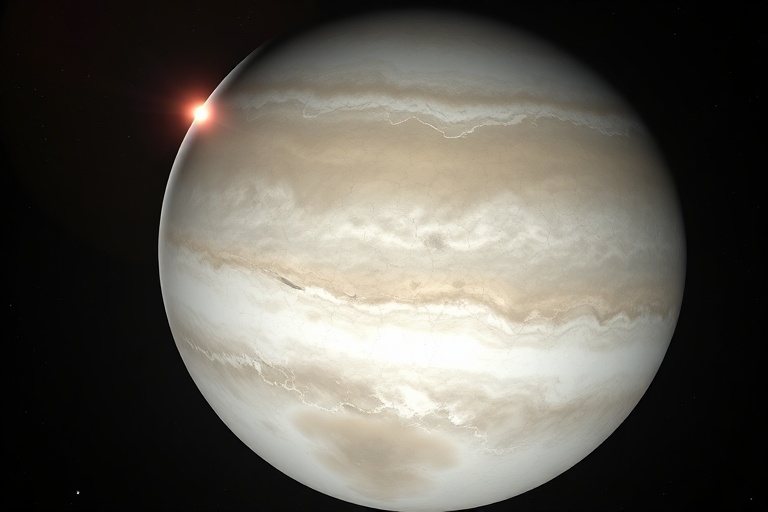
Europa: Jupiter’s Moon and the Search for Alien Life
“`html
Europa: The Moon That Holds the Keys to Life Beyond Earth
Europa, one of Jupiter’s four large moons, has long captivated astronomers and space enthusiasts alike. Discovered by Galileo Galilei in 1610, this icy world is now considered one of the most promising places in our solar system to search for extraterrestrial life. Its smooth, fractured surface hints at a dynamic interior, while evidence of a vast subsurface ocean fuels scientific curiosity. As space agencies like NASA and the European Space Agency (ESA) prepare ambitious missions to explore Europa, the moon’s potential to reshape our understanding of life in the universe grows ever more tangible.
The Science Behind Europa’s Hidden Ocean
Europa’s most intriguing feature is its global subsurface ocean, hidden beneath a thick layer of ice. Data from the Galileo spacecraft, which orbited Jupiter in the late 1990s, revealed that Europa’s magnetic field fluctuates in a way that suggests the presence of a conductive layer—likely a salty ocean—buried beneath the ice. Estimates place the ocean’s depth at around 60 to 100 miles, containing roughly twice the volume of all Earth’s oceans combined.
This ocean remains liquid due to tidal heating, a process driven by Jupiter’s immense gravitational pull. As Europa orbits the gas giant, the varying gravitational forces cause the moon’s interior to flex, generating heat that prevents the water from freezing solid. The surface ice, marked by dark streaks and cracks, may act as a window into this hidden world, with some plumes of water vapor erupting from beneath the ice—a phenomenon observed by the Hubble Space Telescope.
Why Europa Could Be the Best Place to Find Alien Life
The possibility of life on Europa centers on three key ingredients: liquid water, a source of energy, and the right chemical building blocks. Europa’s ocean meets all three requirements. Hydrothermal vents, similar to those on Earth’s ocean floor, could provide the energy and nutrients needed for microbial life to thrive. On Earth, these vents support entire ecosystems in complete darkness, raising the tantalizing prospect that Europa’s ocean might harbor similar life forms.
Scientists are particularly excited about the moon’s chemistry. Spectroscopic data from missions like Galileo and the James Webb Space Telescope have detected salts and organic compounds on Europa’s surface, possibly transported from the ocean below. These molecules, essential for life as we know it, suggest that Europa’s environment could be habitable—if not inhabited.
NASA’s upcoming Europa Clipper mission, set to launch in 2024, will conduct detailed reconnaissance of the moon’s surface and atmosphere. The spacecraft will carry instruments to analyze the composition of plumes, map the ice shell, and search for signs of habitability. Meanwhile, the ESA’s Jupiter Icy Moons Explorer (JUICE), already en route, will study Europa alongside two other Jovian moons, Ganymede and Callisto. Together, these missions could provide the first definitive evidence of life beyond Earth.
Cultural and Historical Significance of Europa
Europa’s influence extends beyond science into human culture and mythology. In Greek mythology, Europa was a Phoenician princess abducted by Zeus, who took the form of a white bull to win her trust. This mythological tale has inspired countless works of art, literature, and music, from Titian’s Renaissance paintings to modern operas. The name “Europa” itself evokes themes of exploration and discovery, making it a fitting moniker for a moon that could redefine our place in the cosmos.
In science fiction, Europa has been a recurring setting for stories about alien encounters and underwater civilizations. Arthur C. Clarke’s 2010: Odyssey Two famously featured a doomsday message to humanity: “All these worlds are yours except Europa. Attempt no landing there.” While Clarke’s warning was fictional, it underscored the moon’s enduring mystique. Today, Europa continues to inspire filmmakers, writers, and artists, cementing its status as a symbol of humanity’s quest to explore the unknown.
The Future of Europa Exploration
The next decade promises unprecedented opportunities to study Europa up close. NASA’s Europa Clipper will perform 45 close flybys of the moon, using radar to peer beneath the ice and spectrometers to analyze surface chemistry. The mission aims to answer critical questions: How thick is the ice shell? Are there active plumes? Could life exist in the ocean below?
Looking further ahead, concepts for a Europa lander are already in development. Such a mission would drill or melt through the ice to directly sample the ocean, a challenge that would push the boundaries of robotic exploration. The technical hurdles are immense—Europa’s harsh radiation environment, extreme cold, and unknown surface composition require innovative solutions. Yet the potential rewards—finding life, or at least the ingredients for it—make the effort worthwhile.
Beyond these robotic missions, Europa also sparks discussions about human exploration. While sending astronauts to Jupiter’s moon remains a distant dream, NASA’s Artemis program, which aims to return humans to the Moon, could serve as a stepping stone for deeper space missions. Establishing a lunar base might provide the experience and technology needed for eventual crewed missions to Europa.
Europa in the Broader Context of Space Exploration
Europa is not the only moon in our solar system with the potential to host life. Enceladus, a moon of Saturn, also boasts a subsurface ocean with active water plumes, while Titan, another of Saturn’s moons, has lakes of liquid methane and a thick atmosphere. However, Europa stands out due to its size, the sheer volume of its ocean, and the relative ease of studying it from orbit. Its proximity to Jupiter also makes it a more accessible target for missions constrained by fuel and time.
The study of Europa also intersects with broader questions about the prevalence of life in the universe. If life can exist in Europa’s extreme environment, it suggests that habitable conditions might be more common than previously thought. This could have profound implications for the search for extraterrestrial intelligence (SETI) and our understanding of planetary formation and evolution.
Moreover, Europa’s exploration highlights the importance of international collaboration in space science. Missions like JUICE and Europa Clipper involve contributions from scientists and engineers across the globe, demonstrating how space exploration can unite nations in pursuit of a common goal. As geopolitical tensions rise on Earth, the cooperative nature of space exploration offers a glimmer of hope for collective progress.
Conclusion: Why Europa Matters Now More Than Ever
Europa is more than just a moon—it is a beacon of possibility in our search for life beyond Earth. Its hidden ocean, dynamic surface, and rich chemical environment make it a prime candidate for discovering extraterrestrial life, even if that life is microbial. The upcoming missions to Europa will not only expand our scientific knowledge but also inspire a new generation of explorers, scientists, and dreamers.
As we stand on the brink of these groundbreaking discoveries, Europa reminds us that the universe is full of mysteries waiting to be unraveled. Whether life exists there or not, the pursuit of answers will push the boundaries of human ingenuity and curiosity. In the grand tapestry of space exploration, Europa is a thread that connects our past, present, and future—a symbol of our relentless drive to uncover the unknown.