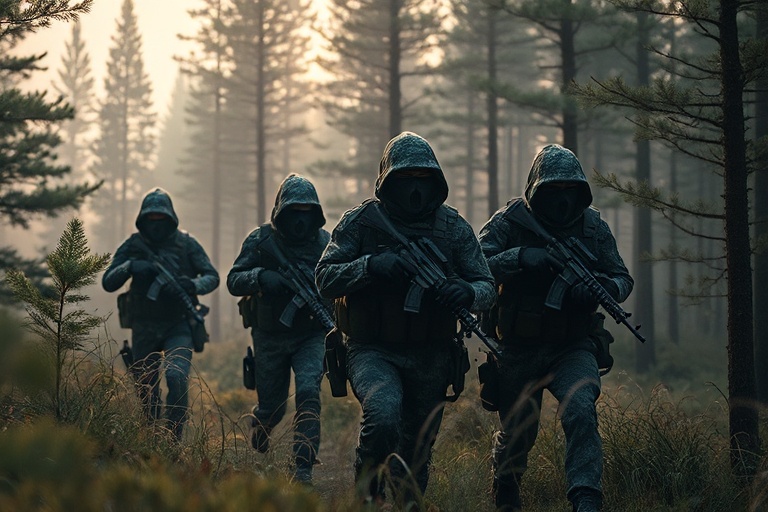
Ubisoft’s Ghost Recon Series: A Legacy of Tactical Precision and Evolving Gameplay
Since its debut in 2001, Ubisoft’s Tom Clancy’s Ghost Recon series has carved out a distinct niche in the tactical shooter genre. Blending realistic military simulation with accessible gameplay, the franchise has consistently pushed boundaries in both storytelling and player agency. Over two decades, it has evolved from a squad-based tactical experience to a sprawling, cinematic universe that explores modern warfare’s complexities.
The series’ enduring appeal lies in its commitment to authenticity. Drawing from real-world military tactics and cutting-edge weaponry, each installment immerses players in high-stakes scenarios that demand strategy over brute force. This balance of realism and entertainment has kept the franchise relevant amid a rapidly changing gaming landscape.
The Evolution of a Tactical Icon
The journey of Ghost Recon began with its first entry, released in 2001. Developed by Red Storm Entertainment and published by Ubisoft, the game introduced players to a near-future conflict where elite U.S. Army operatives—dubbed “Ghosts”—are deployed to thwart global threats. Its isometric perspective and emphasis on teamwork set it apart from contemporaries, emphasizing tactical positioning and coordinated assaults.
Subsequent titles expanded the series’ scope. Ghost Recon: Desert Siege (2002) and Island Thunder (2003) introduced dynamic campaigns and branching missions, while Ghost Recon 2 (2004) transitioned to a first-person perspective, aligning with industry trends. The franchise’s evolution continued with Ghost Recon: Advanced Warfighter (2006), which debuted a cinematic cover system and real-time squad management, earning critical acclaim for its innovation.
The series’ most significant transformation came with Ghost Recon Wildlands (2017) and Breakpoint (2019). These open-world entries shifted focus from linear missions to expansive Bolivian and Pacific island settings, respectively. While Wildlands emphasized cooperative play and emergent storytelling, Breakpoint introduced a persistent online world with RPG mechanics, reflecting Ubisoft’s shift toward live-service models.
- 2001: Original Ghost Recon launches, establishing the franchise’s tactical roots.
- 2006: Advanced Warfighter revolutionizes squad mechanics with real-time controls.
- 2017: Wildlands redefines the series with open-world freedom and co-op focus.
- 2019: Breakpoint experiments with live-service gameplay, sparking mixed reactions.
Gameplay Innovation and Player Agency
The Ghost Recon series has consistently prioritized player choice, whether through loadout customization, mission planning, or adaptive difficulty. Advanced Warfighter 2 (2007) refined this approach with its “Buddy System,” allowing players to issue real-time orders to squadmates—a feature that remains influential in tactical shooters today.
In Wildlands, Ubisoft embraced procedural generation, creating a dense, reactive world where players could approach objectives in multiple ways. The game’s emphasis on verticality and environmental storytelling rewarded exploration, fostering a sense of ownership over the player’s journey. However, Breakpoint’s transition to a loot-driven model alienated some fans, highlighting the risks of overhauling a franchise’s core identity.
Despite these shifts, the series’ commitment to tactical depth remains unwavering. Titles like Ghost Recon: Future Soldier (2012) introduced a cloaking system and drone warfare, pushing the boundaries of what a tactical shooter could simulate. These innovations not only enhanced gameplay but also reflected real-world military advancements, reinforcing the series’ reputation for authenticity.
Narrative and Thematic Depth
Beyond its mechanics, Ghost Recon has explored weighty themes, from geopolitical conflict to the ethics of modern warfare. The franchise’s storytelling often draws from Tom Clancy’s meticulous research, blending fact with fiction to create compelling narratives. Ghost Recon 2’s Korean Peninsula storyline, for instance, tackled Cold War tensions with surprising nuance for its time.
More recent entries have delved into cyber warfare and AI-driven combat. Breakpoint’s post-apocalyptic setting, while divisive, introduced themes of survival and technological collapse. Even in its most experimental phases, the series has maintained a focus on consequence—players’ actions often ripple through the narrative, shaping outcomes in ways that feel meaningful.
This thematic richness has allowed Ghost Recon to resonate with audiences beyond hardcore gamers. Its exploration of military ethics and global instability invites players to reflect on real-world issues, elevating it from mere entertainment to a medium for thoughtful discourse.
The Broader Implications of Ghost Recon
The franchise’s impact extends beyond gaming. Its realistic depiction of military operations has sparked discussions about the portrayal of soldiers in media, particularly in an era where first-person shooters often prioritize spectacle over authenticity. Ghost Recon’s attention to detail—from weapon mechanics to mission parameters—has set a benchmark for tactical shooters, influencing titles like Arma and Squad.
Ubisoft’s embrace of live-service models with Breakpoint also reflects broader industry trends. The shift toward ongoing content updates and monetization strategies has reshaped player expectations, for better or worse. While some fans appreciate the added depth, others lament the dilution of the series’ original focus on tactical precision.
Moreover, the Ghost Recon series has played a role in shaping Ubisoft’s reputation as a publisher willing to take risks. Its willingness to experiment—whether through open-world design or narrative experimentation—has paved the way for other franchises to explore uncharted territory. In an era where sequels and remakes dominate, Ghost Recon’s willingness to evolve stands out.
Looking Ahead: The Future of Ghost Recon
As the franchise enters its fourth decade, its future remains uncertain yet intriguing. Rumors of a new installment have circulated, with speculation about a return to tactical roots or a further embrace of live-service mechanics. Whatever direction Ubisoft chooses, the series’ legacy is secure—a testament to its ability to adapt while staying true to its core identity.
For players, the Ghost Recon series offers more than just adrenaline-fueled action. It provides a lens through which to examine modern warfare, strategic thinking, and the evolving nature of gaming itself. Whether revisiting classic titles or exploring its latest experiments, fans can expect a blend of challenge, innovation, and storytelling that few franchises can match.
The Ghosts may come and go, but their legacy endures.
Key Takeaways
- Authenticity Matters: The series’ commitment to realistic military tactics has set it apart in the tactical shooter genre.
- Evolution Over Revolution: From isometric views to open-world design, Ghost Recon has adapted without losing its identity.
- Narrative Depth: Themes of geopolitical conflict and ethical dilemmas add layers beyond pure gameplay.
- Industry Influence: The franchise has shaped both player expectations and Ubisoft’s approach to game design.
For more on tactical shooters and Ubisoft’s latest projects, visit our Gaming and Technology sections.