<!DOCTYPE html>
<html lang="en">
<head>
    <meta charset="UTF-8">
    <meta name="viewport" content="width=device-width, initial-scale=1.0">
    <title>Trump Orders Changes to Banking, Immigration Status Rules</title>
</head>
<body>
    <article>
        <h1>Trump’s New Executive Actions Target Banking Access and Immigration Status</h1>

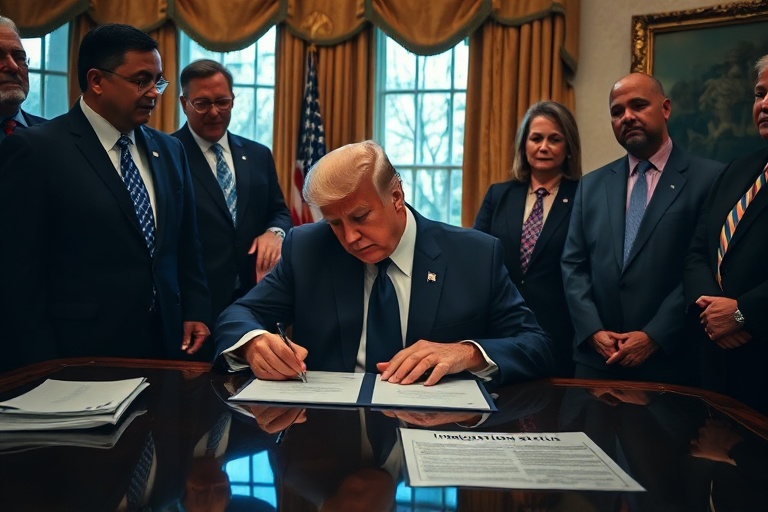
        <p>President Trump has signed a series of executive orders that reshape federal policies on banking regulations and immigration verification. The directives, unveiled last week, aim to tighten financial oversight while accelerating the review of non-citizens’ legal statuses. While framed as measures to enhance national security and economic stability, the orders have sparked immediate legal and political backlash.</p>

        <p>Critics argue the policies disproportionately burden immigrant communities and could destabilize local financial institutions. Supporters, however, contend the changes are necessary to curb fraud and ensure compliance with federal laws. The dual focus on banking and immigration reflects a broader strategy to assert executive authority in areas traditionally managed by Congress and independent agencies.</p>

        <h2>Breaking Down the Executive Orders</h2>

        <p>The first order directs federal agencies to review and potentially revise banking regulations that allow undocumented immigrants to access financial services. Specifically, it mandates that the Treasury Department and Federal Reserve assess whether current policies inadvertently facilitate illegal activities. The review must be completed within 90 days, with recommendations for stricter verification processes.</p>

        <p>The second order focuses on immigration status verification. It requires U.S. Citizenship and Immigration Services (USCIS) to expedite the adjudication of cases involving individuals suspected of visa overstays or fraudulent documentation. This includes prioritizing interviews and background checks for applicants from countries identified as high-risk for immigration violations.</p>

        <p>Additional provisions include:</p>

        <ul>
            <li><strong>Financial penalties:</strong> Banks found to be non-compliant with new verification requirements could face fines or loss of federal deposit insurance.</li>
            <li><strong>Data sharing:</strong> The order encourages collaboration between USCIS, the IRS, and state motor vehicle departments to cross-reference immigration and financial records.</li>
            <li><strong>Public disclosure:</strong> Agencies must publish quarterly reports on the number of cases reviewed and enforcement actions taken under the new policies.</li>
        </ul>

        <h2>Legal Challenges and Political Fallout</h2>

        <p>Within hours of the orders’ announcement, advocacy groups filed lawsuits in federal courts, challenging their legality. The American Civil Liberties Union (ACLU) argues that the banking provisions violate the Equal Credit Opportunity Act, which prohibits discrimination based on national origin. Meanwhile, immigrant rights organizations claim the immigration order violates due process by accelerating deportation proceedings without adequate judicial review.</p>

        <p>Legal experts are divided over the orders’ constitutionality. Some argue that the president has broad authority to enforce immigration laws, while others point to precedents limiting executive overreach in financial regulations. The Supreme Court’s recent rulings on administrative law could play a decisive role in determining the orders’ fate.</p>

        <p>Politically, the directives have deepened divisions between Republicans and Democrats. House Speaker Mike Johnson called the orders a “necessary step to protect American jobs and security,” while Senate Minority Leader Chuck Schumer condemned them as “a thinly veiled attack on immigrant communities.” The White House has defended the measures as a response to congressional inaction on both banking reform and immigration reform.</p>

        <h2>Broader Implications for Banking and Immigration Systems</h2>

        <p>The orders could have far-reaching consequences for both industries. For banks, the new verification requirements may increase operational costs and deter customers who lack traditional identification documents. Community banks and credit unions, which often serve immigrant populations, could face disproportionate burdens. The American Bankers Association has already warned that the policies could “undermine financial inclusion efforts.”</p>

        <p>In the immigration system, the accelerated review process risks overwhelming USCIS, which already faces a backlog of over 10 million pending cases. Critics warn that rushed adjudications could lead to higher error rates and wrongful deportations. Meanwhile, immigrant advocates fear the orders will create a chilling effect, discouraging eligible applicants from pursuing legal status due to fear of scrutiny or retaliation.</p>

        <p>Economically, the policies may disrupt labor markets dependent on immigrant workers, particularly in sectors like agriculture, healthcare, and hospitality. Analysts at the libertarian Cato Institute estimate that stricter immigration enforcement could reduce GDP growth by 0.5% annually. On the banking side, reduced access to financial services for undocumented immigrants could push more transactions into the informal economy, complicating tax collection and anti-money laundering efforts.</p>

        <h2>What’s Next? Compliance and Consequences</h2>

        <p>Federal agencies have begun drafting implementation guidelines, but the process is expected to be contentious. Banks will need to update their compliance systems to meet new verification standards, while immigration attorneys brace for potential delays and increased scrutiny of their clients’ cases. For immigrants, the orders underscore the importance of maintaining up-to-date documentation and seeking legal counsel when navigating the complex U.S. immigration system.</p>

        <p>The orders also raise questions about enforcement priorities. Will the government focus on recent arrivals or target long-term residents with tenuous legal status? How will local law enforcement agencies, many of which rely on federal funding, balance compliance with community trust? These uncertainties are likely to linger until courts rule on the orders’ legality or Congress intervenes with clarifying legislation.</p>

        <p>One thing is clear: the executive actions have intensified an already heated debate over the intersection of economic policy and immigration. Whether they achieve their stated goals—or merely exacerbate existing tensions—will depend largely on how they are implemented and challenged in the coming months.</p>
    </article>

    <!-- Related content links -->
    <section>
        <p>For more analysis on policy shifts affecting financial institutions, visit our <a href="https://www.daveslocker.net/finance">Finance section</a>. To explore ongoing debates about immigration reform, check out our <a href="https://www.daveslocker.net/politics">Politics category</a>.</p>
    </section>

    <!-- Metadata -->