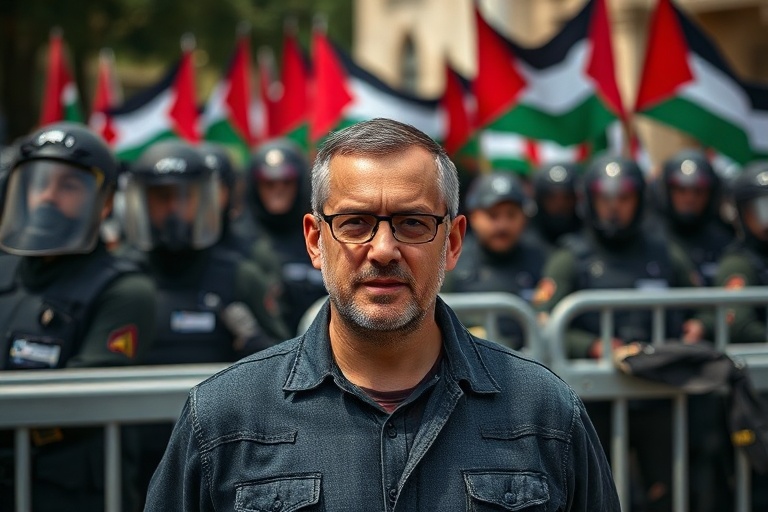
Itamar Ben-Gvir: The Far-Right Figure Reshaping Israeli Politics
“`html
Who Is Itamar Ben-Gvir?
Itamar Ben-Gvir is one of the most polarizing figures in Israeli politics today. A lawyer by training, he has spent years at the center of controversies surrounding far-right activism, security policies, and the Israeli-Palestinian conflict. Born in 1976 in Mevaseret Zion, near Jerusalem, Ben-Gvir’s political journey reflects broader shifts in Israeli society—toward nationalism, religious Zionism, and skepticism of peace processes. His rise from fringe activist to cabinet minister in Benjamin Netanyahu’s government has drawn international attention, especially from those who view his policies as provocative or destabilizing.
Ben-Gvir first gained notoriety in the late 1990s and early 2000s as a teenager and young adult associated with the far-right Kahanist movement. He was convicted in 2007 for incitement to racism and supporting a terrorist organization after displaying a portrait of Baruch Goldstein, who massacred 29 Palestinians in Hebron in 1994. Despite this background, he rebranded himself as a mainstream politician, leveraging social media and populist rhetoric to build a base among religious and nationalist voters.
A Political Career Built on Controversy
Ben-Gvir’s political career began in earnest with his leadership of the Otzma Yehudit (Jewish Power) party, which merged with other right-wing factions ahead of the 2022 elections. His platform emphasizes Jewish sovereignty, opposition to Palestinian statehood, and a hardline stance on security. He has been a vocal critic of Israel’s Supreme Court, calling for judicial reforms that critics argue threaten democratic checks and balances. His rhetoric often targets Arab citizens of Israel, whom he has accused of being a “fifth column,” and he has been filmed multiple times in confrontations with police and Palestinians.
In December 2022, Ben-Gvir was appointed Minister of National Security, a newly expanded role that gave him oversight of the Israel Police and other security agencies. His appointment was met with alarm by human rights groups and foreign governments, particularly in Europe and the United States, where his past statements and activism raised concerns about his commitment to democratic values and minority rights. Supporters, however, praised him as a defender of Jewish interests and a bulwark against rising crime in mixed cities.
Key Policy Positions
Ben-Gvir’s agenda is defined by several core principles:
- Expansion of settlements: He advocates for accelerated construction in the West Bank, dismissing international criticism as hypocritical.
- Opposition to Palestinian statehood: He rejects the two-state solution, arguing that any Palestinian state would threaten Israel’s security.
- Judicial reform: He supports weakening the judiciary’s power to overrule government decisions, framing it as a correction to judicial overreach.
- Crackdown on Arab citizens: He has called for revoking the citizenship of Arab Israelis who, in his view, pose a security threat.
- Police and security control: As National Security Minister, he has pushed for greater police powers, including the use of live fire in certain situations.
These positions have made him a hero to some and a villain to others. In Israel, his popularity reflects a growing disillusionment with traditional political elites and a belief that security concerns outweigh liberal democratic norms. Internationally, his rise has been scrutinized through the lens of rising global populism, where nationalist leaders often challenge liberal internationalism and human rights frameworks.
Global Reactions and Cultural Context
Ben-Gvir’s influence extends beyond Israel’s borders. In the United States, his policies and rhetoric have drawn comparisons to far-right movements in Europe and the U.S., where nationalism and anti-immigrant sentiment are on the rise. The Biden administration, for example, has expressed concern about his role in the government, particularly regarding settlement expansion and treatment of Palestinian citizens of Israel. European Union officials have also criticized his appointment, citing his past and the potential for increased tensions in the region.
In the Middle East, Ben-Gvir’s rise has been met with widespread condemnation. Palestinian leaders, including those in the West Bank and Gaza, view him as a symbol of oppression. Arab states that have normalized relations with Israel, such as the United Arab Emirates and Bahrain, have remained publicly silent on his appointment, focusing instead on broader geopolitical interests. Meanwhile, Iran and other regional rivals have used his rhetoric to rally opposition to Israel, framing it as evidence of Israeli extremism.
Culturally, Ben-Gvir represents a generational shift in Israeli politics. Younger voters, particularly in religious Zionist communities, see him as a leader who speaks their language—a mix of religious fervor, nationalist pride, and skepticism of the establishment. His use of social media, including TikTok and Telegram, has allowed him to bypass traditional media gatekeepers and connect directly with constituents. This approach mirrors strategies used by populist leaders worldwide, from Donald Trump in the U.S. to Marine Le Pen in France.
The Future of Ben-Gvir and Israeli Politics
The question now is what lies ahead for Ben-Gvir and the broader political landscape in Israel. His tenure as National Security Minister has already seen significant changes, including a rise in police raids in Arab communities and a more aggressive posture toward left-wing protesters. Critics warn that his policies could further entrench divisions within Israeli society and undermine efforts to achieve long-term peace with the Palestinians.
Supporters, however, argue that his policies are necessary to address real security threats and restore law and order. They point to rising crime rates in Arab towns and the perceived weakness of previous governments in confronting Palestinian militant groups. For Ben-Gvir, the goal is clear: to reshape Israel in the image of a Jewish, nationalist state, where security and sovereignty take precedence over liberal ideals.
As Israel navigates these turbulent times, Ben-Gvir’s role will likely continue to draw scrutiny. His ability to maintain influence will depend on several factors: the stability of Netanyahu’s coalition, the outcome of ongoing judicial reforms, and the broader geopolitical environment. One thing is certain—his rise reflects deeper currents in Israeli society and the global political landscape, where nationalism, identity, and security are increasingly defining the conversation.
For those interested in exploring similar themes, consider reading about the evolution of right-wing movements in other democracies or the cultural dimensions of nationalism in modern societies.
Ben-Gvir’s story is far from over. Whether he becomes a footnote in Israel’s history or a transformative figure will depend on the choices he makes in the years to come—and the reactions they provoke.