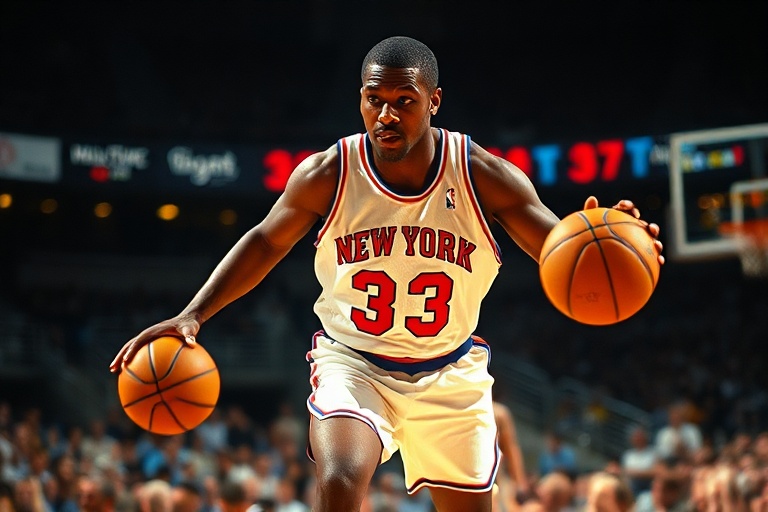
Few athletes leave a legacy as enduring as Patrick Ewing. Drafted first overall by the New York Knicks in 1985, Ewing became the face of a franchise and a symbol of resilience in professional basketball. His 15-year tenure in New York transformed him from a college sensation at Georgetown into one of the most respected big men in NBA history.
Ewing’s impact extended beyond statistics. He embodied the physicality and intensity of 1990s basketball, a time when post players dominated with sheer force and grit. While championships eluded him during his playing days, his leadership and consistency cemented his place in Knicks lore. Even after retiring, Ewing remained tied to the team as a coach and ambassador, ensuring his influence persisted long after his final buzzer.
From Georgetown to the Garden: The Making of a Knicks Icon
Ewing’s journey to Madison Square Garden began in Cambridge, Massachusetts, where he starred at Rindge & Latin School before dominating at Georgetown under coach John Thompson. His college career was defined by physical dominance, culminating in two NCAA championship appearances and a reputation as one of the most unstoppable forces in the sport.
The Knicks selected him with the first pick in the 1985 NBA Draft, a decision that would shape the franchise for years. Early struggles in the NBA—including a rookie season marred by injuries—tempered expectations. Yet, by the late 1980s, Ewing had evolved into a two-way anchor, combining a 7-foot frame with surprising agility and a relentless work ethic.
- Defensive Anchor: Ewing averaged 2.2 blocks per game over his career, altering countless shots with his shot-blocking prowess.
- Scoring Consistency: He averaged 21 points per game over 15 seasons, proving durable even as injuries began to accumulate.
- Leadership Presence: His no-nonsense demeanor set the tone for the Knicks’ physical, defensive-minded identity.
His battles with Larry Bird, Michael Jordan, and Hakeem Olajuwon in the 1990s became legendary, showcasing his ability to match up against the era’s greatest players. While championships remained elusive, Ewing’s performances in the playoffs—including a 1994 Eastern Conference Finals run—solidified his status as a warrior of the game.
The 1990s Knicks: A Team Built on Grit and Grind
The Knicks of the early and mid-1990s were a reflection of Ewing’s persona: tough, disciplined, and unapologetically physical. Coached by Pat Riley, the team became synonymous with defensive intensity, ranking among the league’s best in points allowed. Ewing’s partnership with center Charles Oakley and forward Charles Smith formed the backbone of a unit that thrived on hustle and effort.
Though they never reached the NBA Finals during Ewing’s prime, the 1994 squad came closer than any other, pushing the Houston Rockets to seven games in the Finals. Ewing’s playoff performances were legendary, including a 24-point, 22-rebound Game 7 masterpiece against the Bulls in 1990. His ability to rise to the occasion in high-pressure moments defined his career.
The era also saw Ewing’s rivalry with Shaquille O’Neal escalate during the 1990s, as the younger center’s dominance began to overshadow Ewing’s prime. Yet, even as the game evolved, Ewing refused to fade quietly. His 1999 playoff run, at age 36, proved he could still dominate against younger competition, averaging 20 points and 10 rebounds per game in a first-round series against the Miami Heat.
Beyond the Court: Ewing’s Lasting Influence on the Knicks
Ewing’s contributions to the Knicks extended far beyond his playing days. After retiring in 2002, he transitioned seamlessly into coaching, serving as an assistant under Jeff Van Gundy and later Don Nelson. His basketball IQ and communication skills made him a valued mentor to younger players.
In 2017, the Knicks hired Ewing as their head coach, reuniting him with the franchise that defined his legacy. Though his tenure lasted only two seasons, his presence reinforced the importance of accountability and effort in player development. His coaching philosophy mirrored his playing style: hard work trumps raw talent.
Ewing’s impact on the organization was also felt off the court. As a global ambassador for the Knicks, he represented the team with class and professionalism, embodying the values of New York basketball. His jersey retirement in 2003 cemented his place in franchise history, ensuring that future generations of Knicks fans would recognize his name.
Legacy and Lessons from a Knicks Legend
Patrick Ewing’s career offers more than just nostalgia. It serves as a blueprint for longevity, resilience, and leadership in professional sports. His ability to remain relevant for two decades—despite injuries and evolving competition—speaks to his dedication to the game.
For aspiring athletes, Ewing’s journey underscores the importance of adaptability. While he was never the most athletic center of his era, his footwork, positioning, and basketball IQ allowed him to compete at an elite level. His post-play was a masterclass in fundamentals, proving that technique could outweigh raw athleticism.
Ewing’s legacy also highlights the pressures of playing in New York. The city’s expectations are unrelenting, and the media scrutiny is constant. Yet, he navigated fame with grace, maintaining his composure even in the face of criticism. His career is a reminder that success isn’t solely measured in championships but in the respect earned through effort and consistency.
As the Knicks continue to rebuild, Ewing’s influence remains palpable. His name is synonymous with the franchise’s identity, and his contributions to the game are enshrined in the Basketball Hall of Fame. For fans who grew up watching him, Ewing isn’t just a player—he’s a symbol of what it means to wear the orange and blue with pride.
Learn more about the history of the New York Knicks and the evolution of NBA legends on Dave’s Locker.