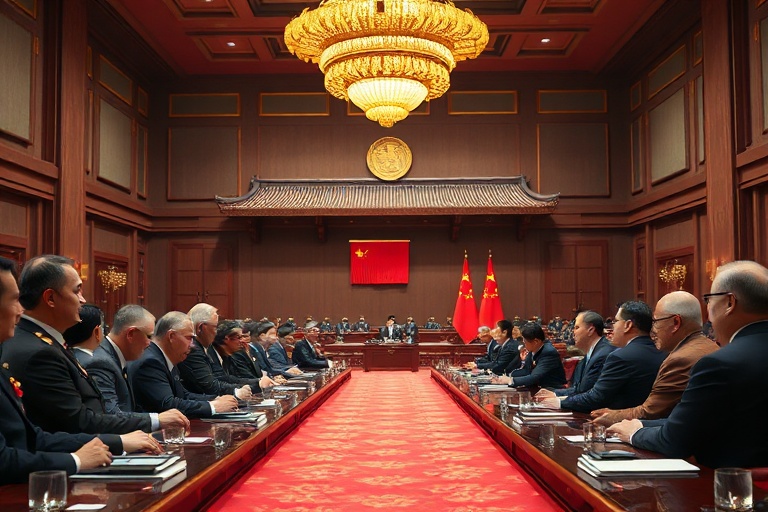
Putin’s China Visit: A Strategic Alliance Shaping Global Geopolitics
“`html
Putin’s Visit to China Reinforces a Strategic Partnership Amid Global Shifts
Russian President Vladimir Putin’s recent visit to Beijing underscored the deepening ties between Moscow and Beijing, highlighting a partnership that extends beyond economics into geopolitical alignment. The two-day state visit, marked by high-level meetings and ceremonial gestures, sent a clear signal to the international community about the durability of their alliance. Against the backdrop of Western sanctions and rising tensions with NATO, this meeting served as a platform for both leaders to reaffirm mutual support and outline future cooperation.
The timing of Putin’s trip was deliberate, coinciding with escalating hostilities in Ukraine and growing concerns about China’s global ambitions. For Beijing, the visit was an opportunity to project stability and strengthen its diplomatic leverage, particularly in regions where Western influence has waned. The carefully orchestrated events, including a state dinner and joint press conference, emphasized unity rather than division, setting the stage for deeper collaboration in trade, technology, and security.
The Economic and Diplomatic Dimensions of the Visit
The discussions between Putin and Chinese President Xi Jinping focused on several key areas, with economic cooperation taking center stage. Trade between the two nations has surged in recent years, reaching record levels despite global disruptions. Both leaders emphasized their commitment to expanding bilateral trade, with a particular focus on energy, agriculture, and infrastructure projects. China’s role as a major importer of Russian oil and gas has become even more critical amid sanctions, providing Moscow with a lifeline in an increasingly isolated economic landscape.
A joint statement released after the meetings outlined a series of agreements, including:
- Increased investment in cross-border infrastructure, such as rail and pipeline projects.
- Collaboration on advanced technologies, including artificial intelligence and quantum computing.
- Joint efforts to promote a multipolar global order, countering what they perceive as unilateral dominance by Western powers.
- Enhanced cultural and educational exchanges to foster long-term people-to-people ties.
The economic dimension of the visit cannot be overstated. China has become Russia’s largest trading partner, accounting for nearly 20% of its total trade volume. This interdependence has allowed Moscow to mitigate the impact of sanctions imposed by the United States and the European Union. For Beijing, the partnership offers access to Russian resources, including oil, gas, and minerals, which are essential for its industrial and technological growth. The visit also highlighted China’s role as a mediator in global affairs, positioning itself as an alternative to Western-led institutions.
Geopolitical Implications: A Counterbalance to Western Influence
The Putin-Xi meeting took place against the backdrop of a rapidly evolving global order. The war in Ukraine has strained relations between Russia and the West, while China’s assertive foreign policy has drawn criticism from Washington and its allies. The two leaders framed their discussions as a defense of sovereignty and territorial integrity, a narrative that resonates in many parts of the Global South. By positioning their partnership as a bulwark against Western hegemony, they sought to rally support from nations skeptical of U.S. dominance.
The joint statement issued after the visit included strong language condemning what they described as “interference in internal affairs” by external powers. This was widely interpreted as a veiled critique of NATO’s expansion and Western military alliances. The leaders also reaffirmed their commitment to the principles of the United Nations Charter, including non-interference and respect for sovereignty—principles often invoked by authoritarian regimes to justify their actions.
The geopolitical implications of the visit extend beyond rhetoric. China’s growing influence in Central Asia, a region traditionally within Russia’s sphere of influence, has raised eyebrows in Moscow. However, the visit demonstrated a willingness to compartmentalize differences in favor of strategic alignment. Both leaders emphasized the importance of stability in the region, particularly in light of recent conflicts and economic instability. By presenting a united front, they sought to reassure their respective populations and international observers that their partnership remains robust.
Cultural and Historical Context: A Relationship Built on Shared Interests
The relationship between Russia and China is rooted in a complex history of cooperation and competition. While the two nations were ideological adversaries during the Cold War, their shared interest in countering Western influence has brought them closer in recent decades. The visit provided an opportunity to highlight this evolving dynamic, with both leaders emphasizing the importance of cultural and historical ties.
One notable aspect of the visit was the emphasis on people-to-people exchanges. Cultural events, including performances and exhibitions, were organized to showcase the richness of both societies. These gestures were not merely symbolic; they reflect a broader strategy to foster long-term goodwill and mutual understanding. By promoting educational exchanges and tourism, the leaders aim to create a foundation for deeper collaboration in the years to come.
The historical context of the relationship also played a role in shaping the narrative of the visit. Both nations have long viewed themselves as civilizational states with unique cultural identities. By emphasizing their shared heritage, Putin and Xi sought to present their partnership as a natural alignment of interests rather than a temporary tactical alliance. This framing resonates with audiences in both countries, where pride in national identity remains a powerful force.
Looking Ahead: The Future of Russia-China Relations
The outcomes of Putin’s visit to China extend beyond the immediate agreements reached during the meetings. The visit served as a reminder of the resilience of the Russia-China partnership, which has weathered numerous challenges over the years. As global tensions continue to rise, the alliance between Moscow and Beijing is poised to play an increasingly important role in shaping the international order.
For observers in the West, the visit underscores the limitations of sanctions and diplomatic isolation as tools of foreign policy. Despite Western efforts to isolate Russia, Moscow has found a willing partner in Beijing, one that shares its skepticism of U.S. global dominance. This dynamic is likely to persist as long as both nations perceive their interests to be aligned.
The cultural and economic exchanges agreed upon during the visit will also have long-term implications. By fostering greater connectivity between their societies, Putin and Xi are laying the groundwork for a relationship that transcends mere political expediency. Whether this partnership will evolve into a true alliance remains to be seen, but the signals sent during the visit suggest a commitment to deepening ties for years to come.
As the world watches the evolving dynamics between Russia and China, one thing is clear: their partnership is more than a temporary alignment of interests. It is a reflection of a broader shift in global power structures, one that challenges the dominance of Western-led institutions. The visit to Beijing was not just about economics or geopolitics; it was a statement about the future of international relations.