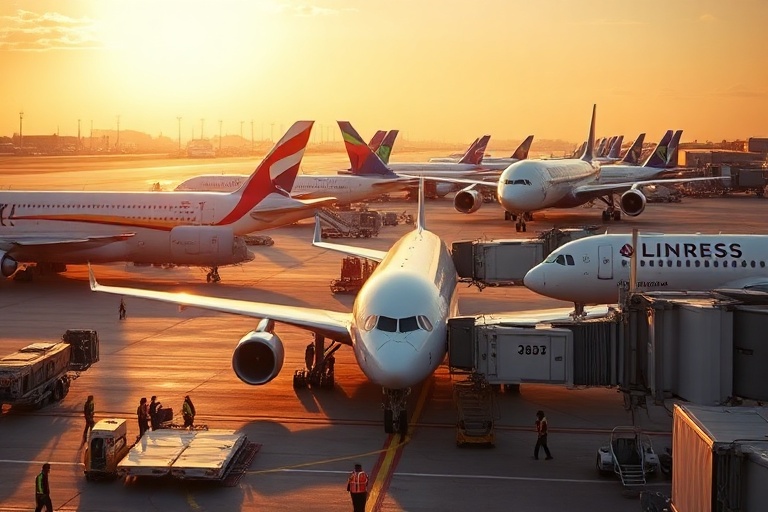
<h2>Global Airlines: The Threads That Bind Continents and Cultures</h2>

<p>The airline industry is more than a network of runways and terminals. It is a living infrastructure that stitches together economies, cultures, and personal stories across every continent except Antarctica. In 2024, global airlines transported over 4.7 billion passengers—nearly the entire population of Earth—while carrying 64 million tons of cargo, making aviation the backbone of modern globalization.</p>

<p>Unlike buses or trains, airplanes do not respect borders. They traverse time zones, legal systems, and cultural expectations in a matter of hours. This unprecedented mobility has reshaped how we understand distance, identity, and opportunity. Whether a student flying from Lagos to Lisbon, a musician touring Tokyo and Toronto, or a family reuniting across continents, the global airline network is the silent partner in countless human journeys.</p>

<h3>The Rise of the Global Aviation Ecosystem</h3>

<p>The foundations of today’s global airline system were laid in the mid-20th century. The Chicago Convention of 1944 established the rules of international air travel, including the five freedoms of the air—rights that allow airlines to fly over, land in, and carry passengers between foreign countries. These agreements created the legal scaffolding for a truly global industry.</p>

<p>By the 1970s, deregulation in the United States and Europe unleashed competition. New airlines emerged, and hubs like Atlanta, Dubai, and Singapore transformed into global gateways. Today, the top 20 airlines—spanning from American Airlines to Qatar Airways—carry nearly half of all passenger traffic. They operate under different models: legacy carriers with deep historical roots, low-cost carriers democratizing access, and state-backed giants shaping national ambition.</p>

<p>This diversity reflects broader geopolitical realities. Airlines are not just transportation companies; they are instruments of soft power. Emirates, for instance, has turned Dubai International into a cultural crossroads, while Singapore Airlines is synonymous with luxury and efficiency. Even in times of tension—such as the recent sanctions affecting Russian airlines—the industry adapts, rerouting flights and redefining networks.</p>

<h3>Cultural Crossroads in the Sky</h3>

<p>Air travel has become a stage for cultural exchange, sometimes subtle, sometimes transformative. Consider the rise of “aviation cuisine.” Airlines serve over 1.8 billion meals annually, blending local flavors with global expectations. Singapore Airlines’ “Book the Cook” program offers regional specialties from Singapore to Stockholm. Meanwhile, Air France’s in-flight meals reflect French culinary philosophy, turning a three-hour flight into a mini-gastronomic tour.</p>

<p>But culture is not just on the menu. It lives in the way passengers interact—or avoid interaction. In East Asia, quiet cabins and respectful seating etiquette reflect Confucian values. In the Middle East, hospitality extends even at 35,000 feet, with generous hospitality lounges and multi-course meals. In the United States, airlines emphasize efficiency and personal space, often at the cost of human connection.</p>

<p>These differences are not superficial. They reveal how air travel adapts to local norms. For example, women-only sections on some Middle Eastern airlines respond to cultural and religious practices. Meanwhile, airlines like Emirates and Qatar Airways train cabin crew in intercultural communication, ensuring that a passenger from Tokyo feels at home in a Dubai layover.</p>

<h3>The Environmental Equation: Progress Amid Pressure</h3>

<p>No discussion of global airlines can ignore the environmental cost. Aviation contributes about 2.5% of global CO₂ emissions. While this is less than shipping or road transport, the growth of air travel—projected to double by 2050—makes sustainability a defining challenge.</p>

<p>In response, the industry has committed to net-zero carbon emissions by 2050. This goal hinges on several strategies:</p>

<ul>
  <li><strong>Sustainable Aviation Fuel (SAF):</strong> Made from waste oils or algae, SAF can cut emissions by up to 80%. Airlines like United and Finnair have pledged to use 100% SAF on select routes by 2030.</li>
  <li><strong>Fleet Renewal:</strong> New aircraft like the Airbus A350 and Boeing 787 are 20–25% more fuel-efficient than their predecessors. Electric and hydrogen-powered planes are in development but remain years away from commercial use.</li>
  <li><strong>Operational Efficiency:</strong> Airlines optimize routes, reduce weight, and use AI to minimize fuel burn. For example, Air Canada’s AI-driven flight planning saved over 100,000 tons of CO₂ in 2023.</li>
  <li><strong>Carbon Offsetting:</strong> Programs like IATA’s Carbon Offset Program allow passengers to fund reforestation or renewable energy projects. Though controversial, they provide a bridge to deeper decarbonization.</li>
</ul>

<p>Yet skepticism persists. Critics argue that offsetting is a form of greenwashing and that true sustainability requires systemic change. The tension between growth and responsibility remains unresolved, but the conversation itself is evolving. Airlines are now publishing detailed sustainability reports, and passengers increasingly choose carriers based on environmental performance.</p>

<h3>The Future: Connectivity, Competition, and Crisis</h3>

<p>The next decade will test the resilience of global airlines. Several trends are converging:</p>

<ol>
  <li><strong>Digital Transformation:</strong> From biometric boarding to AI-driven customer service, technology is redefining the passenger experience. Airlines like Delta and Lufthansa are piloting facial recognition systems that can process a flight in under 20 minutes.</li>
  <li><strong>Market Consolidation:</strong> Mergers and alliances—such as the proposed merger between JetBlue and Spirit—are reshaping competition. The “Big Three” U.S. alliances (Star, SkyTeam, Oneworld) now control over 60% of global traffic.</li>
  <li><strong>Geopolitical Fragmentation:</strong> Rising tensions between the U.S. and China, sanctions on Russia, and Brexit have disrupted traditional routes. Airlines are rerouting flights through neutral hubs like Istanbul or Dubai, transforming them into new power centers.</li>
  <li><strong>Labor and Equity:</strong> Pilots and crew shortages are straining operations. Meanwhile, airlines face pressure to improve diversity. In 2023, only 5.4% of airline pilots worldwide were women, prompting initiatives like “Women in Aviation International” to mentor the next generation.</li>
</ol>

<p>Crisis response remains a core competency. During the COVID-19 pandemic, airlines transformed into cargo carriers overnight, flying medical supplies and vaccines globally. They adapted to border closures, quarantine rules, and vaccine mandates with remarkable agility. This resilience underscores a paradox: airlines are fragile yet indispensable.</p>

<h3>A Shared Horizon</h3>

<p>Global airlines connect more than cities—they connect aspirations. A farmer in Kenya can export produce to Europe overnight. A musician in Brazil can perform in Japan within 24 hours. A refugee can seek safety across continents. These journeys are not just about movement; they are about possibility.</p>

<p>Yet the industry faces an existential question: Can it grow without destroying the planet it connects? Can it remain affordable without compromising safety or labor standards? The answers will be written not just in boardrooms, but in the skies above us, where millions of passengers each day look out the window and see the world shrink—and the future unfold.</p>

<p>One thing is certain: the story of global airlines is far from over. It is a story of human ambition, cultural exchange, and the unrelenting drive to overcome distance. And as long as there are skies to cross, there will be airlines to carry us there.</p>

---

<!-- Metadata -->