International Darts Open Riesa: How a German City Became a Darting Hotspot
“`html
Global Stage Set as International Darts Open Riesa Returns
The International Darts Open Riesa, now in its sixth year, has quietly become one of the most anticipated events on the darting calendar. Held annually in the eastern German city of Riesa, this tournament brings together players from over 20 countries, transforming a modest sports hall into a vibrant stage for precision, pressure, and performance.
Riesa itself is not a city one would immediately associate with major sporting events. Located in Saxony, it was once a center of East German industry, known for steelworks and textiles. Today, the city of around 30,000 people hosts one of the few professional darts tournaments in continental Europe outside the United Kingdom. It’s a reminder that darts has evolved into a truly international sport, transcending its pub-based origins.
From Local Pub to Global Platform
Darts has deep roots in British pub culture, where the game was a social ritual as much as a competitive sport. Yet over the past two decades, the sport has undergone a quiet revolution. Professional tours have expanded, prize money has increased, and international audiences have grown—thanks in part to television broadcasts and streaming services.
The International Darts Open Riesa embodies this transformation. Organized by the German Darts Federation in cooperation with the Professional Darts Corporation, the event attracts both established stars and rising talents. Players like Germany’s own Martin Schindler and Austria’s Rowby-John Rodriguez have used Riesa as a springboard to higher rankings. Meanwhile, veterans such as Raymond van Barneveld and Gary Anderson have graced the stage, lending credibility and excitement.
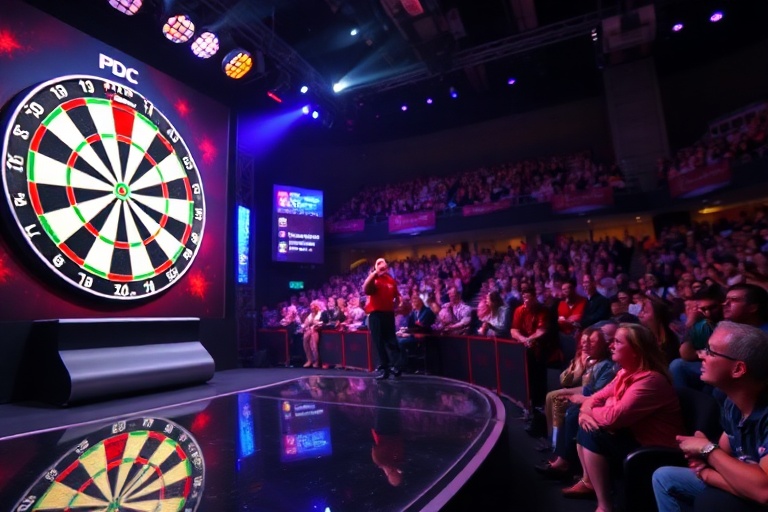
What makes the Riesa event distinctive is its accessibility. Unlike the larger PDC World Darts Championship in London, Riesa offers fans a chance to see top players up close, in an intimate setting that emphasizes the human drama of the sport. The arena’s compact design means that spectators can feel the tension in the air as a player steps up to throw a crucial double.
A Cultural Crossroads in a Changing Europe
Riesa’s location in eastern Germany adds another layer of significance to the International Darts Open. After reunification in 1990, many eastern German cities struggled with economic decline and population loss. Yet events like this help reposition Riesa as a cultural and sporting hub. The tournament draws visitors from across Europe, boosting local hotels, restaurants, and tourism.
This shift reflects a broader trend. Sports events are increasingly used as tools for regional revitalization, especially in areas where traditional industries have faded. In 2022, the tournament attracted over 3,500 spectators, a record for the event. Many were from neighboring Poland, the Czech Republic, or even as far as the Netherlands and Scandinavia—underscoring darts’ growing appeal beyond the UK.
The international flavor of the event is also reflected in the player roster. The PDC’s global expansion has brought new talent from Australia, Japan, the United States, and Eastern Europe. Players such as Fallon Sherrock, who made history as the first woman to win a match at the PDC World Championship, have competed in Riesa, challenging stereotypes and inspiring a new generation.
What to Expect at the Tournament
The International Darts Open Riesa is structured as a European Tour event, part of the PDC’s secondary circuit that offers ranking points and prize money. The format is straightforward but high-pressure: a knockout tournament over two days, culminating in a best-of-19-legs final.
One of the unique aspects of the event is its accessibility to fans. Unlike some larger darts events where tickets sell out months in advance, Riesa often makes last-minute tickets available online. This openness reflects the tournament’s community-focused ethos. Local schools and clubs are invited to watch, and young players are encouraged to attend, sometimes even getting the chance to meet professionals during practice sessions.
For those attending, the atmosphere is part sporting event, part festival. There’s live music, food stalls serving regional specialties like Saxon sausages and beer from local breweries, and even darts-themed merchandise. It’s a celebration of the sport’s culture—not just the competition.
The prize fund, now approaching €100,000, is a far cry from the multi-million-pound World Championship, but it’s substantial enough to attract top-tier talent. Winners earn not only money but valuable ranking points that can secure them a spot in major tournaments later in the year.
Looking Ahead: The Future of Darts in Europe
The success of the International Darts Open Riesa suggests that darts is on a steady upward trajectory in Europe. The PDC has already expanded its European Tour schedule, with events now held in Germany, Austria, Belgium, the Netherlands, and Spain. This growth is part of a deliberate strategy to break free from the sport’s historical reliance on the UK market.
Yet challenges remain. Darts still struggles with perceptions of being a “niche” sport, and media coverage outside the UK is limited. But the rise of streaming platforms like YouTube and Twitch, along with social media engagement, has begun to change that. The International Darts Open Riesa benefits from this shift, as highlights and player interviews are shared widely online, reaching millions.
Looking forward, the tournament organizers are exploring ways to increase its global profile. Ideas include expanding the international commentary team, offering more multilingual broadcasts, and even introducing a women’s exhibition match alongside the main event. These steps could help solidify Riesa’s role as a key fixture on the darts calendar.
For now, the International Darts Open Riesa remains a testament to what can happen when a traditional game meets modern ambition. It’s a story of how sport can bring people together across borders, languages, and cultures—one throw at a time.
As the darts world continues to evolve, events like this one remind us that great sporting moments aren’t always found in the biggest stadiums or under the brightest lights. Sometimes, they’re discovered in the quiet corners of a city like Riesa, where passion and precision collide.
For fans of darts—or anyone curious about the sport’s global growth—this is an event worth watching. And with each passing year, the International Darts Open Riesa is writing a new chapter in the story of darts as a truly international sport.