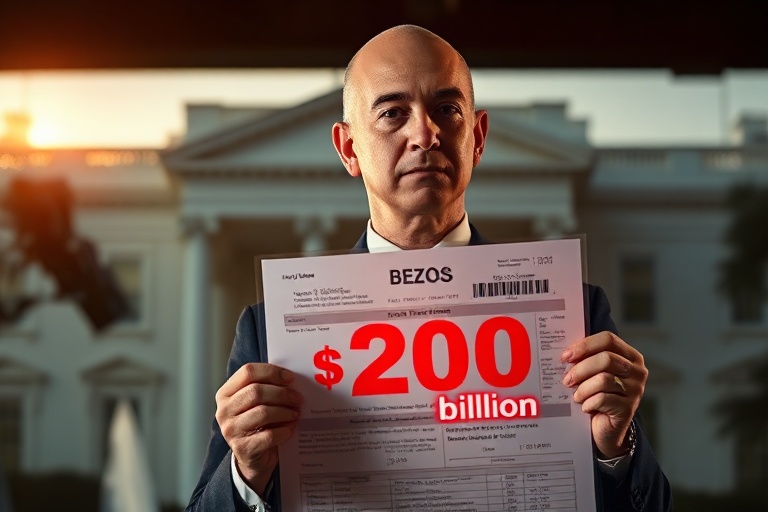
Jeff Bezos, the founder of Amazon and one of the wealthiest individuals in the world, has recently proposed a new tax framework that has sparked significant debate among economists, policymakers, and the public. His proposal, which suggests a wealth tax on the ultra-rich, aims to address growing income inequality and fund social programs. While some view it as a progressive step toward economic fairness, others argue it could stifle innovation and investment.
What Does Bezos’ Tax Proposal Entail?
Bezos’ proposal centers on a 1% annual wealth tax on individuals with a net worth exceeding $500 million. This tax would apply to assets such as stocks, real estate, and other investments, not just income. The revenue generated would be directed toward education, healthcare, and infrastructure improvements. Bezos has framed this as a way to ensure that the wealthiest Americans contribute more to society while maintaining economic growth.
Critics argue that such a tax could lead to capital flight, where wealthy individuals move their assets or themselves to countries with lower tax burdens. Others point out that wealth taxes have been tried in other countries, such as France and Sweden, with mixed results. France, for example, repealed its wealth tax in 2018 after it failed to achieve its intended goals and instead led to a decline in investment.
The Economic Argument for a Wealth Tax
Proponents of Bezos’ proposal highlight the stark wealth inequality in the U.S., where the top 1% of households own nearly 35% of the nation’s wealth, according to the Federal Reserve. They argue that a wealth tax could help redistribute wealth more evenly and fund critical public services. Economists like Gabriel Zucman have supported the idea, suggesting that even a modest wealth tax could generate billions in revenue annually.
A wealth tax could also reduce the influence of billionaires in politics. The concentration of wealth often translates into concentrated political power, which can skew policy decisions in favor of the wealthy. By taxing extreme wealth, the proposal aims to level the playing field and ensure that government priorities align more closely with public needs.
The Counterarguments: Potential Drawbacks
Opponents of the proposal raise several concerns. One major issue is the valuation of assets. Unlike income, which is straightforward to measure, wealth includes illiquid assets like private businesses and real estate, which can be difficult to value accurately. This could lead to disputes and administrative challenges.
Another concern is the potential for reduced investment. If the ultra-wealthy face higher taxes, they may choose to invest less in businesses, startups, or real estate, which could slow economic growth. Critics also argue that a wealth tax could discourage entrepreneurship, as the rewards for taking risks would be diminished.
Historical examples further complicate the debate. In the U.S., the estate tax, which taxes transfers of wealth at death, has been a point of contention for decades. While it aims to prevent dynastic wealth accumulation, opponents argue it unfairly penalizes heirs and small business owners. Bezos’ proposal could face similar challenges in implementation and public perception.
How Does Bezos’ Proposal Compare to Existing Tax Policies?
Bezos’ wealth tax differs from existing U.S. tax policies in several key ways. Current federal taxes primarily target income rather than wealth. The income tax, capital gains tax, and estate tax all play roles in redistributing wealth, but they have limitations. For example, the capital gains tax, which taxes profits from asset sales, is often criticized for allowing the wealthy to defer taxes through reinvestment.
The estate tax, which applies to transfers of wealth after death, has a much lower threshold ($12.92 million in 2023) and a lower rate (up to 40%) compared to Bezos’ proposed 1% annual tax. However, the estate tax only applies once, whereas Bezos’ proposal would be an ongoing tax. This makes it a more aggressive approach to addressing wealth inequality.
Internationally, wealth taxes have been implemented in countries like Spain, Norway, and Switzerland, but with varying degrees of success. Spain, for example, has a wealth tax that applies to assets over €700,000, but it has faced criticism for driving wealthy individuals to move to lower-tax regions within the country. Norway’s wealth tax, which applies to net wealth above a certain threshold, has been more stable but generates relatively modest revenue.
What Are the Political and Social Implications?
Bezos’ proposal arrives at a time of heightened scrutiny over wealth inequality and corporate power. The COVID-19 pandemic exposed the fragility of many social systems, and the economic recovery has disproportionately benefited the wealthy. Polls indicate that a majority of Americans support higher taxes on the rich, suggesting that Bezos’ proposal could resonate politically.
However, the proposal also faces significant political hurdles. The U.S. political system, particularly in Congress, is deeply divided on tax policy. While progressive lawmakers may support Bezos’ idea, conservative lawmakers and business groups are likely to oppose it vehemently. The proposal could become a focal point in debates over economic policy ahead of the next election cycle.
Socially, Bezos’ proposal challenges the idea that wealth accumulation is purely a result of individual merit. Critics of extreme wealth inequality argue that luck, inheritance, and systemic advantages play significant roles in financial success. By proposing a wealth tax, Bezos implicitly acknowledges these structural factors, which could shift public discourse on economic fairness.
Could This Proposal Influence Future Tax Policy?
Bezos’ proposal could serve as a catalyst for broader tax reform discussions. While it is unlikely to pass in its current form, it may influence future legislation by normalizing the idea of a wealth tax. Policymakers and advocacy groups could use Bezos’ proposal as a starting point to craft more feasible versions of a wealth tax.
For example, a graduated wealth tax, where the rate increases with the level of wealth, could address some concerns about fairness and revenue generation. Alternatively, a one-time “solidarity tax” on the ultra-wealthy, as proposed in some European countries, could raise significant revenue without the administrative challenges of an annual tax.
Bezos’ involvement in the debate also lends credibility to the idea. As one of the most visible billionaires, his support for a wealth tax could encourage other wealthy individuals to engage in similar discussions. This could lead to a domino effect where more people advocate for progressive tax policies.
Conclusion: A Step Forward or a Misstep?
Jeff Bezos’ tax proposal represents a bold attempt to address wealth inequality and fund critical social programs. While the idea has merit, it also faces significant challenges in implementation and political feasibility. The debate over a wealth tax is far from settled, but Bezos’ proposal has certainly injected new energy into the conversation.
Ultimately, the success of such a proposal would depend on careful design, bipartisan support, and a clear understanding of its economic and social impacts. Whether it becomes a reality or remains a thought experiment, Bezos’ proposal has already succeeded in sparking a necessary dialogue about wealth, power, and fairness in America. As policymakers and the public weigh the pros and cons, one thing is clear: the conversation about taxing the ultra-wealthy is only just beginning.
For more insights into economic policy and wealth inequality, explore our Analysis and Business sections.