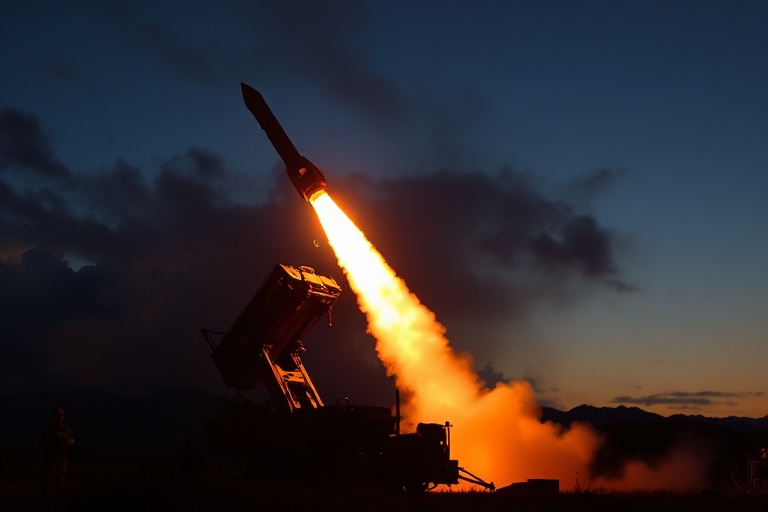
Missiles Explained: From WWII Rockets to Hypersonic Threats
“`html
Understanding Missiles: Technology, History, and Global Impact
Missiles have shaped modern warfare and geopolitics for nearly a century. These precision-guided weapons combine propulsion, guidance systems, and explosive payloads to deliver devastating force across vast distances. From their early development in World War II to today’s hypersonic threats, missiles remain a cornerstone of military strategy and international diplomacy.
The Evolution of Missile Technology
The story of missiles begins with the rocket science of the 1930s and 1940s. German engineers pioneered the first operational guided missile, the Fieseler Fi 103—better known as the V-1 “buzz bomb.” This pulsejet-powered weapon introduced the concept of precision targeting through preset navigation. Concurrently, the V-2 rocket became the first ballistic missile to reach space before striking targets hundreds of kilometers away.
Post-war advancements accelerated as both Cold War superpowers invested heavily in missile technology. The Soviet Union’s R-7 intercontinental ballistic missile (ICBM) demonstrated the ability to deliver nuclear warheads across continents, while the U.S. Minuteman ICBM solidified the concept of mutually assured destruction. These systems transformed warfare from battlefield engagements to strategic deterrence.
Key milestones in missile development
- 1957: The Soviet Union launches the R-7, the world’s first ICBM, paving the way for space exploration with its modified version, the Sputnik rocket.
- 1960s: The introduction of Multiple Independently Targetable Reentry Vehicles (MIRVs) allows a single missile to strike multiple targets simultaneously.
- 1980s: The U.S. develops the Pershing II and cruise missiles, introducing precision guidance through terrain-matching radar and inertial navigation.
- 2010s: Hypersonic missiles like the Russian Avangard and Chinese DF-17 emerge, traveling at speeds exceeding Mach 5 while remaining maneuverable.
Types of Missiles and Their Strategic Roles
Missiles are categorized by their launch mode, range, and mission profile. Each type serves distinct strategic purposes, from tactical battlefield use to global nuclear deterrence. Understanding these classifications reveals how modern militaries deploy these weapons in different scenarios.
Ballistic missiles follow a parabolic trajectory after an initial powered ascent. They are typically divided into short-range (less than 1,000 km), medium-range (1,000–3,000 km), intermediate-range (3,000–5,500 km), and intercontinental (over 5,500 km) categories. ICBMs form the backbone of nuclear arsenals due to their ability to strike targets anywhere on Earth within 30 minutes.
Common missile classifications
- Cruise Missiles: Fly at low altitudes using jet engines and aerodynamic lift. Examples include the U.S. Tomahawk and Russian Kalibr.
- Anti-Ship Missiles: Designed to destroy naval vessels, such as the Chinese DF-21D “carrier killer.”
- Surface-to-Air Missiles (SAMs): Intercept incoming aircraft or missiles, such as the U.S. Patriot system.
- Air-to-Air Missiles: Fired from fighter jets to engage other aircraft, including the AIM-9 Sidewinder and beyond-visual-range Meteor.
- Anti-Tank Missiles: Precision weapons like the Javelin, which use top-attack or direct-fire modes to penetrate armor.
Missiles in Modern Geopolitics
The proliferation of missiles has reshaped international relations, creating new flashpoints and altering defense postures. Nations now view missile development not only as a military necessity but also as a symbol of technological sovereignty and deterrence credibility.
In Northeast Asia, North Korea’s rapid missile testing program has prompted regional arms races. Its development of solid-fueled missiles and submarine-launched systems demonstrates a shift from quantity to quality in its arsenal. Meanwhile, Japan has reinterpreted its pacifist constitution to allow preemptive strikes using domestically developed missiles like the Type 12.
In Europe, Russia’s deployment of intermediate-range missiles in Kaliningrad and near Ukraine has violated the 1987 Intermediate-Range Nuclear Forces (INF) Treaty. This withdrawal underscored the treaty’s erosion and sparked renewed debates about arms control in a multipolar world.
The Middle East has become a laboratory for missile technology. Iran’s ballistic and cruise missile programs, including the Shahab and Soumar systems, extend its influence across Syria, Yemen, and Iraq. Israel’s Arrow and David’s Sling missile defense systems illustrate the region’s layered security architecture.
Ethical and Strategic Implications
The rise of autonomous and hypersonic missiles introduces profound ethical dilemmas. Hypersonic glide vehicles, for instance, combine speed with unpredictability, making interception nearly impossible with current technology. This raises concerns about escalation risks and the potential for accidental conflict.
Missile defense systems, while designed to protect populations, have fueled arms races. The U.S. deployment of Terminal High Altitude Area Defense (THAAD) systems in South Korea and Poland drew sharp criticism from China and Russia, who view them as threats to their own nuclear deterrents.
Moreover, the dual-use nature of missile technology complicates non-proliferation efforts. Civilian space programs often share components with ballistic missile systems, creating loopholes in export controls. The 2017 UN Security Council resolution targeting North Korea’s missile and nuclear programs highlighted the challenges of enforcing global standards.
As artificial intelligence integrates with missile guidance, questions arise about accountability. Who is responsible if an AI-driven missile misidentifies a target? The lack of clear legal frameworks for autonomous weapons systems remains a critical gap in international law.
Broader implications to consider
- Technological Leapfrogging: Emerging nations can acquire advanced missiles without developing full-scale aerospace industries, altering the balance of power.
- Economic Burden: Missile programs divert resources from social programs, healthcare, and infrastructure, particularly in resource-constrained states.
- Public Perception: Domestic support for missile programs often stems from nationalist rhetoric, making disarmament politically toxic for leaders.
- Environmental Impact: Rocket launches and missile tests release toxic chemicals like perchlorates, contaminating soil and groundwater near test sites.
Conclusion
Missiles represent both human ingenuity and the darker aspects of technological progress. They have redefined the nature of warfare, shifted global power dynamics, and forced nations to rethink security paradigms. As hypersonic systems and AI-driven targeting become more prevalent, the stakes will only grow higher.
Yet, the same technology that enables destruction also drives innovation in defense, space exploration, and scientific research. The challenge lies in balancing deterrence with diplomacy, innovation with regulation, and security with ethics. The future of missiles will not be determined solely by engineering breakthroughs, but by the choices societies make about how—and whether—to deploy them.
For further exploration of military technology and its broader implications, visit our Technology and Analysis sections on Dave’s Locker.