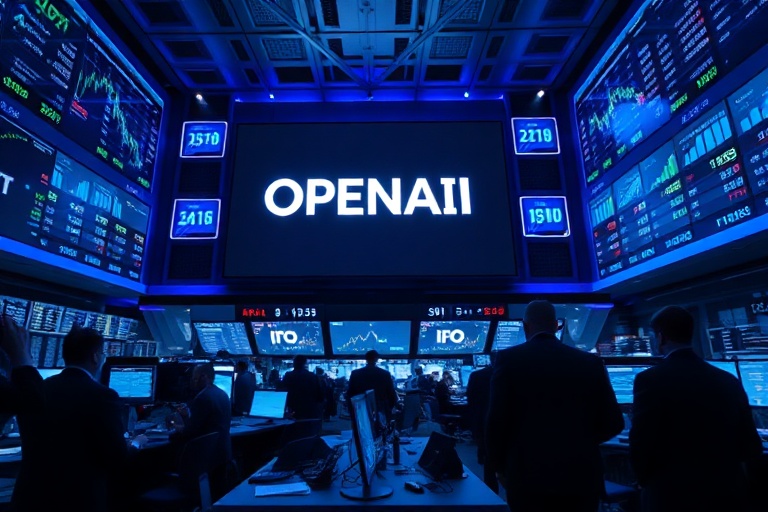
OpenAI’s potential initial public offering (IPO) has become one of the most anticipated financial events in the technology sector. As artificial intelligence reshapes industries from healthcare to finance, the company’s move toward public markets could redefine investor expectations for AI-driven innovation. With a valuation rumored to exceed $100 billion, OpenAI’s IPO would not only be a milestone for the company but also a referendum on the future of AI as a commercially viable force.
The Road to an OpenAI IPO: From Nonprofit to Public Company
OpenAI was founded in 2015 as a nonprofit research lab with a mission to ensure artificial general intelligence (AGI) benefits all of humanity. Its early work focused on ethical AI development, but the organization’s trajectory shifted dramatically with the launch of ChatGPT in late 2022. The chatbot’s viral adoption—reaching 100 million users in just two months—demonstrated the commercial potential of large language models and forced a strategic pivot.
In 2023, OpenAI transitioned into a “capped-profit” entity, allowing it to raise capital while maintaining a degree of mission alignment. This structure enabled partnerships with Microsoft and other tech giants, injecting billions into the company’s research and infrastructure. Analysts now view an IPO as the next logical step in OpenAI’s evolution, though the company has not officially confirmed timing or valuation.
Several factors suggest OpenAI is preparing for public markets:
- Regulatory filings: Reports indicate OpenAI has engaged with financial advisors to assess market conditions.
- Profitability concerns: Despite its technological breakthroughs, OpenAI has yet to achieve consistent profitability, raising questions about its long-term revenue model.
- Competitive pressure: Rivals like Anthropic and Mistral AI are also racing to commercialize AI, intensifying the need for OpenAI to secure capital for R&D.
Global Reactions: Why the World Is Watching OpenAI’s IPO
The potential IPO has sparked discussions far beyond Silicon Valley. In Europe, regulators are scrutinizing how AI companies balance innovation with ethical safeguards. The European Commission’s AI Act, which takes full effect in 2025, could impose stricter oversight on OpenAI’s operations post-IPO. Meanwhile, in Asia, governments are accelerating their own AI strategies, viewing OpenAI’s public debut as a bellwether for the industry’s maturity.
Cultural attitudes toward AI also play a role in investor sentiment. In Japan, where robotics and automation are deeply embedded in society, OpenAI’s IPO is seen as a validation of AI’s mainstream adoption. Conversely, in regions like Latin America, where digital infrastructure remains uneven, the IPO raises questions about accessibility and equity. The global divide in AI readiness could influence how investors perceive OpenAI’s long-term growth potential.
Media coverage has amplified these discussions. In India, financial analysts debate whether OpenAI’s IPO could trigger a “tech IPO wave,” encouraging local startups to follow suit. In Africa, where AI adoption is still nascent, the IPO serves as a reminder of the continent’s lag in AI infrastructure—a gap that could widen if OpenAI’s public offering diverts investor attention elsewhere.
Investor Considerations: Risks and Rewards of an OpenAI IPO
For retail and institutional investors, OpenAI’s IPO presents a high-stakes opportunity. The company’s association with Microsoft, which holds a significant stake, provides a layer of stability. However, several risks could dampen enthusiasm:
- Valuation uncertainty: OpenAI’s lack of transparent financials makes it difficult to assess whether its $100 billion+ valuation is justified. Comparable tech IPOs, such as those of Rivian or WeWork, show how quickly hype can fade.
- Regulatory scrutiny: Governments worldwide are tightening AI regulations, which could limit OpenAI’s ability to monetize certain products. Legal challenges over copyrighted training data or user privacy violations could also emerge.
- Technological disruption: AI is evolving rapidly, and OpenAI’s current dominance may not translate into future market leadership. Competitors with more efficient models or superior infrastructure could emerge.
- Ethical controversies: OpenAI has faced criticism over its handling of safety protocols and the misuse of its tools. Public backlash could deter investors wary of reputational risks.
Despite these challenges, the potential rewards are substantial. OpenAI’s ecosystem—spanning cloud services, enterprise solutions, and consumer applications—positions it as a one-stop shop for AI innovation. If the company can demonstrate a clear path to profitability, its IPO could become one of the most lucrative tech listings in recent history.
What Comes Next? The Broader Implications of OpenAI’s Public Debut
OpenAI’s IPO, whenever it occurs, will send ripples across the global economy. For the technology sector, it could herald a new era of AI-driven growth, with investors flocking to similar companies. The financial markets may also see a shift in how they value intangible assets like intellectual property and data moats, which are critical to AI firms.
Beyond finance, the IPO could influence public perception of AI. If OpenAI’s stock performs well, it might accelerate adoption across industries hesitant to embrace the technology. Conversely, a lackluster debut could reinforce skepticism about AI’s commercial viability. The outcome will likely shape policy discussions, as governments grapple with how to regulate an industry that is both revolutionary and unpredictable.
For now, all eyes are on OpenAI. The company’s decisions in the coming months—whether to go public, how to structure the offering, and which markets to prioritize—will set the tone for AI’s next chapter. As the world watches, one thing is clear: OpenAI’s IPO is not just about a single company. It’s about the future of innovation itself.
For those interested in the intersection of technology and finance, explore our Technology and Business sections for deeper analysis on AI trends and market movements.