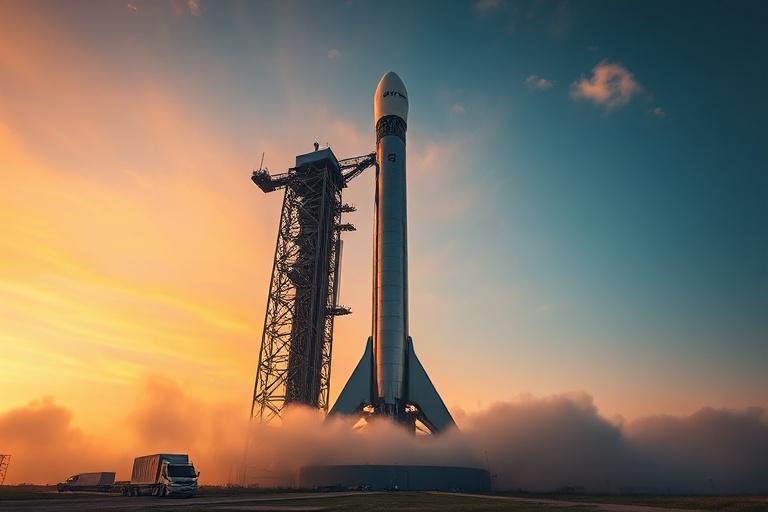
starship
“`html
Starship: The Rocket Redefining Space Travel and Global Ambitions
Elon Musk’s SpaceX has once again positioned itself at the forefront of aerospace innovation with Starship, the most ambitious rocket project in history. Designed to carry humans and cargo to the Moon, Mars, and beyond, Starship represents more than just technological progress—it embodies a new era of space exploration driven by private enterprise. With its fully reusable architecture and unmatched payload capacity, Starship is not merely a vehicle; it is a cultural and geopolitical catalyst, reshaping how nations and corporations envision the future of humanity among the stars.
The Vision Behind Starship: From Science Fiction to Reality
Starship’s origins trace back to Musk’s long-standing fascination with space colonization, a dream first articulated in a 2002 white paper and later refined in public statements over two decades. The rocket’s design philosophy—rapid reusability, affordability, and scalability—was inspired by science fiction classics and the limitations of traditional spaceflight. Unlike NASA’s Space Launch System or other government-led rockets, Starship was built with commercial viability in mind. Its stainless-steel construction, methane-fueled Raptor engines, and towering 120-meter height reflect a fusion of industrial pragmatism and futuristic ambition.
What makes Starship unique is its dual-purpose design. It serves as both a second-stage rocket and a standalone spacecraft capable of carrying up to 100 metric tons to Mars. This versatility has allowed SpaceX to attract diverse partnerships, from NASA’s Artemis program to commercial satellite deployments. The rocket’s potential to reduce the cost of space travel from $10,000 per kilogram to under $100 has made it a disruptive force in an industry long dominated by government budgets and slow technological cycles.
A Global Perspective: How Nations and Corporations Are Responding
The emergence of Starship has triggered a ripple effect across the globe. In the United States, NASA’s decision to award SpaceX a $2.9 billion contract for the Artemis Moon landings in 2021 signaled a major shift in space policy. By selecting Starship as the lunar lander, NASA embraced a commercial partner over traditional aerospace giants like Boeing or Lockheed Martin. This move underscored the agency’s pivot toward public-private collaboration, a trend mirrored in Europe and Japan, where space agencies are exploring similar partnerships with companies like ArianeGroup and ispace.
In China, the response has been both competitive and strategic. While Beijing has accelerated its own heavy-lift rocket programs, including the Long March 9, state media has frequently highlighted Starship’s challenges—particularly its early test failures—as evidence of American overreach. Yet, privately, Chinese engineers have studied Starship’s design, with some prototypes resembling its stainless-steel aesthetic. The competition between the U.S. and China in space is no longer confined to government programs; it now includes private enterprises like SpaceX, Blue Origin, and emerging startups in India and the UAE.
Meanwhile, in Europe, the reaction has been cautious but increasingly pragmatic. The European Space Agency (ESA) has acknowledged Starship’s potential but emphasized the need for European autonomy in access to space. This has led to investments in reusable rocket technologies, such as the Prometheus engine and the Ariane 6 rocket, while also exploring collaborations with SpaceX for payload launches. The continent’s space sector, long dominated by institutional funding, is now navigating a landscape where private innovation dictates the pace of progress.
Technological Breakthroughs: What Makes Starship Different
Starship’s technological innovations are as much about engineering as they are about rethinking the economics of spaceflight. At its core, the rocket relies on three key advancements: full reusability, in-orbit refueling, and rapid turnaround times. Unlike traditional rockets that are discarded after a single use, Starship and its Super Heavy booster are designed to land, refurbish, and relaunch within days. This capability could reduce the cost of a Mars mission from hundreds of billions to just a few billion dollars.
The rocket’s Raptor engines, which run on methane and liquid oxygen, offer several advantages. Methane is easier to produce on Mars, making it ideal for in-situ resource utilization—a critical factor for long-term colonization. The engines also boast a higher thrust-to-weight ratio than traditional kerosene-fueled engines, enabling Starship to carry heavier payloads with greater efficiency.
Another groundbreaking feature is Starship’s in-orbit refueling system. Because Mars-bound missions require more fuel than a single launch can carry, SpaceX plans to refuel Starship in low Earth orbit using tanker versions of the same rocket. This strategy, while complex, eliminates the need for massive, one-time-use rockets and aligns with the company’s goal of making interplanetary travel routine.
The Challenges and Controversies Surrounding Starship
Despite its promise, Starship has faced significant hurdles. Early test flights in 2023 and 2024 ended in dramatic explosions, with the rocket’s massive size and complexity proving difficult to control. Regulatory scrutiny has also intensified, particularly around SpaceX’s Starbase facility in Boca Chica, Texas, where environmental groups have raised concerns about the impact of frequent launches on local wildlife and communities. The Federal Aviation Administration (FAA) has imposed strict conditions on test flights, delaying progress and sparking debates about the balance between innovation and safety.
Critics argue that Starship’s focus on Mars colonization is premature, given the unresolved challenges of sustaining human life on the Red Planet. Others question whether the rocket’s development is diverting resources from more immediate needs, such as satellite internet via Starlink or lunar exploration. Meanwhile, skeptics within the aerospace industry have dismissed Starship as a “megaproject” driven more by hype than practicality, pointing to the rocket’s repeated delays and technical setbacks.
Yet, Musk’s vision has always been long-term. The challenges Starship faces today are not unlike those encountered by the Wright brothers or the early pioneers of aviation. What matters is the trajectory—Starship is pushing the boundaries of what’s possible, forcing both critics and competitors to adapt.
The Cultural Impact: Starship as a Symbol of Human Aspiration
Beyond its technical achievements, Starship has become a cultural phenomenon, capturing the imagination of people worldwide. Its sleek, retro-futuristic design—reminiscent of 1950s sci-fi illustrations—has made it an icon in popular media, from video games to fashion. The rocket’s name itself evokes a sense of adventure, conjuring images of explorers setting sail for uncharted worlds. In an era marked by geopolitical tensions and environmental crises, Starship offers a narrative of hope and possibility, a reminder that humanity’s greatest achievements often begin with audacious dreams.
Starship’s influence extends into education and entertainment. Schools and universities have incorporated its development into STEM curricula, using the rocket as a case study in physics, engineering, and entrepreneurship. Meanwhile, Hollywood has seized on the rocket’s story, with documentaries and sci-fi films dramatizing its potential to change the course of human history. The rocket’s social media presence, with millions of followers tracking its progress, has further amplified its cultural footprint, turning it into a global symbol of innovation.
In countries like India and Nigeria, where space exploration was once seen as a luxury reserved for wealthy nations, Starship has inspired a new generation of engineers and entrepreneurs. Startups in these regions are now developing their own satellite technologies and launch systems, fueled by the belief that space is no longer the exclusive domain of superpowers. Starship’s success could democratize access to space, enabling smaller nations to participate in lunar missions, asteroid mining, and even Mars colonization.
What’s Next for Starship? The Road to Mars and Beyond
The next phase of Starship’s development will be critical. Scheduled for 2025-2026, SpaceX plans to conduct uncrewed missions to the Moon as part of NASA’s Artemis program. These missions will test Starship’s ability to land on the lunar surface and support human exploration. If successful, the rocket could become the backbone of a sustainable lunar economy, with companies and governments leveraging its capabilities for scientific research, tourism, and resource extraction.
Looking further ahead, Starship’s most ambitious goal remains Mars. Musk has repeatedly stated his intention to establish a self-sustaining city on the Red Planet within the next few decades. While this timeline is speculative, the progress made with Starship suggests that such a vision is no longer confined to the realm of fantasy. The rocket’s ability to carry large numbers of colonists and cargo could make interplanetary migration a reality, albeit one fraught with ethical, logistical, and environmental challenges.
Yet, the path forward is not without risks. The psychological and physiological effects of long-duration spaceflight remain poorly understood. The political will to sustain such a monumental project over decades is uncertain. And the environmental impact of frequent rocket launches—particularly methane emissions—has raised alarms among climate scientists. These challenges demand not only technological solutions but also global cooperation and foresight.
As Starship continues to evolve, it serves as a reminder that space exploration is not just about reaching new worlds—it is about redefining what it means to be human. In an age of division and uncertainty, the rocket stands as a testament to humanity’s capacity for innovation, ambition, and collaboration. Whether it fulfills its promise or becomes a cautionary tale, its journey will leave an indelible mark on history.
Conclusion: A New Chapter in Human Spaceflight
Starship is more than a rocket; it is a catalyst for change. It challenges the status quo, pushes the boundaries of technology, and redefines humanity’s relationship with the cosmos. From the deserts of Texas to the launchpads of Cape Canaveral, from the boardrooms of Silicon Valley to the classrooms of Mumbai, its impact is being felt across the globe. While its ultimate success remains uncertain, its significance is undeniable. Starship represents the first step toward a future where humanity is not just a visitor to space, but a permanent resident of the stars.
As SpaceX continues to refine the rocket, the world watches with bated breath. The next decade will determine whether Starship fulfills its promise or becomes another ambitious dream deferred. One thing, however, is clear: the age of space exploration has entered a new chapter, and Starship is its most powerful protagonist.
—
METADATA
{
“title”: “Starship: The Rocket Redefining Space Travel and Global Ambitions”,
“metaDescription”: “Explore how Space