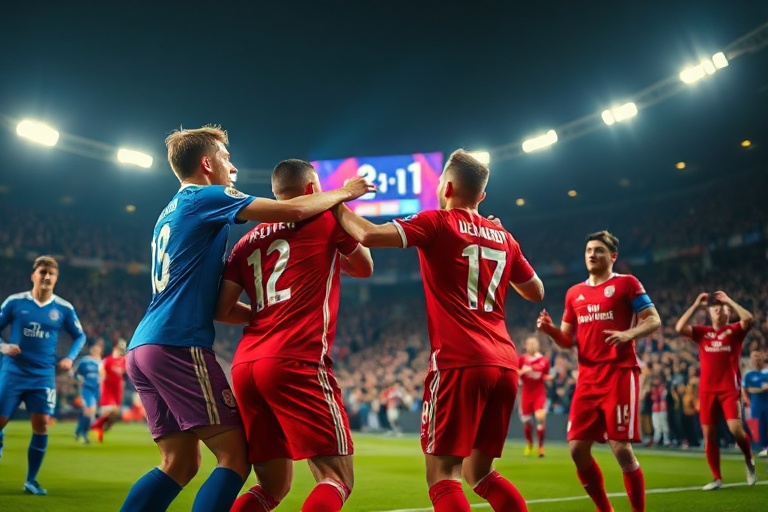
UEFA Nations League: How It’s Changing International Football
“`html
UEFA Nations League: How the Tournament Is Reshaping International Football
The UEFA Nations League arrived in 2018 as a bold experiment to redefine international football. Designed not just for prestige but for competitive meaning, the tournament has quietly transformed how national teams approach the game. What began as a replacement for most international friendlies has grown into a structured, high-stakes competition that demands consistency and ambition from Europe’s top footballing nations.
While the World Cup and European Championship remain the ultimate prizes, the Nations League offers a pathway to qualification and a stage to test emerging talent. It has also introduced financial incentives, elite-level scheduling, and a new narrative arc to the international calendar. For fans, it means more meaningful matches throughout the year. For players, it means fewer meaningless friendlies cluttering their schedules. For coaches, it means a clearer competitive structure to evaluate progress.
The Structure and Logic Behind the Tournament
The UEFA Nations League divides 55 European national teams into four leagues based on UEFA coefficients. League A features the continent’s elite, League D the lowest-ranked teams. Each league is split into four groups of three or four teams, playing home-and-away fixtures over six matchdays in September, October, and November.
The competition culminates in a finals weekend in June, featuring the four group winners from League A. These teams compete in a knockout format for the trophy. Meanwhile, promotion and relegation between leagues add stakes to every match, ensuring even lower-ranked teams have something to fight for beyond just avoiding embarrassment.
This pyramid system contrasts sharply with the one-off qualifiers of past tournaments. It rewards consistency over time and gives smaller nations a realistic chance to climb the ladder. For example, Finland and Norway have both risen from League C to League B through strong group performances, gaining access to higher-level opponents and greater visibility.
Key Features of the UEFA Nations League
- Promotion and Relegation: Teams move between leagues each edition, creating a dynamic hierarchy.
- Path to Euro Qualification: The top performers from each league gain playoff spots for the European Championship.
- Fewer Friendlies: Competitive matches replace many exhibition games, reducing player fatigue.
- Financial Incentives: UEFA distributes revenue based on performance, benefiting all 55 member associations.
- Development Platform: Young players and new coaches gain high-level experience in structured competition.
How the Nations League Has Changed National Team Strategies
For years, international football was dominated by cautious friendlies and high-profile friendlies that often lacked intensity. The Nations League forced a shift. Coaches now prioritize fitness, cohesion, and tactical discipline over short-term spectacle. Nations with smaller player pools, like Iceland or Estonia, have adapted by rotating squads more carefully and focusing on compact defensive systems.
Spain’s resurgence under Luis de la Fuente is partly credited to the Nations League. After failing to qualify for Euro 2024 through the traditional route, Spain topped its Nations League group and secured a playoff berth. The competition gave the team a platform to rebuild with young talent like Pedri and Gavi, blending experience with innovation.
Meanwhile, traditional powerhouses like Germany and France have used the tournament to integrate new generations. The pressure to perform every two years has made squads more competitive internally. Players now know they can’t hide behind friendlies; every match counts toward ranking and morale.
Even the big clubs have adjusted. With players often missing September and October weekends for Nations League duty, clubs now lobby for fewer midweek internationals. Yet the quality of these matches has made the compromise worthwhile. A September fixture between England and Italy carries the weight of a knockout tournament, something rare in friendlies.
The Broader Impact on European and Global Football
The Nations League’s influence extends beyond Europe. Its success has inspired similar competitions, such as CONCACAF Nations League and the upcoming African Nations League. These tournaments mirror UEFA’s model: regional competition with promotion, relegation, and clear pathways to major tournaments.
Financially, the league has been a boon for UEFA. Revenue from broadcasting and sponsorship has grown, partly due to the increased relevance of the competition. Smaller federations receive more funding, helping develop grassroots football across the continent. UEFA’s commitment to distributing wealth more evenly is evident in how prize money is allocated based on final standing, not just market size.
Yet challenges remain. Critics argue the finals weekend disrupts domestic seasons and that the tournament dilutes the prestige of friendlies too much. Some national coaches still prefer traditional preparation, especially for World Cup years. And in smaller leagues, the travel demands for away games in distant nations can strain budgets and player availability.
Still, the overall trajectory is positive. The Nations League has given international football a new rhythm. It has made every match meaningful, reduced the number of meaningless friendlies, and created a sustainable model for development. For fans, it means more high-quality football throughout the year. For the game, it means a stronger foundation for the future.
Looking Ahead: What’s Next for the Nations League?
The next edition, beginning in September 2024, will expand its role further. With Euro 2028 on the horizon, the Nations League playoffs will once again offer a second chance to teams that miss out on direct qualification. This dual pathway ensures that even strong teams have multiple routes to major tournaments.
There are talks of further reform, including potential adjustments to group sizes or the inclusion of promotion/relegation playoffs. Some suggest adding a final-eight format or integrating more nations through preliminary rounds. Whatever changes come, the core principle remains: competitive football should be continuous, not episodic.
One thing is clear: the Nations League is no longer a sideshow. It has earned its place in the international football calendar. It has given hope to underdogs, tested the best, and redefined what it means to represent a nation. As club football dominates the headlines, the Nations League quietly ensures that international football remains vibrant, relevant, and deeply competitive.
For fans tired of friendlies that feel like training sessions, that is progress worth celebrating.