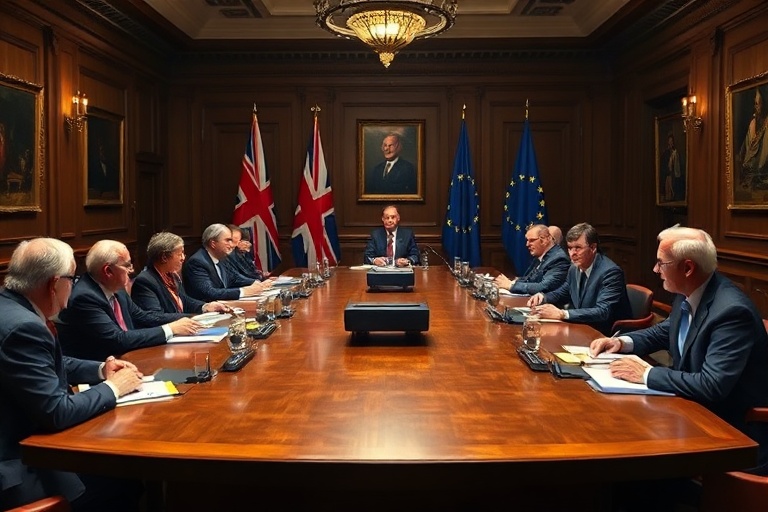
UK Rejoining EU: Economic and Political Implications Explored
“`html
UK Rejoining EU Discussions Gather Momentum After Decade of Separation
The United Kingdom’s potential return to the European Union has resurfaced as a serious topic of debate, nearly a decade after the Brexit referendum. Recent polling shows a narrowing gap between those supporting reintegration and those opposed, signaling a shift in public opinion. While political leaders remain cautious, the economic and geopolitical pressures of the post-Brexit era have intensified discussions about the feasibility of rejoining.
Analysts note that the conversation has evolved beyond nostalgia for EU membership. The current challenges—such as supply chain disruptions, labor shortages, and trade barriers—have made the idea of rejoining more pragmatic. A recent survey by YouGov found that 42% of Britons now favor rejoining the EU, up from 33% in 2020. This trend suggests that the initial enthusiasm for Brexit has waned, particularly among younger voters and business owners.
Economic Pressures Drive the Reintegration Conversation
The economic fallout from Brexit has been a key driver of the renewed interest in rejoining the EU. Businesses, particularly in sectors like manufacturing and agriculture, have struggled with increased costs and bureaucratic hurdles. The food industry, for example, has faced delays at borders and higher import tariffs, leading to shortages and rising prices. According to the British Chambers of Commerce, 62% of businesses cite trade barriers as a major obstacle to growth.
Meanwhile, the financial services sector, a cornerstone of the UK economy, has seen a significant shift of operations to EU cities like Frankfurt and Paris. The loss of passporting rights—allowing UK firms to operate freely across the EU—has forced companies to establish subsidiaries on the continent. This exodus has raised concerns about London’s long-term dominance as a financial hub. Some economists argue that rejoining the EU could restore stability and reduce these economic frictions.
Trade data also highlights the challenges. The UK’s trade with the EU has declined by approximately 15% since 2020, with sectors like automotive and pharmaceuticals hit hardest. The UK government’s own figures show that exports to the EU fell by £22 billion in the first two years post-Brexit. These figures have fueled arguments that rejoining could reverse some of these losses, though the political path remains complex.
Political Divides Deepen Over the Reintegration Question
The debate over rejoining the EU has exposed deep divisions within the UK’s political landscape. The Labour Party, now leading in the polls, has taken a cautious stance, with leader Keir Starmer ruling out a return to the EU in the near term. Instead, Labour has focused on improving the existing Brexit deal through closer cooperation with Brussels on trade and regulation. This approach reflects a pragmatic middle ground, avoiding the polarizing rhetoric of the past.
On the other side, the Liberal Democrats and the Green Party have been vocal advocates for rejoining the EU. The Liberal Democrats, in particular, have made EU reintegration a central plank of their platform, calling for a second referendum. Their polling numbers have risen, suggesting that this stance resonates with a segment of the electorate disillusioned by Brexit’s consequences. Meanwhile, the Conservative Party remains deeply split, with some factions pushing for a closer relationship with the EU while others vehemently oppose any steps toward reintegration.
The Scottish National Party (SNP) has also weighed in, framing EU reintegration as a path to independence. Scotland voted overwhelmingly to remain in the EU in 2016, and its government has argued that rejoining could bolster its case for another independence referendum. This has added another layer of complexity to the national conversation, particularly as the UK government seeks to maintain its territorial integrity.
Public Sentiment Shifts as Brexit’s Consequences Unfold
Public opinion on the UK’s relationship with the EU has undergone a noticeable shift in recent years. The initial optimism that followed the Brexit vote has given way to frustration and regret among many voters. A Deltapoll survey conducted in late 2023 found that 56% of respondents believe Brexit has harmed the UK economy, while only 32% believe it has helped. This sentiment is particularly strong among younger voters, 60% of whom now support rejoining the EU.
The cultural and social implications of Brexit have also played a role in changing attitudes. The loss of easy travel and study opportunities in the EU has affected students and young professionals. Programs like Erasmus+, which facilitated exchanges between UK and EU universities, have been replaced by less accessible alternatives. Additionally, the rise in hate crimes and xenophobia following the Brexit referendum has left a lasting impact on communities, further eroding support for the decision.
However, rejoining the EU is not a universally popular idea. Older voters, who were more likely to support Brexit, remain skeptical. Many view the EU as bureaucratic and undemocratic, and they are wary of ceding sovereignty to Brussels once again. This generational divide underscores the challenges of reversing Brexit, even as economic pressures mount.
What Would Rejoining the EU Actually Look Like?
The process of rejoining the EU would be neither quick nor straightforward. The UK would need to apply for membership, a process that typically takes years. According to Article 49 of the Treaty on European Union, any European country may apply for membership if it meets the Copenhagen criteria—stability of institutions, a functioning market economy, and adherence to democratic principles. The UK, as a former member, would have a head start but would still need to negotiate terms with the remaining 27 EU countries.
One of the biggest hurdles would be the UK’s adoption of the euro and the Schengen Agreement, both of which are core components of EU membership. Public opinion in the UK remains firmly against adopting the euro, and the Schengen Agreement’s open borders would likely face resistance due to concerns over immigration. These issues could make negotiations contentious and prolong the process.
Another critical factor is the UK’s financial contribution. As a member, the UK would be required to pay into the EU budget, though its contributions would likely be adjusted based on its economic situation. The EU might also seek concessions on issues like fisheries, agriculture, and regional policy, areas where the UK has historically clashed with Brussels.
Politically, rejoining the EU would require a significant shift in the UK’s approach to governance. The country would need to align its laws and regulations with EU standards, particularly in areas like environmental policy, consumer rights, and labor laws. This alignment could be contentious, particularly for a government that has spent years deregulating in the name of sovereignty.
Conclusion: A Long Road Ahead for Reintegration
The conversation about the UK rejoining the EU is no longer confined to the fringes of political debate. Economic struggles, shifting public opinion, and geopolitical pressures have brought the idea into the mainstream. However, the path to reintegration remains fraught with challenges, from political resistance to the practical hurdles of negotiation.
For now, the most likely scenario is a gradual rapprochement rather than an immediate return. The Labour Party’s focus on improving the existing Brexit deal suggests that closer cooperation with the EU may be the next step, even if full membership remains distant. Yet, as the consequences of Brexit continue to unfold, the debate over rejoining will only grow louder.
The journey back to the EU, if it happens at all, will be a slow and arduous one. But for many Britons, the question is no longer whether the UK should rejoin—it’s when and how.
For more insights into the UK’s political landscape, visit our Politics section. To explore the economic impacts of Brexit, check out our Business category.