<!DOCTYPE html>
<html lang="en">
<head>
    <meta charset="UTF-8">
    <meta name="viewport" content="width=device-width, initial-scale=1.0">
    <title>Giro d'Italia: A Century of Speed, Strategy, and Italian Passion</title>
</head>
<body>

<h2>Giro d'Italia: A Century of Speed, Strategy, and Italian Passion</h2>

<p>The Giro d’Italia is more than a bicycle race. It’s a three-week spectacle that carves through Italy’s soul, from the Dolomites’ jagged peaks to the sun-drenched coasts of Sicily. Founded in 1909 as a bold response to France’s Tour de France, the Giro quickly became a symbol of national pride and athletic endurance. Over 116 editions, it has grown into one of cycling’s three Grand Tours, alongside the Tour de France and Vuelta a España, but it remains uniquely Italian in character.</p>

<p>This year, as the pink jersey once again takes center stage, the Giro continues to evolve. It’s not just about speed anymore—it’s about technology, tactics, and the unshakable spirit of a nation that lives and breathes cycling. From its origins as a marketing stunt by newspaper <em>La Gazzetta dello Sport</em> to today’s globalized sporting event, the Giro has mirrored Italy’s own transformation: from post-unification struggles to economic miracles, from industrial decline to digital renaissance. It’s a mirror held up to a country constantly reinventing itself.</p>

<h3>The Birth of a Legend: From Page to Pedal</h3>

<p>The Giro was born not from athletic idealism, but from circulation wars. In 1908, <em>La Gazzetta dello Sport</em>, Italy’s leading sports daily, was locked in a fierce competition with <em>Corriere della Sera</em>. To boost readership, editor Emilio Colombo proposed a bold idea: a multi-stage cycling race across Italy, sponsored by the newspaper. The first Giro in 1909 featured 8 stages and 127 riders, most of whom rode heavy steel frames with minimal gear. Only 49 finished.</p>

<p>The race’s iconic pink jersey, or <em>maglia rosa</em>, dates to 1931. It was introduced to honor race leader Alfredo Binda, who had already won four Giri. The color matched the paper of <em>La Gazzetta</em>, creating a visual identity that endures today. That first maglia rosa winner, Learco Guerra, became a national hero—his image plastered on postcards and in cafés across the peninsula.</p>

<p>This blend of commerce and sport set a precedent. The Giro was never just a race; it was a cultural event. Riders became folk heroes. Tifosi—fanatical supporters—lined the roads, offering water, wine, and sometimes sabotage to rivals. In 1950, Fausto Coppi, the "Campionissimo," won the Giro and Tour in the same year, a feat that elevated cycling to the status of national obsession. His rivalry with Gino Bartali became a moral allegory: Coppi, the modernizer, versus Bartali, the devout traditionalist. Their battles played out on roads still scarred by World War II, symbolizing Italy’s own healing and rebirth.</p>

<h3>The Route That Defines a Nation</h3>

<p>The Giro’s route is a carefully curated journey through Italy’s geography, history, and identity. Unlike the Tour de France, which often explores neighboring countries, the Giro rarely strays beyond Italy’s borders. This insularity is intentional. It forces riders to confront the nation’s diversity: its mountains, its food, its dialects, its contradictions.</p>

<p>The race typically features three types of stages:</p>

<ul>
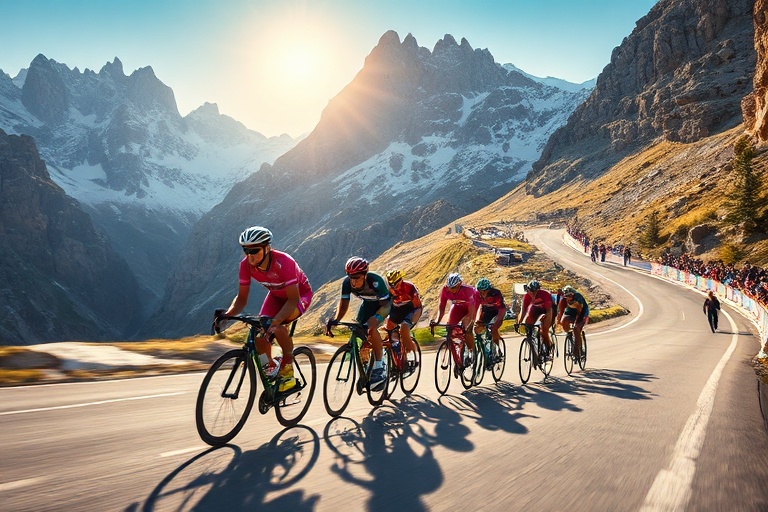
    <li><strong>High mountain stages:</strong> These are the soul of the Giro. Routes like the Stelvio, Gavia, or Mortirolo test riders to their limits. These climbs are not just physical barriers—they’re cultural landmarks. The Stelvio, for example, is a 48 hairpin-turned climb that crosses the border into Switzerland. Its slopes have witnessed legendary battles, including Marco Pantani’s 1998 attack that secured his Giro-Tour double.</li>
    <li><strong>Flat stages and sprints:</strong> These often wind through Italy’s agricultural heartlands—Piedmont’s vineyards, Emilia-Romagna’s fields, or Puglia’s olive groves. They showcase the country’s culinary bounty and give sprinters like Elia Viviani or Arnaud Démare a chance to shine.</li>
    <li><strong>Individual and team time trials:</strong> These stages reward precision and strategy. In recent years, time trials have become battlegrounds for marginal gains, where seconds are sliced off through aerodynamics and positioning. The 2023 Giro’s 34.2km time trial in time trial specialist Filippo Ganna showcased how technology—carbon frames, power meters, and wind tunnels—has reshaped racing.</li>
</ul>

<p>The route is not just a path; it’s a narrative. It tells the story of Italy through its landscapes. The Giro begins with a prologue or short stage in a major city—Sardinia, Rome, or Turin—before spiraling outward into the countryside. It peaks in the Dolomites or the Alps, where the air grows thin and the crowds roar. Then it descends into the south, where the heat is oppressive and the roads are lined with orange groves and ancient ruins.</p>

<p>This year’s route, unveiled in November, includes a grueling stage from Venaria Reale to the Santuario di Oropa, featuring the Cervinia climb. It’s a reminder that the Giro is not just a sporting event—it’s a pilgrimage. Riders and fans alike are drawn to these sacred places, where suffering and beauty intertwine.</p>

<h3>The Globalization of the Giro: Riders, Teams, and Technology</h3>

<p>The Giro is no longer a European affair. In the 1990s, Italian riders dominated—Coppi, Bartali, Felice Gimondi. Today, the peloton is a global village. Riders from Colombia, Australia, Britain, and even Eritrea line up at the start. The 2024 Giro features stars like Geraint Thomas, Tao Geoghegan Hart, and Remco Evenepoel, each bringing their own riding styles and cultural perspectives.</p>

<p>Teams, too, reflect this shift. While Italian squads like Trek-Segafredo and Astana-Qazaqstan still field strong contenders, the sport is increasingly shaped by British, Dutch, and American teams. The rise of INEOS Grenadiers and Jumbo-Visma has brought tactical innovation and data-driven training to the Giro. Riders now train with power meters, analyze routes with AI, and recover with cryotherapy and altitude tents.</p>

<p>Technology has transformed the Giro in subtle ways. GPS tracking allows fans to follow riders in real time. Social media—Instagram, TikTok, YouTube—has turned riders into influencers. Even the bikes have evolved. Modern carbon frames weigh less than 7 kilograms, while electronic shifting allows for instantaneous gear changes. Yet, despite these advancements, the Giro retains its human core. Riders still rely on instinct, courage, and teamwork. The pink jersey is not just a symbol of speed; it’s a testament to endurance.</p>

<p>The Giro also reflects broader trends in global sport. Like the Premier League or the NBA, it has become a showcase for branding and marketing. Sponsors like Enel, Nutrixxion, and Liquigas invest millions, not just for visibility, but for association with Italian culture. The Giro’s pink jersey is now a global brand, licensed for apparel and merchandise from Milan to Melbourne.</p>

<h3>The Giro in Culture: From Opera to Esports</h3>

<p>The Giro’s influence extends beyond sport. It has seeped into Italy’s cultural DNA. Films like <em>Il Grande Torino</em> and <em>The Program</em> (about Lance Armstrong’s doping scandal) use cycling as a metaphor for ambition and betrayal. Literature, too, has embraced the Giro. In 2018, writer Paolo Cognetti published <em>The Eight Mountains</em>, a novel that uses cycling as a lens to explore friendship and loss. The Giro even inspired an opera: <em>La Corsa</em>, by Italian composer Fabio Vacchi, premiered in 2016 and weaves cycling rhythms into its score.</p>

<p>In the digital age, the Giro has found new audiences. Esports platforms like Zwift host virtual Giri, where riders compete on digital replicas of the Stelvio and Gavia. These virtual races attract younger fans and introduce them to the Giro’s history and routes. Meanwhile, streaming services like Eurosport and Rai Sport broadcast the race globally, with commentary in multiple languages.</p>

<p>Even fashion has been touched by the Giro. Designers like Giorgio Armani and Brunello Cucinelli have created capsule collections inspired by the maglia rosa. The jersey’s pink hue has been reinterpreted in everything from haute couture to streetwear, proving that cycling’s aesthetic is as influential as its athletic feats.</p>

<h3>A Race That Keeps Reinventing Itself</h3>

<p>The Giro’s endurance is a testament to its adaptability. It has survived doping scandals, economic crises, and shifting fan interests. In the 1990s, as cycling’s reputation was tarnished by EPO and blood doping, the Giro became a symbol of clean(er) sport under the leadership of race director Carmine Castellano. Today, under Mauro Vegni, the Giro balances tradition with innovation, preserving its Italian soul while welcoming global talent.</p>

<p>The race also reflects Italy’s own challenges. The Giro has traversed regions scarred by earthquakes, economic decline, and migration. In 2020, as Italy grappled with COVID-19, the Giro was postponed. When it finally returned in 2021, it was a symbol of resilience. Riders wore black armbands. Crowds cheered from balconies. The maglia rosa became a beacon of hope in a darkened world.</p>

<p>As the Giro approaches its 117th edition, it remains a vital part of Italy’s cultural fabric. It is more than a race—it’s a living archive of the country’s triumphs and tragedies, its beauty and brutality. From the cobblestone streets of Naples to the glacial passes of the Alps, the Giro tells a story that belongs to Italy, but resonates globally.</p>

<p>For fans of <a href="/category/sports/">sports</a>, the Giro offers drama, strategy, and spectacle. For students of culture, it’s a masterclass in identity and reinvention. And for those who love the open road, it’s a reminder that the greatest journeys are not just about speed—they’re about the soul of the places we pass through.</p>

<p>The Giro d’Italia is not just a race. It’s a rhythm. A heartbeat. A story that never ends.</p>

---

<!-- METADATA -->
---
METADATA
{
  "title": "Giro d’Italia: 116 Years of Racing, Culture, and Italian Pride",
  "metaDescription": "From its 1909 origins to today’s global spectacle, explore how the Giro d’Italia mirrors Italy’s soul—through cycling, culture, and constant reinvention.",
  "