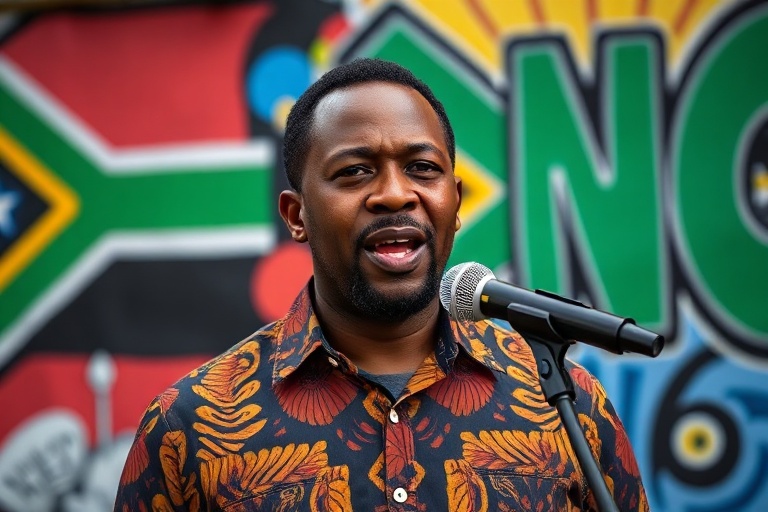
Julius Malema: How South Africa’s Most Controversial Leader Shapes Politics
“`html
Julius Malema: The Controversial Figure Shaping South Africa’s Political Landscape
Julius Malema remains one of South Africa’s most polarizing political figures. As the leader of the Economic Freedom Fighters (EFF), he has carved out a reputation for fiery rhetoric, unapologetic activism, and relentless opposition to the country’s economic and political establishment. His influence extends far beyond party lines, shaping national debates on land reform, racial justice, and economic inequality. Understanding Malema requires examining his rise, his ideological stance, and the broader implications of his movement on South Africa’s future.
The Rise of Julius Malema: From ANC Youth League to EFF Leader
Malema’s political career began within the African National Congress (ANC), where he quickly rose through the ranks. By 2008, he became president of the ANC Youth League, a position that amplified his visibility and influence. His outspoken advocacy for policies such as land expropriation without compensation and nationalization of key industries aligned with the ANC’s broader goals, but his confrontational style often put him at odds with party leadership.
In 2013, Malema was expelled from the ANC following a series of disciplinary hearings. The move was seen by many as a power play by then-President Jacob Zuma, who viewed Malema as a threat. Rather than fading into obscurity, Malema leveraged his expulsion to launch the Economic Freedom Fighters (EFF), a political party that positioned itself as the radical alternative to the ANC’s perceived moderation.
The EFF’s rapid ascent was undeniable. In the 2014 general elections, the party secured 6.35% of the national vote, becoming the third-largest party in South Africa’s parliament. Malema’s leadership was instrumental in this success, as he cultivated a base of young, disillusioned voters who felt abandoned by the ANC’s failure to address persistent inequality and unemployment.
Key Moments in Malema’s Political Journey
- 2008: Elected president of the ANC Youth League, positioning himself as a voice for radical economic transformation.
- 2011: Expelled from the ANC Youth League for bringing the party into disrepute, a decision later upheld by the ANC’s national disciplinary committee.
- 2013: Officially expelled from the ANC after a series of disciplinary hearings, paving the way for the EFF’s formation.
- 2014: Led the EFF to electoral success in the national elections, winning 25 seats in parliament.
- 2019: The EFF increased its parliamentary representation to 44 seats, solidifying its role as a major political force.
The Ideological Core: What Does Malema Stand For?
At the heart of Malema’s political philosophy is the demand for economic justice. The EFF’s manifesto is built on three pillars: expropriation of land without compensation, nationalization of mines and banks, and a rejection of neoliberal economic policies. These positions resonate deeply with South Africa’s black majority, many of whom remain economically marginalized decades after the end of apartheid.
Malema’s rhetoric often frames these demands in the language of historical injustice. He frequently invokes the Freedom Charter, a 1955 document that called for a non-racial South Africa and economic redistribution. By positioning the EFF as the true heir to the anti-apartheid struggle, Malema challenges the ANC’s claim to moral authority, arguing that the ruling party has betrayed its revolutionary roots.
Critics argue that Malema’s policies are economically reckless and unfeasible. Nationalizing key industries, they contend, would stifle investment and cripple growth. Supporters, however, see these proposals as necessary correctives to a system that has perpetuated racial and economic disparities. The debate over Malema’s ideology is not just academic; it reflects broader tensions within South African society about the pace and nature of transformation.
The Broader Implications: How Malema is Reshaping South African Politics
Malema’s influence extends beyond the EFF’s electoral performance. He has fundamentally altered the political discourse in South Africa, forcing mainstream parties to engage with issues they once avoided. The ANC, in particular, has had to respond to the EFF’s demands, with President Cyril Ramaphosa publicly endorsing land reform as a national priority. Even opposition parties like the Democratic Alliance (DA) have been compelled to address economic inequality in their platforms.
The EFF’s presence in parliament has also transformed legislative debates. The party’s MPs are known for their disruptive tactics, from singing revolutionary songs during speeches to staging walkouts in protest. While these actions have drawn criticism, they have also kept pressing issues—such as corruption and unemployment—at the forefront of national conversations.
Malema’s relationship with other African leaders is another area of interest. While he has found allies among pan-Africanists who share his critique of neocolonialism, his confrontational style has also alienated some. For instance, his criticism of Zimbabwe’s Robert Mugabe in 2017 highlighted tensions between his revolutionary rhetoric and pragmatic politics. These dynamics underscore the complexity of his role as a regional political figure.
Malema’s Impact on South African Society
- Shift in Political Discourse: The EFF has forced mainstream parties to address issues like land reform and economic inequality more aggressively.
- Youth Mobilization: Malema’s appeal to young voters has energized a generation that feels disconnected from traditional political structures.
- Cultural Influence: His use of revolutionary symbols and language has reignited debates about the legacy of apartheid and the unfinished business of liberation.
- International Scrutiny: Malema’s outspoken views on foreign policy, including his criticism of Israel and support for Palestine, have drawn global attention to South Africa’s foreign affairs.
- Legal and Ethical Challenges: His legal troubles, including multiple court cases for hate speech and corruption allegations, have raised questions about accountability in public office.
Conclusion: The Future of Julius Malema and the EFF
Julius Malema’s political career is a study in contradictions. He is both a revolutionary and a pragmatist, a disruptor and a potential kingmaker. As South Africa grapples with deepening inequality and political instability, the EFF’s role in shaping the country’s future cannot be ignored. Whether Malema’s movement will lead to meaningful transformation or further polarization remains an open question, but his influence on the national conversation is undeniable.
For now, Malema continues to dominate headlines with his bold statements and confrontational style. His ability to mobilize supporters and unsettle opponents ensures that he will remain a central figure in South African politics for years to come. As the country approaches its next election cycle, the EFF’s performance will be a key indicator of whether Malema’s vision resonates with a broader cross-section of the electorate.
The broader implications of Malema’s movement extend beyond South Africa’s borders. His unapologetic advocacy for economic justice has inspired similar movements across the continent, from Namibia to Kenya. At the same time, his confrontational tactics have sparked debates about the limits of democratic dissent and the role of radical politics in governance.
One thing is certain: Julius Malema is not a passing political phenomenon. He is a defining force in South Africa’s ongoing struggle for equity and justice. As the country navigates its complex political landscape, the EFF’s leader will remain a figure to watch—whether as a disruptor, a leader, or a cautionary tale.
For further reading on South African politics and influential figures, explore our Politics category or dive into our Analysis section for deeper insights.