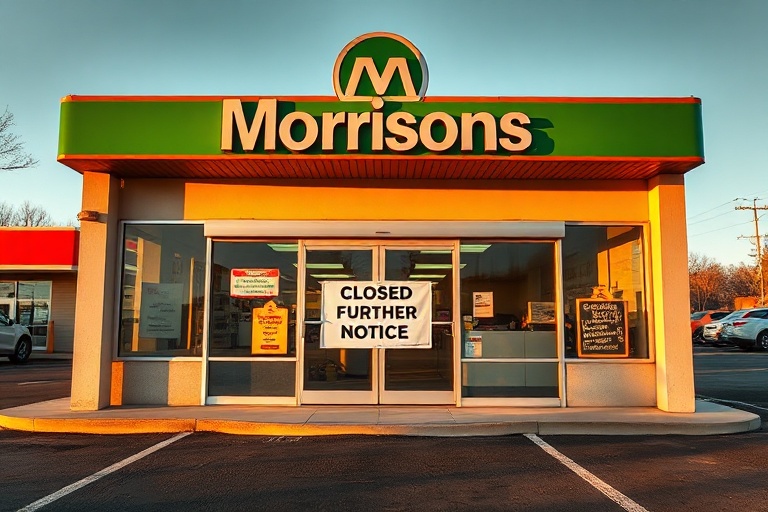
Morrisons Closes 18 Convenience Stores: Why It Matters
“`html
Morrisons Convenience Store Closures: What’s Behind the Shutdowns
Morrisons has confirmed plans to close 18 convenience stores across the UK, marking another step in the supermarket chain’s strategic shift toward online and larger-format retail. The closures, announced in early 2024, affect locations in urban and suburban areas, from Bristol to Manchester. While the company has framed the move as part of broader efficiency efforts, the decision highlights ongoing challenges in the convenience retail sector.
The Scale of the Closures and Affected Locations
Morrisons has identified 18 stores slated for closure, with the majority located in high-footfall areas. The list includes branches in cities such as Leeds, Sheffield, and Birmingham, as well as smaller towns like Colne in Lancashire and Fareham in Hampshire. According to company filings, these outlets have underperformed compared to Morrisons’ larger superstores and online operations.
The closures are part of a wider restructuring that began in 2021, when Morrisons was acquired by private equity firm Clayton, Dubilier & Rice. Since then, the chain has focused on streamlining its physical footprint while investing in delivery infrastructure. A company spokesperson stated that the closures would allow Morrisons to “better align resources with customer demand.”
Which Stores Are Closing?
The full list of affected locations includes:
- Morrisons Daily in Colne, Lancashire
- Morrisons Local in Fareham, Hampshire
- Morrisons Convenience in Leeds City Centre
- Morrisons Local in Sheffield, South Yorkshire
- Morrisons Daily in Manchester, Hulme
- Morrisons Convenience in Bristol, Clifton
- Morrisons Local in Nottingham, Lenton
- Morrisons Convenience in Liverpool, Anfield
- Morrisons Daily in Cardiff, Grangetown
- Morrisons Local in Glasgow, Dennistoun
Morrisons has confirmed that redundancies are expected, though the company has not disclosed exact numbers. Affected staff will be offered redeployment opportunities where possible, with support for those seeking alternative roles.
Why Morrisons Is Shifting Focus Away from Small Stores
The decision to close convenience stores reflects broader trends in UK grocery retail. Morrisons has faced intensifying competition from discounters like Aldi and Lidl, as well as the rapid growth of online delivery services. Smaller convenience stores, which typically operate on lower margins, have become less viable as consumer habits evolve.
Morrisons’ pivot toward larger superstores and digital sales is also tied to cost efficiency. The company has invested heavily in its Morrisons.com platform, which now serves over 95% of UK postcodes. By consolidating its physical presence, Morrisons aims to reduce overheads and improve profitability.
The Role of Private Equity in the Strategy
Since the 2021 buyout, Clayton, Dubilier & Rice has pushed Morrisons toward a leaner, more scalable business model. The private equity firm has prioritized returns over growth, a strategy that often involves divesting underperforming assets. Convenience stores, with their high operational costs and thin margins, fit this narrative.
Industry analysts suggest that Morrisons’ convenience estate was a legacy of its 2004 acquisition of Safeway, which included numerous smaller-format stores. While these outlets once served a purpose, their relevance has diminished in today’s retail landscape. The closures signal a decisive break from that past.
Impact on Local Communities and Employees
The closures are likely to have a disproportionate impact on local communities, particularly in areas where Morrisons is the only major supermarket within walking distance. Residents in Bristol’s Clifton and Liverpool’s Anfield, for example, will lose convenient access to groceries, pharmacy services, and fuel.
For employees, the closures bring uncertainty. Morrisons has pledged to support affected staff through redeployment and redundancy packages, but the loss of jobs—even in small numbers—can ripple through local economies. Trade unions have raised concerns about the long-term effects on workers, especially in areas with high unemployment.
Consumer Reactions and Alternative Options
Social media responses to the closures have been mixed. Some customers express frustration at losing familiar shopping spots, while others acknowledge the inevitability of Morrisons’ strategy. Many have already shifted to online grocery shopping or switched to competitors like Tesco Express or Co-op.
For those seeking alternatives, the affected areas still have other convenience retailers, though choice may be limited. In Fareham, for instance, residents can turn to Tesco Metro or Sainsbury’s Local, but some may face longer travel times.
What’s Next for Morrisons’ Convenience Strategy?
Morrisons insists that the closures are not the end of its convenience retail presence. The company plans to retain around 200 convenience stores, focusing on high-traffic locations in cities and transport hubs. These stores will serve as pick-up points for online orders, integrating them into Morrisons’ broader digital ecosystem.
Looking ahead, Morrisons may explore partnerships with local retailers or franchise models to maintain a presence in some areas. The company has also hinted at further investments in automation and delivery logistics, which could reshape its operational footprint in the coming years.
For now, the closures underscore a fundamental truth about UK grocery retail: convenience is no longer just about physical proximity. It’s about speed, digital convenience, and cost efficiency. Morrisons’ strategy reflects this reality, even as it leaves some communities at a disadvantage.
Conclusion: A Retail Landscape in Flux
The closure of 18 Morrisons convenience stores is more than a corporate cost-cutting measure. It’s a symptom of a retail industry grappling with digital disruption, changing consumer habits, and the pressures of private equity ownership. While Morrisons positions itself for long-term survival, the closures highlight the challenges faced by traditional retailers in an era dominated by e-commerce and discount grocers.
For affected communities and employees, the impact is immediate and tangible. The challenge now lies in ensuring that Morrisons’ transition doesn’t leave gaps in local retail infrastructure. As the grocery sector continues to evolve, the balance between efficiency and accessibility will remain a critical debate.
For more insights on grocery retail trends, visit our News section. To explore how convenience stores are adapting to digital shifts, check out our Analysis category.