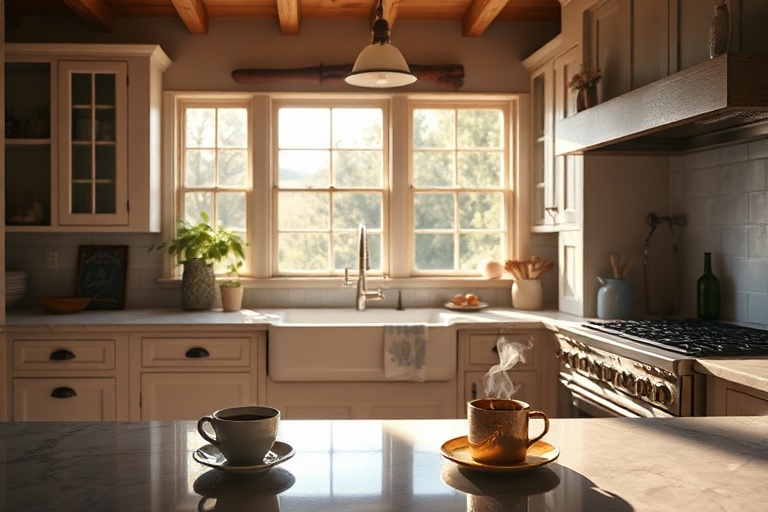
Nancy Meyers has quietly built an empire on the idea that the best stories unfold in kitchens where soup simmers on the stove and wine glasses are never empty. For over three decades, the writer-director has crafted films that feel less like escapist fantasy and more like a well-appointed second home. Her movies—from Baby Boom in 1987 to Something’s Gotta Give in 2003 and The Holiday in 2006—offer a specific brand of comfort: impeccably designed spaces, witty dialogue, and characters who solve life’s chaos with a well-timed quiche.
Meyers’ work is as much about architecture as it is about romance. The homes in her films aren’t just backdrops; they’re characters themselves, meticulously curated to reflect the personalities of their inhabitants. This attention to detail has earned her a devoted following among interior design enthusiasts and film buffs alike. But Meyers’ genius lies in her ability to balance aesthetic perfection with emotional authenticity. Her stories rarely rely on grand gestures or manufactured conflict. Instead, they thrive on the quiet moments—when a character peels an apple while debating love or when a couple argues over the proper way to fold a fitted sheet.
What makes Meyers’ films endure isn’t just their visual appeal but their emotional resonance. She writes women who are intelligent, capable, and flawed, often navigating midlife crises or career pivots with humor and grace. Her protagonists aren’t waiting for a prince to arrive; they’re building their own happily-ever-after, one well-placed throw pillow at a time.
The Meyers Method: How She Builds a Cinematic Home
Nancy Meyers’ films follow a formula, but it’s a formula that feels organic rather than restrictive. At its core, her storytelling revolves around three key elements: relatable protagonists, idyllic settings, and the promise of transformation. The protagonists are almost always women in their 40s or 50s—a demographic often ignored by mainstream cinema—who are re-evaluating their lives. Whether it’s Diane Keaton’s Annie in Something’s Gotta Give rediscovering passion or Meryl Streep’s Jane in The Holiday finding unexpected joy in a borrowed cottage, Meyers’ characters feel like friends you’d trust to give solid life advice.
Her settings are equally deliberate. Meyers doesn’t just pick a pretty house; she chooses spaces that reflect the emotional journey of her story. In It’s Complicated (2009), Meryl Streep’s Jane’s bakery and home in upstate New York are warm and lived-in, mirroring her journey from heartbreak to renewal. The film’s most iconic scene—Jane and Adam Scott’s Adam sharing a plate of cookies on her kitchen island—isn’t just charming; it’s a testament to Meyers’ belief that the best conversations happen over food.
Meyers’ attention to detail extends to the smallest props. A recurring motif in her films is the use of food as a metaphor for care and connection. In The Holiday, Cameron Diaz’s Amanda learns to bake a proper English trifle, a scene that doubles as a romantic subplot and a lesson in patience. Even the way characters arrange their kitchens speaks volumes. Meyers’ sets are never sterile; they’re cluttered with cookbooks, half-empty wine bottles, and the kind of mismatched china that suggests a life fully lived.
The Role of Food in Meyers’ Films
Food isn’t just a prop in Nancy Meyers’ films—it’s a narrative device. Her characters cook not because they have to, but because it’s a form of self-care. Whether it’s Diane Keaton’s Annie in Something’s Gotta Give whipping up a seafood stew after a breakup or Kate Winslet’s Iris in The Holiday burning her first attempt at roast chicken, food serves as a bridge between isolation and connection.
Meyers’ own love of cooking is well-documented. She’s been quoted saying that writing screenplays is like cooking a meal: both require patience, precision, and the occasional adjustment when things don’t go as planned. This philosophy permeates her work. Her characters don’t just eat; they savor. They linger over meals, debate recipes, and occasionally burn dinner when they’re distracted by romance or career opportunities. In Meyers’ world, food isn’t fuel—it’s an experience.
Her most famous culinary scenes are often the most intimate. In It’s Complicated, Jane’s slow dance with a batch of croissants—rolling, shaping, and finally slipping them into the oven—isn’t just a montage; it’s a metaphor for her emotional awakening. The act of cooking becomes an act of creation, both in the kitchen and in her personal life.
Beyond the Set: Meyers’ Influence on Design and Pop Culture
Nancy Meyers’ impact extends far beyond the silver screen. Her films have inspired a generation of interior designers, real estate agents, and homeowners to embrace what’s now dubbed “the Nancy Meyers aesthetic.” Think neutral palettes, vintage rugs, and kitchens with marble countertops and top-of-the-line appliances. Her sets have become blueprints for aspirational living, and it’s not uncommon to see her influence in boutique hotels or Airbnb listings marketed as “cozy” or “storybook.”
Meyers’ style is deceptively simple. It’s the kind of design that looks effortless but requires meticulous planning. She favors warm woods, soft lighting, and textures that invite touch—think linen curtains, chunky knit throws, and weathered leather chairs. The result is a look that feels both timeless and lived-in, a far cry from the sterile minimalism often celebrated in design magazines.
Her influence isn’t limited to physical spaces. The term “Nancy Meyers boyfriend” has entered the lexicon to describe a man who’s emotionally available, cooks dinner, and knows his way around a wine list. The phrase itself is a testament to how deeply her films have seeped into the cultural consciousness. Meyers didn’t just create a visual style; she defined a kind of romantic ideal—one where love is less about grand gestures and more about shared meals and quiet understanding.
Even fashion has felt her impact. The wardrobes in her films are as carefully curated as the sets, favoring classic silhouettes, luxurious fabrics, and a color palette that skews toward earthy tones. Diane Keaton’s wardrobe in Something’s Gotta Give—all cashmere turtlenecks and tailored trousers—became a template for “elegant relaxation.” It’s a look that prioritizes comfort without sacrificing sophistication.
Why Nancy Meyers’ Films Still Matter
In an era where blockbusters dominate the box office and streaming services churn out content at a relentless pace, Nancy Meyers’ films stand out for their restraint. She doesn’t rely on high-stakes action or CGI spectacles. Instead, her stories hinge on the kind of quiet moments that resonate with anyone who’s ever felt the ache of growing older or the thrill of starting over. Her films are a reminder that not every story needs to be a three-act tragedy or a happily-ever-after fairy tale. Sometimes, the best stories are the ones that unfold in a sunlit kitchen, with a glass of wine in hand and a heart open to change.
Meyers’ films also offer a rare portrayal of women who are unapologetically themselves. Her protagonists are flawed, funny, and fully realized. They don’t sacrifice their ambitions for love, nor do they abandon their personal lives for career success. Instead, they find a way to make both work—often by redesigning their homes, their careers, or even their entire lives. In a culture that often pits ambition against domesticity, Meyers’ films suggest that the two can coexist beautifully.
Her recent projects, like Book Club (2018) and Father of the Year (2018), prove that her appeal isn’t limited to a specific decade. While these films may not have the same cultural footprint as her earlier work, they still carry her signature blend of humor, heart, and impeccable taste. Even when she ventures into genres outside her usual rom-com wheelhouse, her attention to detail remains unwavering.
Perhaps the most enduring aspect of Nancy Meyers’ work is its ability to make viewers feel seen. Her films don’t just entertain; they offer a kind of validation. In a world that often feels chaotic and uncertain, Meyers’ stories remind us that there’s beauty in the everyday. That a well-made meal, a cozy sweater, and a good book can be just as fulfilling as any grand adventure.
What’s Next for Nancy Meyers?
At 75, Nancy Meyers shows no signs of slowing down. While she’s kept a relatively low public profile in recent years, her influence continues to grow. Fans eagerly await her next project, wondering if she’ll return to the romantic comedy genre or explore new territory. Given her track record, it’s safe to assume that whatever she creates will be meticulously crafted, emotionally resonant, and visually stunning.
For now, Meyers’ legacy is secure. Her films remain a touchstone for anyone seeking a moment of comfort in an often-disquieting world. Whether you’re rewatching The Holiday for the tenth time or discovering Something’s Gotta Give for the first time, you’re guaranteed to find something to savor—both on screen and in the quiet corners of your own imagination.
In a film industry that often prioritizes spectacle over substance, Nancy Meyers is a rare gem. She’s proven that the best stories don’t need explosions or car chases to captivate audiences. Sometimes, all you need is a well-set table, a bottle of wine, and a story about people learning to love themselves—and each other—just as they are.
Explore more about romantic comedies and their cultural impact: