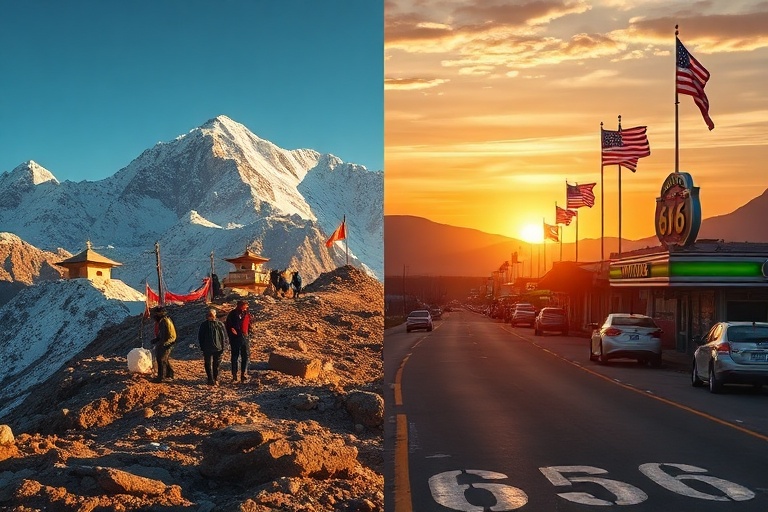
Nepal vs USA: Culture, Economy and Global Contrasts
“`html
Global Perspectives: Nepal and the USA in Contrast
The world’s most populous country and one of its oldest democracies stand in stark contrast to a Himalayan nation of 30 million, deeply rooted in tradition yet navigating rapid change. Nepal and the United States represent two vastly different models of development, governance, and cultural expression. While the U.S. is a global superpower with vast resources and influence, Nepal remains a developing nation grappling with poverty, political instability, and environmental vulnerability. Yet, both countries share a commitment to democratic ideals—however differently interpreted—and a complex relationship with globalization.
Understanding these two nations requires more than comparing GDP or military strength. It demands a look at geography, history, social structures, and national identity. Nepal’s rugged terrain and rich ethnic diversity contrast sharply with America’s vast plains and cultural mosaic. These differences shape everything from education systems to environmental policy, from cuisine to conflict resolution. What follows is a comparative exploration of Nepal and the U.S., not to rank them, but to highlight how geography and history forge distinct national characters.
Geography and Landscape: Mountains vs. Superpower Terrain
Nepal is a landlocked country nestled between China and India, dominated by the Himalayas, including eight of the world’s ten highest peaks. Its topography is both breathtaking and limiting—rugged mountains cover 80% of the land, restricting agriculture, transportation, and urban development. The country is prone to natural disasters: earthquakes, landslides, and floods regularly displace communities and strain infrastructure. Despite these challenges, Nepal’s geography has shaped a resilient people, deeply connected to the land and dependent on subsistence farming.
The United States, by contrast, spans a continent with diverse landscapes: the Appalachian Mountains, the Great Plains, the deserts of the Southwest, and the tropical ecosystems of Hawaii. Its vast size and varied climate support diverse industries—agriculture, energy, technology—and allow for geographic mobility. While the U.S. faces environmental threats like wildfires and hurricanes, its infrastructure and economic resilience generally mitigate their impact. The contrast is stark: in Nepal, a single landslide can cut off a village for weeks; in the U.S., such events are managed through advanced early warning systems and rapid response teams.
Economic Models: From Subsistence to Superpower
Nepal’s economy is primarily agrarian, with over 60% of the population engaged in farming. Tourism, particularly trekking in the Himalayas, contributes significantly to GDP, but remains vulnerable to political instability and global crises like pandemics. Remittances from Nepalis working abroad—especially in the Gulf states and Malaysia—account for nearly 30% of national income, highlighting both the challenges of local employment and the country’s reliance on foreign labor markets.
The U.S. economy is the largest in the world, driven by technology, finance, manufacturing, and services. It is a post-industrial economy where over 80% of workers are employed in service sectors. While inequality persists, the U.S. benefits from high productivity, innovation, and a consumer-driven market. The contrast is visible in daily life: in Kathmandu, street vendors sell fresh produce from bicycles; in New York, grocery stores offer pre-packaged meals from around the world. These differences reflect not just wealth, but divergent relationships with time, labor, and consumption.
Politics and Governance: Federalism and Fragmentation
Nepal transitioned from a monarchy to a federal democratic republic in 2008 after a decade-long civil war. Its government operates under a complex federal structure with seven provinces, designed to accommodate ethnic diversity and regional autonomy. Yet, political fragmentation has led to frequent changes in leadership and policy paralysis. Corruption remains a persistent issue, and public trust in government institutions is low.
The United States, by contrast, has a stable two-party system with a long constitutional tradition. While political polarization has intensified in recent years, the framework of checks and balances has prevented systemic collapse. The U.S. federal system delegates powers to states, allowing regional variation in laws and policies. However, debates over states’ rights, gun control, and healthcare reveal tensions similar to those in Nepal, though on a larger scale. Both nations grapple with balancing unity and diversity—one through ethnic federalism, the other through constitutional federalism.
Education and Social Development: Contrasting Paths to the Future
In Nepal, access to education has improved dramatically since the 1990s. Primary enrollment rates exceed 95%, but quality remains uneven, especially in rural areas. Many students, particularly girls, drop out due to poverty, early marriage, or the need to support families. Higher education is limited: only a few institutions, like Tribhuvan University, offer advanced degrees, and many students seek education abroad.
The U.S. boasts some of the world’s top universities and a culture that values higher education. Over 40% of Americans hold a bachelor’s degree or higher, and institutions like Harvard, MIT, and Stanford attract students globally. However, rising tuition costs and student debt have created a crisis, disproportionately affecting low-income families. Both countries face challenges in education equity, but the scale and systems differ vastly—from one-room schoolhouses in the Himalayas to massive state universities in California.
Cultural Identity: Tradition Meets Modernity
Nepal’s culture is deeply spiritual and communal. Hinduism and Buddhism coexist harmoniously, shaping festivals, rituals, and daily life. The country is home to seven UNESCO World Heritage Sites, including the temples of the Kathmandu Valley and the birthplace of Buddha in Lumbini. Art, music, and dance are integral to identity, often tied to religious narratives and seasonal cycles.
The U.S., in contrast, is a nation of immigrants. Its cultural identity is fluid, shaped by waves of migration from Europe, Africa, Asia, and Latin America. While English is dominant, over 350 languages are spoken across the country. American culture emphasizes individualism, innovation, and adaptability—values reflected in everything from fast food to Hollywood films. Yet, beneath this diversity lie persistent issues of racial inequality, cultural appropriation, and the erosion of shared civic values.
Environmental Challenges: Climate Vulnerability and Responsibility
Nepal is one of the most climate-vulnerable countries in the world. Rising temperatures melt Himalayan glaciers, increasing the risk of glacial lake outburst floods. Deforestation and erratic rainfall threaten agriculture in a country where 70% of people depend on farming. Despite contributing less than 0.1% of global carbon emissions, Nepal faces disproportionate climate impacts.
The U.S. is the second-largest emitter of greenhouse gases. While it has made progress in renewable energy, political divisions have slowed climate action. Wildfires, hurricanes, and droughts cost billions annually. Yet, American technological innovation—from solar panels to carbon capture—offers potential solutions. The contrast highlights a global paradox: the nations most affected by climate change often contribute the least to the problem.
Conclusion: Two Nations, One Planet
Nepal and the United States are not merely economic or political opposites—they are reflections of different historical paths and philosophical choices. One nation grows from ancient wisdom and communal bonds; the other from frontier spirit and technological ambition. Both face challenges of inequality, environmental degradation, and political instability, though on vastly different scales.
What unites them, ultimately, is their place in an interconnected world. Nepal’s struggle for sustainable development resonates globally as climate change accelerates. The U.S.’s debates over democracy and identity echo across nations experiencing similar tensions. In an era of globalization, the stories of Nepal and the United States remind us that progress is not a single path, but a mosaic of human experience.
Rather than asking which country is “better,” we might ask: How can each learn from the other’s strengths? Nepal’s emphasis on community resilience and spiritual balance offers lessons in sustainability. The U.S.’s capacity for innovation and large-scale problem-solving could help address global challenges. In the end, the comparison is not about competition, but about understanding the diverse ways humanity thrives.
To explore more on global development and cultural studies, visit our Analysis section. For deeper insights into international relations, check out our News coverage.