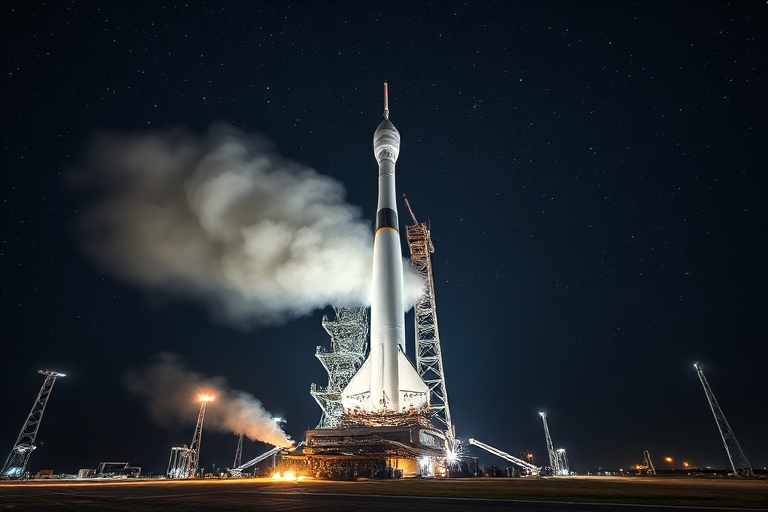
Starship Launch: How SpaceX’s Breakthrough Is Reshaping Space Travel
“`html
Starship Launch: How SpaceX’s Giant Leap Changes Everything
SpaceX’s Starship rocket has once again pushed the boundaries of aerospace innovation with its latest launch. The colossal vehicle, designed for full reusability and massive payload capacity, represents more than just another test flight. It signals a fundamental shift in humanity’s relationship with space exploration and commercialization. Unlike previous iterations, this launch demonstrated critical milestones that could redefine orbital missions, lunar landings, and even Mars expeditions.
The mission faced challenges—some expected, others unexpected—but the progress underscores SpaceX’s relentless engineering culture. For observers outside the aerospace industry, the implications stretch far beyond launchpad smoke and cheering engineers. Starship’s success or failure influences satellite deployment, deep-space research, and the economics of space travel. This moment deserves closer examination.
The Road to Launch: Years of Iteration and Setbacks
Starship didn’t emerge fully formed. Development began in earnest in 2019 with the “Starhopper” prototype, a squat, stainless-steel test vehicle that barely reached 150 meters. From there, SpaceX progressed through multiple full-scale prototypes—SN1 through SN15—each improving avionics, structure, and engine performance. Early flights ended in dramatic explosions, earning the program both criticism and cautious admiration.
By 2023, Starship had evolved into a two-stage system: the Super Heavy booster and the Starship upper stage. The first integrated flight test in April 2023 lasted just four minutes before a malfunction forced a controlled abort. Engineers called it a success. The second attempt in November 2023 reached stage separation before the vehicle was lost. The third flight, conducted earlier this year, achieved orbital velocity for the first time and demonstrated in-space engine relights—critical for future missions.
Each setback carried valuable data. SpaceX’s “fail fast, learn faster” philosophy has reshaped how modern aerospace companies approach development. Traditional contractors like Boeing or Lockheed Martin spend years in static testing and paper simulations. SpaceX’s rapid prototyping has compressed timelines, though at the cost of visible failures broadcast globally.
Key Milestones in Starship’s Development
- August 2020: Starhopper completes first untethered hop to 150 meters
- May 2021: SN15 lands successfully after four prior explosions
- April 2023: First integrated flight ends in explosion after 4 minutes
- November 2023: Second flight reaches stage separation before failure
- March 2024: Third flight achieves orbital velocity and controlled reentry
- June 2024: Fourth integrated test focuses on heat shield performance and Raptor engine efficiency
Why This Launch Matters Beyond the Launchpad
Starship’s true significance lies in its potential to slash the cost of space access. Traditional rockets like NASA’s Space Launch System (SLS) cost over $2 billion per launch. Starship aims for under $10 million. That price point could unlock entirely new industries: space tourism, orbital manufacturing, even asteroid mining.
NASA has already placed its bets. The agency awarded SpaceX a $2.9 billion contract under the Artemis program to develop a lunar lander variant of Starship. This vehicle will carry astronauts from lunar orbit to the surface during the Artemis 3 and 4 missions, currently slated for 2026 and beyond. If Starship fails here, NASA’s timeline collapses. If it succeeds, humanity returns to the Moon decades after Apollo.
Commercial applications are equally transformative. Companies like Starlink could deploy entire fleets of satellites in a single launch, accelerating global internet coverage. Startups eyeing space-based solar power or zero-gravity pharmaceuticals now have a viable delivery system. Even Elon Musk’s vision of a million-person city on Mars hinges on Starship’s success.
Environmental concerns have also emerged. Starship burns liquid methane and oxygen—cleaner than kerosene but still carbon-intensive. Methane leaks during fueling could offset some climate benefits. SpaceX counters by highlighting Starship’s potential to deliver massive solar arrays or carbon capture satellites, framing space tech as part of the solution, not just the problem.
The Broader Aerospace Landscape: Competition and Consequences
SpaceX isn’t alone in the heavy-lift game anymore. China’s Long March 9 is in development, targeting 150-ton payloads by 2030. Blue Origin’s New Glenn, though smaller, promises operational reusability. Even Europe’s ArianeGroup is accelerating its reusable rocket plans. The result? A space race reminiscent of the 1960s, but with private capital and global ambition.
This competition benefits science. Lower launch costs mean more frequent missions. CubeSats, once limited to university projects, now fly alongside billion-dollar probes. Mars sample return missions could launch every two years instead of every decade. The democratization of space access could lead to discoveries we can’t yet imagine.
Yet challenges remain. Regulatory frameworks lag behind technology. The FAA’s environmental reviews took over two years for Starship’s first launch. International treaties governing lunar or Martian resource extraction are nearly nonexistent. Space debris from frequent launches could clog Earth orbit, risking collisions with satellites worth billions.
SpaceX has shown it can innovate faster than governments. But without coordinated policy, innovation outpaces responsibility. The next decade will reveal whether humanity can balance ambition with accountability in the new space age.
What Comes Next for Starship and Space Exploration
The next Starship launch window is expected in late 2024. Engineers are focusing on heat shield durability, engine reliability, and in-orbit refueling—a critical step for Mars missions. SpaceX plans to attempt a controlled belly-flop reentry to test thermal protection systems, followed by a soft water landing in the Pacific.
Longer term, Starship will evolve into Starship 2 and potentially Starship 3, each increasing payload capacity. Mars missions could launch during optimal orbital windows every 26 months. Musk has suggested crewed missions as early as 2029, though skepticism remains high given the technical hurdles.
For now, the focus is on proving the vehicle works. Each flight builds confidence. Each success attracts investment. Each failure teaches a lesson. In an industry where patience is rare and stakes are cosmic, SpaceX’s iterative approach may be the only way forward.
One thing is clear: Starship isn’t just a rocket. It’s a catalyst. It’s forcing governments to rethink space policy. It’s pushing engineers to redefine what’s possible. And it’s reminding the world that the final frontier isn’t so far away after all.
As we watch the next launch unfold, we’re not just spectators. We’re participants in history—a history being written in flame, steel, and ambition.
Explore more on space technology and innovation or dive into cutting-edge scientific developments on Dave’s Locker.