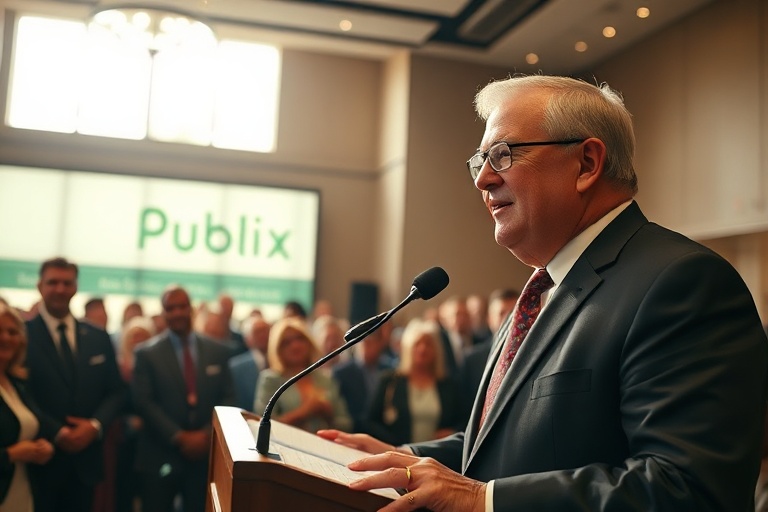
Todd Jones’ Retirement from Publix: A Quiet Exit from a Corporate Icon
Todd Jones, the familiar face of Publix Super Markets for over three decades, announced his retirement in late 2023, marking the end of an era for one of the most recognizable corporate leaders in American retail. As the face of the employee-owned grocery chain, Jones’ departure invites reflection on his legacy, the evolution of Publix itself, and the broader implications for corporate leadership in an increasingly competitive market.
Publix, founded in 1930 in Winter Haven, Florida, has long been more than just a supermarket—it’s a cultural institution. The company’s commitment to employee ownership, Southern hospitality, and community engagement has made it a model for corporate culture in the U.S. Jones, who joined Publix in 1990 as a management trainee, rose through the ranks to become president and CEO in 2016. His tenure coincided with a period of significant growth, innovation, and adaptation, particularly as the grocery industry faced disruption from e-commerce and shifting consumer habits.
The Man Behind the Apron: Todd Jones’ Journey
Jones began his career at Publix bagging groceries, a detail that resonated with employees and customers alike. His journey from the store floor to the executive suite was often cited as a testament to the company’s core values: hard work, loyalty, and a focus on people. Unlike many corporate leaders who prioritize shareholder returns above all, Jones emphasized Publix’s unique employee stock ownership plan (ESOP), which has made the company a favorite among workers.
During his time at the helm, Jones oversaw Publix’s expansion beyond Florida into new markets like North Carolina and Virginia, while also navigating the challenges of the COVID-19 pandemic. The grocery chain became a lifeline for communities during lockdowns, reinforcing its reputation as a trusted local brand. Jones’ leadership style—collaborative, humble, and community-focused—stood in contrast to the aggressive, profit-driven approaches of competitors like Walmart and Amazon.
A Changing Landscape for Grocery Retail
The grocery industry has undergone seismic shifts in recent years, with e-commerce giants and discounters reshaping consumer expectations. Publix, with its deep roots in the Southeast, has had to adapt while staying true to its identity. Under Jones’ leadership, the company invested in digital tools like curbside pickup and delivery, though it lagged behind competitors in some areas of online grocery sales.
Jones’ retirement comes at a pivotal moment. The rise of automation, labor shortages, and inflation have forced retailers to rethink their strategies. Publix’s employee-owned model, while a strength, also presents challenges in terms of scaling innovation and competing with publicly traded giants. The question now is whether Publix can maintain its distinct culture while evolving to meet the demands of a rapidly changing market.
What’s Next for Publix Without Jones?
Publix has not yet named a successor, but the company’s leadership transition is likely to be smooth given its strong internal culture. The ESOP structure means that employees have a vested interest in the company’s success, which could help ease concerns about leadership changes. However, the grocery industry’s competitive landscape shows no signs of slowing down.
For Jones personally, retirement marks the end of a storied career, but his influence will linger. His emphasis on people—both employees and customers—has left a lasting imprint on Publix. As the company looks to the future, it will need to balance tradition with innovation, ensuring that it remains a beloved brand in an increasingly impersonal retail world.
A Global Perspective on Corporate Leadership
Jones’ retirement also offers a lens through which to view corporate leadership trends worldwide. Employee-owned companies, like Publix, are relatively rare in the U.S. but have seen resurgence in countries like Spain (where Mondragon Corporation thrives) and Germany (where co-determination is a cornerstone of corporate governance). These models prioritize long-term stability and worker well-being over short-term profits, a philosophy that Jones embodied.
In contrast, many global retailers have embraced aggressive cost-cutting and automation, often at the expense of workforce stability. Publix’s approach—prioritizing both customers and employees—has won it loyal followings, but it also raises questions about scalability. Can employee-owned models compete in a world dominated by tech-driven giants? Jones’ legacy may lie in proving that they can, at least in niche markets.
The Cultural Legacy of Publix
Beyond its business model, Publix has woven itself into the fabric of Southern culture. Its famous “sub sandwiches,” sponsorship of local events, and even its mascot, the “Publix Apron,” have made it a beloved institution. Jones’ leadership helped sustain this cultural connection, ensuring that Publix remained more than just a place to shop—it’s a community hub.
As Publix moves forward without Jones, the company will need to find new ways to nurture that connection. The rise of digital shopping threatens to erode the personal touch that has defined Publix’s brand. Yet, if history is any indication, the company’s deep roots in its communities will help it weather the storm.
Looking Ahead: Lessons from Todd Jones’ Tenure
Jones’ retirement is more than a corporate milestone—it’s a moment to reflect on what it means to lead with integrity in a complex industry. His career underscores the value of long-term thinking, employee loyalty, and community engagement, principles that are often undervalued in today’s fast-paced business world.
For other retailers, Jones’ tenure offers a counterpoint to the cutthroat competition of modern commerce. His emphasis on people—both employees and customers—highlights a model that prioritizes sustainability over short-term gains. Whether Publix can maintain this ethos in the face of industry disruption remains to be seen, but Jones’ legacy will undoubtedly shape its future.
As the grocery wars heat up, one thing is clear: Publix’s story is far from over. With Jones’ retirement, the company enters a new chapter, one that will test its ability to balance tradition with innovation. For now, the aprons remain hung, the sandwiches are still fresh, and the communities still rely on their local Publix. The next act is just beginning.