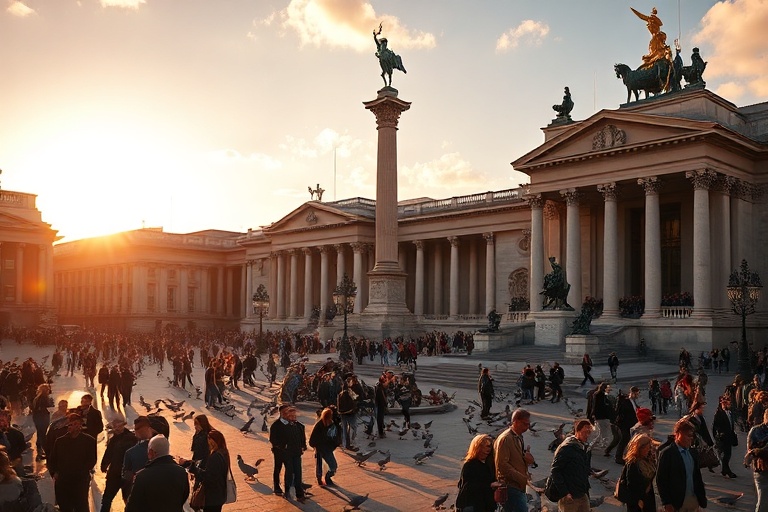
Few urban spaces command the same immediate recognition as Trafalgar Square. With Nelson’s Column rising over the fountains and the National Gallery anchoring its northern edge, this is more than just a public square—it is a living stage where history, art, and activism intersect daily. Its significance stretches far beyond its geographical footprint in central London, serving as a barometer for the city’s social and political pulse.
The Origins and Evolution of a National Landmark
Designed by Sir Charles Barry and completed in 1845, Trafalgar Square was commissioned to commemorate Admiral Horatio Nelson’s victory at the Battle of Trafalgar in 1805. The square’s name itself is a nod to the broader 18th-century British naval triumphs that shaped imperial identity. Yet its creation was not merely celebratory—it was also an urban planning intervention intended to revitalize a then-neglected area between the City of London and Westminster.
Architecturally, the square embodies the grandeur of the Victorian era. The four plinths flanking the base of Nelson’s Column were originally intended to hold statues of British monarchs, though only two remain today. The fourth plinth, however, has been repurposed as a rotating platform for contemporary art, a decision that transformed the space from a static monument into a dynamic cultural forum. Since 1999, the plinth has hosted works by artists such as Yinka Shonibare, David Shrigley, and Rachel Whiteread, challenging visitors to reconsider the relationship between history and modernity.
Key Transformations Over Time
- 1820s: Original plans drafted by John Nash and William Railton, envisioning a grand square with Nelson’s Column at its center.
- 1845: Official completion and public opening, featuring the iconic lions sculpted by Sir Edwin Landseer added in 1867.
- 1950s: Introduction of Christmas trees gifted annually by Norway, beginning a tradition that continues today.
- 2000s: The Fourth Plinth Programme launched, turning the square into a global stage for modern art.
More Than a Square: A Stage for Dissent and Celebration
Trafalgar Square has long transcended its role as a tourist attraction. It is a space of protest, celebration, and collective memory. During the 1960s and 1970s, it became a focal point for civil rights marches, anti-war demonstrations, and labor strikes. The square’s wide, open expanse and proximity to government buildings make it an ideal venue for amplifying voices that might otherwise go unheard.
In 1990, the Poll Tax Riots drew nearly 200,000 protesters to the square, highlighting public dissatisfaction with government policy. More recently, climate activists from Extinction Rebellion have occupied the space, using its symbolic power to demand urgent environmental action. These events underscore how Trafalgar Square functions not just as a static monument, but as a living forum where democracy unfolds in real time.
Conversely, the square also serves as the epicenter of national celebration. From VE Day in 1945 to the London 2012 Olympics, millions have gathered here to mark historic milestones. The annual Pride in London parade culminates here, reinforcing the square’s role as a site of inclusion and visibility for marginalized communities.
Art, Accessibility, and the Fourth Plinth Programme
The Fourth Plinth Programme, managed by the Mayor of London and Arts Council England, has redefined the square’s cultural impact. By commissioning temporary installations from international artists, it has turned Trafalgar Square into one of the most visible contemporary art platforms in the world. Works like Hahn/Cock (2013) by Katharina Fritsch—a giant blue cockerel perched atop the plinth—sparked both controversy and conversation, proving that public art can provoke as much as it inspires.
This initiative has also raised important questions about accessibility in public art. While the programme has diversified the voices represented in the square, critics argue that it remains dominated by established artists from Western contexts. The inclusion of more underrepresented voices, including artists of color and those from the Global South, continues to be a point of ongoing debate.
Notable Fourth Plinth Installations
- 2005: Alison Lapper Pregnant by Marc Quinn – a marble sculpture of a pregnant disabled woman.
- 2016: Folkestone Monument by Antony Gormley – 100 cast-iron figures based on local residents.
- 2022: Antinomy by Teresa Margolles – a sculpture exploring themes of migration and loss.
The Square in the 21st Century: Challenges and Opportunities
Today, Trafalgar Square faces a new set of challenges. The rise of social media has transformed the way people engage with public spaces. Visitors no longer come solely for contemplation or protest—they come for the perfect Instagram shot. This shift has led to concerns about overcrowding, commercialization, and the erosion of the square’s historical gravitas.
Meanwhile, debates about the square’s role in a post-Brexit Britain continue to unfold. As the UK redefines its global identity, Trafalgar Square remains a powerful symbol of national pride and historical legacy. Some argue for a more inclusive reinterpretation of the square’s monuments, while others advocate for preserving its traditional narrative. The tension between preservation and progress is palpable, reflecting broader societal divides.
Yet, despite these challenges, Trafalgar Square remains a vital part of London’s identity. Its ability to adapt—whether through art, activism, or public engagement—ensures its relevance in an ever-changing world. It is not just a relic of the past, but a living, breathing entity that continues to shape and be shaped by the people who pass through it.
A Gathering Place for All
From tourists snapping photos to activists raising banners, from schoolchildren on field trips to pigeons (a less welcome presence), Trafalgar Square belongs to everyone—and no one at the same time. Its power lies in its contradictions: it is both a monument to history and a blank canvas for the future; a space of order and a site of disruption. In an age of digital disconnection, such a place remains essential.
As London evolves, so too will Trafalgar Square. But one thing is certain: its role as a stage for the city’s collective life will endure. Whether through art, protest, or quiet reflection, the square will continue to reflect the soul of London—flawed, vibrant, and always in motion.
For more insights into London’s cultural landmarks and urban transformations, visit our Culture and Travel sections.