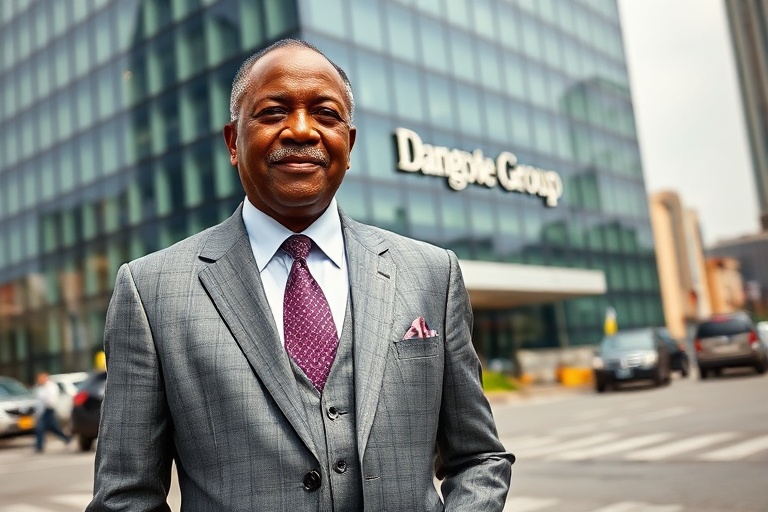
Aliko Dangote stands as a towering figure in global business, his name synonymous with African industrialization and economic transformation. Born in 1957 in Kano, Nigeria, Dangote built an empire that now spans multiple continents, challenging perceptions of what African enterprise can achieve. His journey from a small trading business to the continent’s richest person reflects both personal ambition and a broader movement toward African self-reliance in critical industries.
What sets Dangote apart is not just his wealth—estimated at over $13 billion as of 2024—but the scale and ambition of his industrial projects. Unlike many billionaires who focus on finance or technology, Dangote has staked his fortune on manufacturing, agriculture, and infrastructure. This strategic focus has made him a symbol of Africa’s potential to process its own raw materials rather than simply exporting them raw, a shift with profound implications for the continent’s economic future.
The Rise of a Business Empire
Dangote’s early career began in the 1970s when he borrowed $3,000 from his uncle to start a small trading firm. This modest beginning would grow into one of Africa’s most diversified conglomerates. The Dangote Group, founded in 1981, initially focused on commodities trading before expanding into manufacturing and production. By the 1990s, the company had established itself as a major player in Nigeria’s cement industry, a sector that would become the foundation of Dangote’s wealth.
The turning point came in 2005 when Dangote commissioned Nigeria’s first privately owned cement plant. This $2.5 billion investment didn’t just make him Nigeria’s cement king—it demonstrated that African businesses could compete with multinational corporations in heavy industry. Today, the Dangote Group operates in 20 African countries, employing over 30,000 people and contributing significantly to local economies through job creation and infrastructure development.
Dangote’s business philosophy emphasizes vertical integration, where his companies control every stage of production from raw material to finished product. This approach has allowed him to weather economic downturns and maintain profitability even during Nigeria’s frequent currency crises. It’s a model that has inspired a new generation of African entrepreneurs to think bigger about industrial development.
Industrial Projects That Redefine African Capabilities
Few business leaders have had as transformative an impact on their continent as Dangote has through his industrial projects. His investments span multiple sectors, each designed to reduce Africa’s reliance on foreign imports while creating thousands of jobs.
Cement: Building Africa’s Future
Dangote Cement, now Africa’s largest cement producer, operates in 10 countries with an annual production capacity exceeding 51 million tons. The company’s operations have been particularly transformative in countries like Ethiopia, where Dangote Cement’s plants have helped reduce construction costs and improve infrastructure quality. In Nigeria alone, the company has been credited with making housing more affordable and accessible to millions.
The company’s success story includes overcoming significant challenges. When Dangote first entered the cement market, Nigeria was importing nearly all its cement at premium prices. By building domestic production capacity, Dangote not only captured the local market but began exporting to neighboring countries, turning Nigeria into a cement exporter for the first time in decades.
The $19 Billion Refinery: A Game-Changer for Energy Independence
Perhaps Dangote’s most ambitious project is the Dangote Refinery, currently under construction near Lagos. When completed, this $19 billion facility will be Africa’s largest oil refinery and the world’s third-largest single-train refinery. Its 650,000 barrels per day capacity will make Nigeria self-sufficient in refined petroleum products for the first time since the 1960s.
The refinery’s impact promises to be revolutionary. Nigeria currently imports most of its fuel despite being Africa’s largest oil producer, a paradox that costs the country billions annually. The Dangote Refinery will eliminate these imports, save foreign exchange, and potentially make Nigeria a net exporter of refined products. This project alone could reshape Nigeria’s economy and serve as a model for other African nations seeking energy independence.
Beyond its economic impact, the refinery represents a cultural shift. For decades, Africa’s natural resources have flowed out of the continent in raw form, only to return as finished products at many times the original price. Dangote’s refinery challenges this dynamic, proving that African industry can add value to its own resources.
Cultural Impact and the Dangote Effect
Dangote’s influence extends beyond business into the cultural and social fabric of Africa. He has become a symbol of what’s possible when African entrepreneurs think globally while acting locally. His success has inspired countless young Africans to pursue careers in business rather than seeking opportunities abroad, reversing what was once called “brain drain.”
In Nigeria and across Africa, Dangote has become a cultural icon. His name is invoked in discussions about economic development, industrialization, and African pride. Schools, hospitals, and community projects bear his name, reflecting how deeply he’s woven into the social fabric. This cultural capital has made Dangote more than just a businessman—he’s become a symbol of African potential.
Dangote’s philanthropy, though less publicized than his business achievements, has also left a mark. Through the Aliko Dangote Foundation, he has invested in health initiatives, education programs, and poverty alleviation across Africa. The foundation’s work in nutrition and child health, in partnership with organizations like the World Health Organization, has improved millions of lives.
This combination of business success and social impact has created what’s been called “The Dangote Effect”—a phenomenon where his achievements inspire others to dream bigger about what Africa can accomplish. It’s a shift from seeing Africa as a recipient of aid to viewing it as a continent of innovators and industrialists.
The Challenges and Controversies
Despite his success, Dangote’s journey hasn’t been without challenges and controversies. The business environment in many African countries remains difficult, with infrastructure gaps, bureaucratic hurdles, and inconsistent policies posing constant threats. Dangote’s companies have sometimes faced criticism for their market dominance, particularly in Nigeria’s cement sector where competitors have accused the company of anti-competitive practices.
The sheer scale of Dangote’s projects has also made them targets for political interference. Some governments have pressured his companies for favors or concessions, while others have questioned whether such large foreign investments truly benefit local communities. In Ethiopia, for instance, there have been debates about whether Dangote’s cement plants adequately address local employment needs versus bringing in foreign labor.
Dangote himself has faced scrutiny over his close relationships with African leaders. Some critics argue that his business success is partly due to favorable government contracts and policies rather than purely market competition. While Dangote has never been accused of corruption, the opacity of some deals has fueled speculation about how much his political connections contribute to his success.
Yet these challenges haven’t diminished Dangote’s standing. If anything, they’ve highlighted the need for better business environments across Africa. His willingness to tackle difficult, capital-intensive projects in challenging markets has demonstrated that Africa’s potential can be realized despite systemic obstacles.
Lessons from Dangote’s Success
Several key factors have contributed to Dangote’s unprecedented success:
- Long-term vision: Dangote’s projects are designed to create lasting value rather than short-term profits. The Dangote Refinery, for example, won’t turn a profit immediately but will transform Nigeria’s energy sector for decades.
- Vertical integration: By controlling every stage of production, Dangote minimizes costs and maximizes efficiency across his businesses.
- Risk tolerance: His willingness to invest billions in unproven markets and massive infrastructure projects sets him apart from more conservative investors.
- Local adaptation: Dangote’s businesses are deeply rooted in African markets, adapting to local needs and conditions rather than imposing foreign models.
- Economic nationalism: His focus on reducing imports and adding value to African resources aligns with growing pan-African sentiments about economic independence.
A Legacy in the Making
As Dangote approaches his seventh decade, his legacy is still being written. At 67 years old, he shows no signs of slowing down, with plans to expand into new sectors like agriculture and telecommunications. His most significant contribution may prove to be the blueprint he’s created for African industrialization—one that emphasizes self-reliance, vertical integration, and long-term thinking.
Dangote’s impact extends beyond business metrics. He has fundamentally changed how the world views African business potential. Where once Africa was seen primarily as a source of raw materials, Dangote has demonstrated that it can be a center of industrial production and innovation. His refinery project alone could redefine Nigeria’s role in global energy markets.
The challenges ahead are substantial. Africa’s infrastructure gaps, political instability in some regions, and global economic pressures all threaten to constrain growth. Yet Dangote’s story proves that these obstacles can be overcome with the right combination of vision, capital, and persistence.
As Africa’s population continues to grow and urbanize, the demand for infrastructure, housing, and consumer goods will only increase. Dangote’s companies are positioning themselves to meet this demand while creating economic value that stays within the continent. In this sense, his legacy may be measured not just in dollars or tons of cement produced, but in the industries he’s helped create and the entrepreneurs he’s inspired.
For a continent often defined by its challenges, Dangote represents a different narrative—one of ambition, capability, and transformative change. His story reminds us that economic transformation isn’t just possible in Africa; it’s already happening, one cement plant, one refinery, one factory at a time.
Explore more about African business leaders and their global impact on Dave’s Locker Business.
Discover how infrastructure development is shaping Africa’s future in our Analysis section.