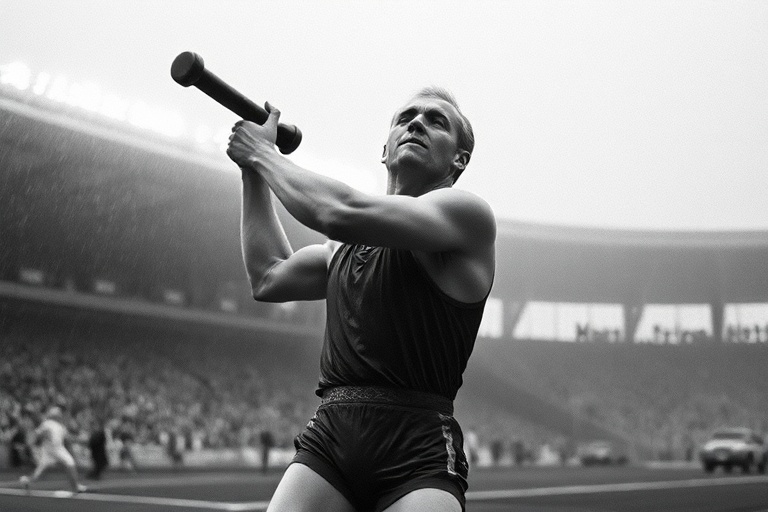
Who Was Karl Hein?
Karl Hein occupies a peculiar space in sports history—as one of the most dominant yet overlooked figures of the early 20th century. Born in 1908 in Hamburg, Germany, Hein rose to prominence as a hammer thrower, a sport in which he would rewrite the record books and leave an indelible mark on athletics.
His career spanned the 1920s and 1930s, a period marked by the global rise of competitive sports and the institutionalization of international competitions. Hein’s name became synonymous with the hammer throw during his prime, as he shattered world records and claimed gold medals that cemented his legacy. Yet, despite his achievements, his story has largely faded from public memory, overshadowed by more contemporary athletic icons.
Hein’s journey began not in grand stadiums, but on the muddy fields and industrial outskirts of Hamburg. His early life was shaped by the working-class neighborhoods of the city, where physical labor was a way of life. It was in this environment that Hein developed the raw strength and technique that would later define his throwing style—grounded in discipline, repetition, and an intuitive understanding of momentum.
The Rise of a Throwing Titan
Hein’s breakthrough came in 1930, when he first eclipsed the 50-meter barrier in the hammer throw. This was no small feat. The hammer throw demands a rare combination of explosive power, rotational speed, and precise timing. At the time, only a handful of athletes had managed to exceed 50 meters, and Hein did so with a technique that blended traditional British-style throws with innovative body mechanics.
By 1934, Hein had claimed his first European Championships title, a victory that signaled the arrival of a new force in track and field. His dominance was not merely about strength—it was about rhythm. He perfected a spinning delivery that maximized centrifugal force, allowing the hammer to reach unprecedented distances. Coaches and athletes from across Europe studied his form, trying to replicate the fluidity and control he exhibited in competition.
- 1930: First throw beyond 50 meters (50.87m)
- 1934: European Champion in Turin, setting a new championship record
- 1936: Gold medal at the Berlin Olympics with a throw of 56.49m
- 1938: Final world record of 58.24m, unbroken for nearly a decade
His performance at the 1936 Berlin Olympics remains one of the most iconic moments in his career. Held in a stadium designed to showcase Aryan physical superiority, Hein’s victory carried symbolic weight. Though his success was a testament to individual excellence, it also became entangled in the political narratives of the era—a reality Hein navigated with quiet professionalism rather than political engagement.
Technique, Training, and the Science Behind the Throw
What set Hein apart from his contemporaries was not just his results, but his methodical approach to the sport. In an era when athletic training was often ad hoc, Hein worked closely with coaches to develop structured regimens that emphasized biomechanics, recovery, and mental preparation. He was among the first throwers to use filmed analysis to refine his technique, a practice that would later become standard in elite sports.
His throwing style was characterized by a compact, controlled spin—three full rotations before release—allowing for optimal energy transfer from the ground through the kinetic chain of the body. This approach minimized wasted motion and maximized rotational velocity, a principle that modern hammer throwers still study today. In many ways, Hein was a pioneer of the technical revolution in throwing sports.
Hein also understood the importance of conditioning. Unlike many athletes who relied solely on natural strength, he incorporated weighted exercises, explosive plyometrics, and rotational drills into his training. His approach foreshadowed the modern emphasis on functional strength and sport-specific training, bridging the gap between raw power and athletic precision.
The Hammer Throw in the Early 20th Century
The hammer throw was still a relatively new discipline in international competition during Hein’s era. The event originated in Scotland in the 16th century as a test of strength among blacksmiths, who would swing a sledgehammer in contests of endurance and distance. By the late 19th century, it had evolved into a formal sport, with standardized equipment and rules.
Hein competed during a transitional period when the hammer was shifting from a rural pastime to an Olympic event. His success helped legitimize the discipline, proving that it required not just brute force, but skill, strategy, and finesse. In doing so, he elevated the profile of the hammer throw and inspired a generation of athletes to take up the implement.
Legacy and the Quiet Endurance of Greatness
After retiring from competition, Hein largely disappeared from the public eye. He worked as a coach and later in sports administration, but he never sought the spotlight that followed many of his contemporaries. His retirement in 1948 coincided with the post-war reconstruction of Europe, a time when athletic priorities shifted toward recovery and renewal.
Despite his relative obscurity today, Hein’s records stood for years. His 1938 world record of 58.24 meters remained unbroken until 1956. Even after it was surpassed, his technique continued to influence throwers in East Germany and the Soviet Union, where hammer throwing became a point of national pride during the Cold War.
Hein’s story reflects a broader theme in sports history: the tension between recognition and legacy. While Jesse Owens, Luz Long, and other 1936 Olympians became global icons, Hein’s achievements were confined largely to the annals of track and field. His life reminds us that greatness is not always measured by fame, but by the standards one sets and the barriers one breaks.
Why Karl Hein Still Matters
Hein’s career offers more than just a historical footnote. It provides a lens through which to examine the evolution of athletic training, the globalization of sports, and the role of politics in competition. His technical innovations laid groundwork that modern athletes still build upon, and his dedication to refinement over raw power challenges contemporary notions of athletic development.
In an era obsessed with metrics and instant validation, Hein’s story underscores the value of patience, precision, and process. He did not seek viral moments or social media fame. Instead, he pursued excellence through repetition, analysis, and quiet mastery—a model that resonates even in today’s high-pressure sports culture.
As we reflect on the pioneers of track and field, Karl Hein deserves a place among the greats—not just for what he achieved, but for how he achieved it. His legacy is not one of spectacle, but of substance. It is a legacy built on discipline, innovation, and an unyielding commitment to the craft of throwing.
In revisiting his story, we are reminded that true excellence often lies not in the roar of the crowd, but in the silence of the training field—where one athlete, spinning under a gray Hamburg sky, redefined what was possible.
For those interested in the evolution of throwing sports and the athletes who shaped them, explore more on Sports and History at Dave’s Locker.