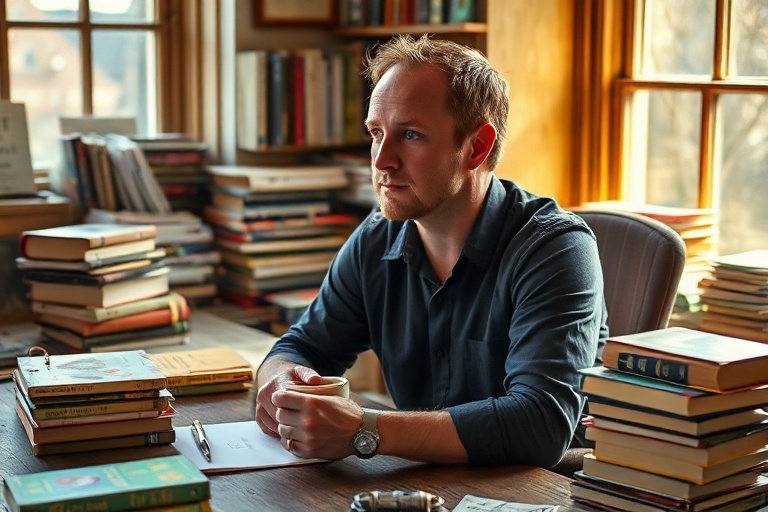
Matt Haig is one of the most distinctive voices in contemporary literature, crafting stories that feel both timeless and urgently relevant. His work spans novels, non-fiction, and children’s books, yet all share a rare ability to articulate the anxieties and small joys of everyday life. Whether exploring mental health, identity, or the quiet desperation of modern existence, Haig’s prose resonates with readers who often feel overlooked by mainstream narratives.
Born in Sheffield, England, in 1974, Haig began his literary career after a personal struggle with depression and anxiety. This period of his life became the foundation for his memoir The Sick Bag Song, a fragmented, poetic reflection on mental health and recovery. His breakthrough novel How to Stop Time (2017) further cemented his reputation as a writer who blends the extraordinary with the deeply human. Today, Haig’s books have sold millions of copies worldwide, translated into over forty languages, and adapted into screen projects, including a forthcoming film adaptation of The Midnight Library.
From Struggle to Storytelling: The Core of Haig’s Work
Haig’s writing career didn’t follow a predictable path. After studying English and history at Hull University, he worked in advertising before turning to full-time writing. His early novels, such as The Dead Fathers Club (2006), a darkly comic retelling of Hamlet, and The Possession of Mr Cave (2008), a psychological thriller, showcased his versatility. But it was Reasons to Stay Alive (2015), a memoir about his battle with depression, that transformed him into a literary figure for a generation.
This book, written in spare, poetic fragments, became a lifeline for readers grappling with their own mental health challenges. Unlike traditional self-help texts, Haig’s memoir reads like a conversation with a trusted friend—raw, honest, and infused with dark humor. It also established a recurring theme in his work: the idea that even in despair, there are reasons to keep going.
Haig’s novels often explore similar themes through imaginative frameworks. In The Midnight Library (2020), a woman finds herself in a liminal space between life and death, where she can explore alternate versions of her life based on different choices. The novel became a cultural touchstone, especially during the pandemic, when readers sought narratives about regret, possibility, and second chances. It wasn’t just a bestseller; it was a phenomenon that spoke to the collective uncertainty of the moment.
The Power of Accessibility in Haig’s Writing
One of the most remarkable aspects of Haig’s success is his refusal to write for a narrow literary elite. His prose is clean, direct, and often funny, avoiding the pretentiousness that can alienate general readers. This accessibility has made his work a staple in schools, book clubs, and mental health advocacy circles alike.
His children’s books, such as the A Boy Called Christmas series, continue this ethos. These stories, filled with warmth and whimsy, tackle themes of belonging and resilience in a way that feels natural rather than didactic. Haig has spoken openly about how his own childhood struggles with bullying influenced these tales, making them deeply personal yet universally relatable.
Haig’s Literary Themes: Mental Health, Time, and Human Connection
Haig’s work consistently circles back to three major themes: mental health, the passage of time, and the importance of human connection. In Notes on a Nervous Planet (2018), he extends the conversation from Reasons to Stay Alive by examining how modern technology—particularly social media—exacerbates anxiety and depression. The book is less a critique and more an invitation to mindfulness, offering practical advice without moralizing.
His fascination with time is evident in novels like How to Stop Time, where the protagonist ages at an imperceptible rate. The story weaves historical figures like Shakespeare and Captain Cook into a meditation on memory, legacy, and the fear of being forgotten. It’s a novel that asks: What would you do if you had all the time in the world? The answer, for Haig, is simple—live fully, even in the mundane moments.
Human connection is perhaps the most consistent thread. In The Humans (2013), an alien takes over the body of a Cambridge professor to prevent humanity from discovering a revolutionary mathematical theorem. The twist? The alien becomes unexpectedly fond of human irrationality—our capacity for love, art, and even self-destruction. It’s a story about what it means to be human, told from the outside in, and it’s quintessential Haig: profound yet playful.
Beyond the Page: Haig’s Influence and Adaptations
Haig’s reach extends beyond books. He’s a vocal advocate for mental health awareness, frequently collaborating with organizations like mental health charities and participating in campaigns to reduce stigma. His social media presence is notable for its authenticity, often sharing personal reflections alongside book promotions. This blend of public advocacy and private reflection has made him a trusted figure for readers seeking both entertainment and enlightenment.
His stories have also found new life in other formats. The Midnight Library is being adapted into a film by Universal Pictures, with Haig involved in the process. The project aims to capture the novel’s emotional depth while translating its surreal premise into cinematic language. Similarly, A Boy Called Christmas was adapted into a Netflix film in 2021, introducing Haig’s whimsical world to a global audience of families and fantasy lovers.
The adaptations speak to Haig’s ability to straddle genres—literary fiction, fantasy, memoir, and children’s literature—without losing his distinctive voice. Whether he’s writing about a man who lives for centuries or a boy who discovers the truth about Santa Claus, Haig’s stories always circle back to the same question: What does it mean to be alive?
The Future of Matt Haig’s Literary Legacy
As of 2024, Haig continues to write prolifically. His next novel, Hill of Dreams, is eagerly anticipated by fans who appreciate his blend of historical fiction and psychological depth. He’s also exploring new formats, including essays and potential television projects. Despite his success, Haig remains grounded, often emphasizing the importance of writing for himself first and foremost.
What sets Haig apart is his refusal to be pigeonholed. He’s neither a genre writer nor a literary purist, but something in between—a storyteller who respects his readers enough to challenge them without overwhelming them. In an era where literature is often dismissed as irrelevant, Haig’s work proves that stories still have the power to heal, to question, and to connect.
For those new to his work, the entry point matters less than the journey. Start with Reasons to Stay Alive if you’re seeking solace. Try The Midnight Library if you’re pondering life’s what-ifs. Or dive into A Boy Called Christmas for a dose of holiday magic. Each book offers a different facet of Haig’s genius, but all share the same core: a deep, abiding belief in the resilience of the human spirit.
In a literary landscape crowded with noise, Matt Haig’s voice stands out for its clarity and compassion. He writes not to escape reality, but to illuminate it—one page, one reader, at a time.
About the Author: This article was written by a staff writer for Dave’s Locker, focusing on contemporary authors whose work resonates across genres and generations.