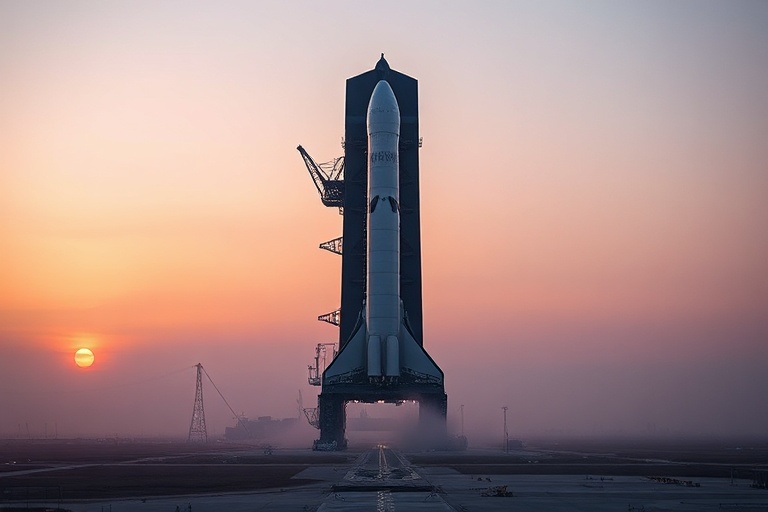
Starship: SpaceX’s Revolutionary Rocket for Mars and Beyond
“`html
Starship: The Ambitious Future of Space Exploration
SpaceX’s Starship represents one of the most ambitious engineering projects of the 21st century. Designed to be fully reusable, this massive rocket system aims to revolutionize space travel by drastically reducing costs and increasing payload capacity. With its stainless steel construction and massive Raptor engines, Starship is built to carry humans to Mars and beyond, while also supporting lunar missions and satellite deployments.
The program has faced numerous challenges, from early prototype explosions to regulatory hurdles, yet each setback has brought valuable lessons. As SpaceX continues testing, the world watches closely, recognizing that Starship could redefine humanity’s relationship with space. This article examines the key aspects of Starship’s development, its technological innovations, and the broader implications for the future of space exploration.
The Evolution of Starship: From Concept to Reality
SpaceX first unveiled the Starship concept in 2016 under the name “BFR” (Big Falcon Rocket). Elon Musk, the company’s CEO, described it as a fully reusable, two-stage rocket designed for missions to Mars. The design has undergone significant changes since then, evolving from a smaller, carbon-fiber structure to the current stainless steel iteration.
Key milestones in Starship’s development include:
- 2019: Construction begins on the first prototypes in Boca Chica, Texas.
- 2020: First high-altitude test flights, though several prototypes, including SN8 and SN9, exploded during landing attempts.
- 2021: Successful high-altitude flight and landing of SN15, marking a major breakthrough.
- 2022: Starship’s upper stage completes a full-duration orbital test flight, though the booster stage was lost during the mission.
- 2023: Rapid iteration continues with tests of the integrated Starship and Super Heavy booster system.
The iterative approach—testing, failing, and refining—has been central to SpaceX’s strategy. Unlike traditional aerospace programs that prioritize perfection before flight, SpaceX embraces rapid prototyping, learning from each failure to improve the next iteration. This philosophy has accelerated development but also drawn scrutiny from regulators and safety advocates.
Technological Innovations Behind Starship
Starship’s design incorporates several groundbreaking technologies that set it apart from other rockets. Its stainless steel structure, for instance, offers durability and heat resistance, crucial for re-entry from deep space missions. The Raptor engines, powered by methane and liquid oxygen, are another standout feature. Unlike traditional rocket engines that use kerosene, Raptor engines are designed for full reusability, with the ability to be rapidly refurbished and reflown.
The rocket’s size is also unprecedented. Standing at nearly 400 feet tall, Starship is the largest and most powerful launch vehicle ever built. Its payload capacity of over 100 metric tons to low Earth orbit surpasses even NASA’s Space Launch System (SLS). This capacity is essential for ambitious projects like building a lunar base or establishing a self-sustaining city on Mars.
Another innovation is the fully reusable design. While the Space Shuttle was partially reusable, Starship is intended to be entirely reusable, with both the booster (Super Heavy) and the upper stage (Starship) designed to land back on Earth for refurbishment and reflight. This could reduce the cost of space travel by orders of magnitude, making it feasible to send thousands of people to Mars over the coming decades.
Challenges and Setbacks
Despite its promise, Starship’s development has not been without obstacles. Early prototypes, such as SN1 and SN3, suffered structural failures during ground testing. Later, high-altitude test flights revealed issues with engine performance, fuel management, and landing stability. Each failure provided critical data, but they also delayed schedules and raised concerns among critics about the program’s safety and reliability.
Regulatory challenges have also played a significant role. The Federal Aviation Administration (FAA) has conducted multiple environmental reviews, and the approval process for orbital test flights has been lengthy. In 2022, the FAA cited SpaceX for over 75 environmental violations related to the Starship program, including impacts on wildlife and cultural resources in the Boca Chica area. SpaceX has since worked to address these concerns, but regulatory scrutiny remains a hurdle.
Starship’s Role in Space Exploration and Beyond
Starship is poised to play a pivotal role in several key areas of space exploration. One of its primary missions is NASA’s Artemis program, which aims to return humans to the Moon by 2026. Starship has been selected as the lunar lander for Artemis missions, tasked with ferrying astronauts from lunar orbit to the Moon’s surface. This contract, worth nearly $3 billion, underscores NASA’s confidence in Starship’s capabilities, despite its ongoing development challenges.
Beyond the Moon, Starship is central to SpaceX’s vision of making humanity a multi-planetary species. Musk has long emphasized Mars as the ultimate goal, and Starship is designed to carry up to 100 people on a single trip. The rocket’s capacity to transport large payloads also makes it ideal for constructing habitats, greenhouses, and other infrastructure necessary for a sustainable Martian colony.
In addition to human spaceflight, Starship could revolutionize satellite deployment and space tourism. Its massive payload capacity allows for the launch of entire constellations of satellites in a single mission, reducing the cost of global internet coverage and Earth observation. Companies like Starlink, which is already using SpaceX’s Falcon rockets, could benefit immensely from Starship’s efficiency.
The Broader Implications for Spaceflight
Starship’s success could reshape the economics of space travel. Traditional rockets are expendable, meaning each launch requires building a new vehicle, driving up costs. Starship’s full reusability could slash the price of sending payloads to orbit from tens of thousands of dollars per kilogram to just a few thousand. This cost reduction could unlock new industries, such as asteroid mining, space manufacturing, and even off-world tourism.
The program also highlights the growing competition in the commercial space sector. Companies like Blue Origin, with its New Glenn rocket, and United Launch Alliance, with its Vulcan Centaur, are developing heavy-lift rockets to compete with Starship. Meanwhile, international players like China’s Long March 9 and Russia’s Yenisei are also advancing their own super-heavy rockets. The space race is no longer solely between nations but increasingly between private companies.
However, Starship’s ambitions extend beyond competition. By proving that large-scale, fully reusable rockets are viable, SpaceX could set a new standard for the industry. This could encourage other companies to adopt similar technologies, accelerating the pace of innovation and making space more accessible than ever before.
What’s Next for Starship?
As of 2024, SpaceX continues to push the boundaries of Starship’s capabilities. The next major milestone is the completion of an orbital test flight, where the Starship upper stage will attempt to reach orbit before splashing down near Hawaii. Simultaneously, SpaceX is ramping up production in Boca Chica and developing the infrastructure needed for frequent launches, including a new launch site in Florida.
The company is also focusing on improving the reliability of its Raptor engines, which have experienced issues with combustion instability and wear. Upgrades to the engine design, along with enhancements to the rocket’s thermal protection system, are expected to address these challenges. Additionally, SpaceX is working on refining the Starship’s landing systems to ensure safe returns, whether on Earth or other planetary surfaces.
Looking further ahead, Musk has outlined a timeline for crewed missions to Mars, with the first uncrewed cargo missions potentially launching in the late 2020s. While these dates are ambitious, the progress of Starship suggests that such goals are within reach. The rocket’s development is a testament to the power of iterative engineering and the relentless pursuit of ambitious objectives.
Conclusion: A New Era of Spaceflight
Starship stands at the forefront of a potential revolution in space exploration. Its innovative design, ambitious goals, and rapid development cycle have captured the imagination of scientists, engineers, and space enthusiasts worldwide. While challenges remain, the progress made so far demonstrates the feasibility of fully reusable, large-scale rockets—a concept once considered science fiction.
As Starship continues to evolve, its impact will extend far beyond SpaceX. It has the potential to redefine the economics of space travel, enable new scientific discoveries, and pave the way for humanity’s expansion into the solar system. Whether it succeeds or faces further setbacks, Starship has already proven that bold visions can drive progress, even in an industry as complex and unforgiving as aerospace.
For those watching the skies, Starship represents more than just a rocket. It is a symbol of what is possible when innovation, determination, and a willingness to embrace risk converge. The journey to Mars—and beyond—has only just begun.