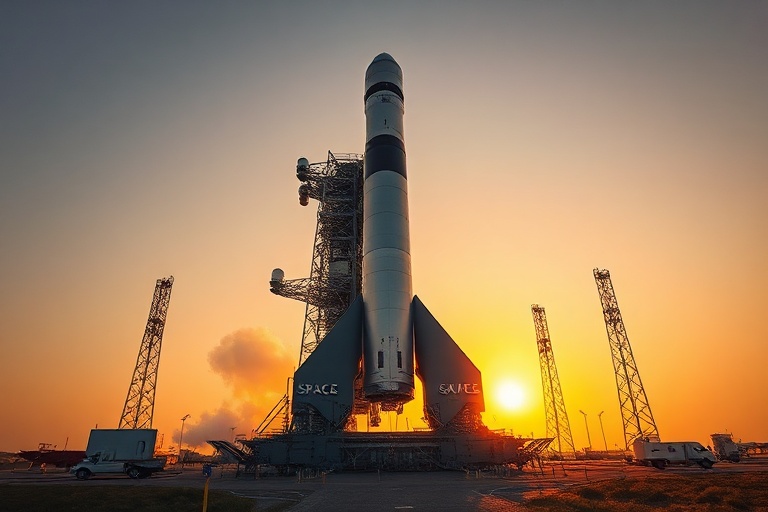
Starship: The Rocket Redefining Space Travel and Global Ambition
“`html
The Starship: Engineering Ambition Meets Cosmic Ambition
Space exploration has always been defined by milestones that once seemed impossible. Few projects embody that spirit as completely as SpaceX’s Starship. Designed as a fully reusable, super-heavy lift launch vehicle, Starship isn’t just another rocket—it’s a reimagining of how humans access the cosmos. With its stainless-steel body, methane-fueled Raptor engines, and towering 120-meter profile, it represents a fusion of industrial boldness and futuristic vision.
From its first suborbital hops in Texas to ambitious lunar and Martian aspirations, Starship has become a symbol not only of technological progress but also of global ambition. It challenges the status quo of spaceflight by prioritizing reusability, cost reduction, and scalability. As nations and private companies race toward sustainable off-world colonization, Starship sits at the forefront—both as a tool and a testament to human ingenuity.
A Revolution in Reusability and Design
Traditional rockets are, by design, disposable. Once launched, their components are discarded, often burning up in the atmosphere or sinking into the ocean. Starship flips this model entirely. Both its first-stage booster, known as Super Heavy, and the upper-stage spacecraft are built to return to Earth intact and be reused. This fundamental shift could slash the cost of space access from tens of thousands of dollars per kilogram to just hundreds—a transformation that could democratize orbital industry.
The rocket’s distinctive stainless-steel construction isn’t merely aesthetic. Unlike carbon fiber or aluminum-lithium alloys, steel maintains strength at cryogenic temperatures and resists heat during re-entry, reducing the need for complex thermal protection systems. The choice reflects SpaceX’s ethos: practical, durable, and scalable engineering over polished perfection.
Its Raptor engines, burning liquid methane and oxygen, are another innovation. Methane can be synthesized on Mars using local resources, making Starship a potential key to sustainable interplanetary travel. This closed-loop thinking is central to Elon Musk’s vision of becoming a multi-planetary species.
Global Collaboration and Competition
Starship’s development is not happening in isolation. While SpaceX leads the charge, the project has catalyzed a global response. In Europe, the Ariane 6 and reusable concepts from companies like Rocket Lab and Isar Aerospace are evolving in parallel. China’s Long March 9 and reusable rockets from CASC and private firms like LandSpace are advancing rapidly, often drawing inspiration from Starship’s design philosophy.
In India, the Indian Space Research Organisation (ISRO) has accelerated its Gaganyaan and reusable launch vehicle programs, with test flights of scaled prototypes. Japan’s JAXA continues to refine its H3 rocket while exploring reusability. Even nations like the UAE and Saudi Arabia are investing in spaceports and satellite ventures, positioning themselves for a future where orbital and lunar infrastructure becomes central to national strategy.
This isn’t just competition—it’s a new era of spacefaring nationalism. Countries are no longer content to be spectators; they are building sovereign access to space, often with Starship serving as both inspiration and challenge.
Cultural Symbolism and Public Imagination
Beyond engineering, Starship has captured the public imagination in ways few space vehicles have. Its sleek, retro-futuristic design evokes both vintage sci-fi pulp covers and the bold optimism of the Apollo era. When prototypes like SN10 and SN15 performed controlled landings—albeit with dramatic explosions—the internet erupted not just with technical analysis, but with memes, art, and even fashion inspired by its form.
Starship has become a cultural artifact, appearing in video games like Kerbal Space Program 2, referenced in music videos, and even inspiring architectural projects. It represents a bridge between the tangible and the aspirational—a reminder that space isn’t just for astronauts anymore. It’s for dreamers, creators, and entire generations who grew up watching launches on YouTube.
Its naming too carries weight. “Starship” echoes the grand narratives of science fiction, reinforcing the idea that humanity’s future lies among the stars. This narrative is especially potent in an era of climate anxiety and geopolitical tension. Starship offers a counter-narrative: progress, expansion, and hope.
Challenges and Controversies
But ambition doesn’t come without risk. Starship’s development has faced technical setbacks, regulatory hurdles, and public scrutiny. The April 2023 test flight of the full stack ended with a rapid unscheduled disassembly—an industry euphemism for explosion—just minutes after liftoff. The debris field stretched across the Gulf of Mexico, raising environmental and safety concerns.
Residents of Boca Chica, Texas, where SpaceX’s Starbase is located, have reported noise pollution, road closures, and anxiety over potential accidents. Local communities, though supportive of economic opportunities, have also become vocal about balancing innovation with quality of life. SpaceX has responded with community outreach, but the tension between progress and place remains a real challenge.
Environmental concerns extend beyond the launch site. Methane leaks, though rare, could have significant climate impacts if scaled. Critics argue that focusing on Mars colonization distracts from urgent Earth-based crises like climate change. Supporters counter that space technology often yields terrestrial benefits—satellites for weather monitoring, GPS for disaster response, and materials science innovations.
What’s Next for Starship?
As of 2024, Starship is preparing for its fourth integrated flight test, with milestones including orbital refueling demonstrations and lunar landing rehearsals. NASA’s Artemis program has selected a modified Starship as the Human Landing System for the first crewed return to the Moon, targeting a 2026 landing. This partnership marks a pivotal moment—government and private sector aligning on a shared vision.
The long-term goal remains Mars. Musk has repeatedly stated that Starship’s ultimate purpose is to enable the colonization of the Red Planet, with the first uncrewed cargo missions potentially launching in the late 2020s. While skeptics question the timeline, the infrastructure is being built—launch sites in Texas and Florida, orbital propellant depots, and even early habitats.
Starship’s journey is far from over. It’s a work in progress, a symbol, and a catalyst. It challenges engineers, inspires artists, and forces nations to reconsider their place in the cosmos. In an age where division often dominates the headlines, Starship offers a unifying vision: that humanity’s future is not confined to a single planet.
Conclusion: A New Chapter in Human Spaceflight
Starship is more than a rocket. It’s a declaration that the next giant leap for mankind isn’t just possible—it’s being engineered today. Its stainless skin gleams not just with reflected sunlight, but with the accumulated dreams of a species reaching for the stars.
As SpaceX continues to refine the design and global partners step up their own ambitions, one thing is clear: the age of reusable, interplanetary travel has begun. Whether through lunar bases, Mars cities, or entirely new industries in Earth orbit, Starship will likely be the vehicle that carries us there.
And in the grand story of human exploration, that may be its most important legacy—not just as a machine, but as a mirror of our own potential.
Further Reading
- Explore more on space technology and science on Dave’s Locker.
- Follow the latest in aerospace innovation through our technology section.