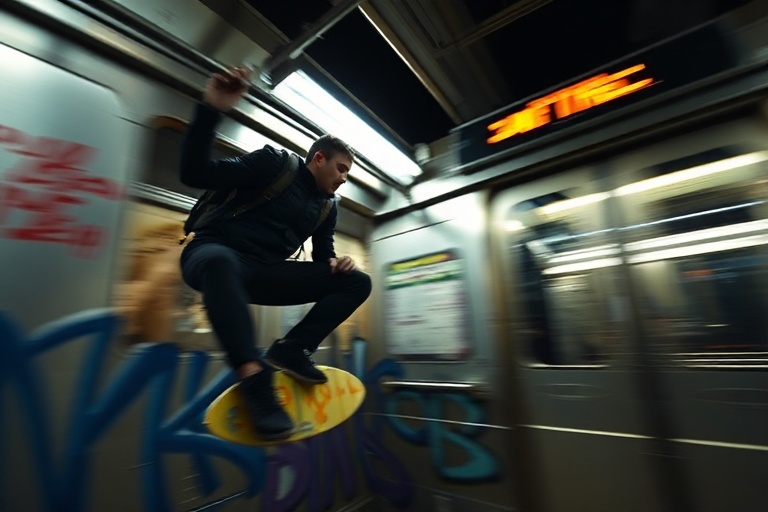
On a late summer evening in New York City, a viral video captured a fleeting moment of adrenaline. A lone figure balanced on the side of a moving subway car, arms outstretched, as the train accelerated through a tunnel. The footage, shared across social platforms, reignited a debate about subway surfing—an extreme activity that blends urban exploration, risk-taking, and a dash of rebellion.
Once confined to niche subcultures, subway surfing has resurfaced as a controversial trend, fueled by social media and a generation seeking new forms of thrill. While some dismiss it as reckless behavior, others see it as a raw expression of freedom in an increasingly controlled world. But beyond the daring images lies a complex reality of legal consequences, safety risks, and psychological allure.
The Rise of a Forbidden Pastime
Subway surfing, also known as train hopping or platform jumping, traces its roots to the early 20th century, when hobos and drifters rode freight trains across America. The urban version—clinging to subway cars—emerged in dense cities like New York, London, and Tokyo, where public transit became both a necessity and a playground.
By the 1980s and 1990s, subway surfing had evolved into a subculture, immortalized in graffiti art, hip-hop lyrics, and underground films. It wasn’t just about transportation; it was about defiance, craft, and connection to the city’s pulse. For many, it symbolized escape from the monotony of routine, a way to feel alive in a world of steel and concrete.
Today, social media has transformed the act from a secretive skill into a shareable spectacle. Platforms like TikTok and Instagram amplify each daring clip, turning subway surfers into instant influencers—sometimes with millions of views. But with visibility comes scrutiny, and the thrill now carries the weight of public judgment.
The Allure: Why People Risk It All
The motivations behind subway surfing are as varied as the participants themselves. For some, it’s about the rush. The human brain releases dopamine in response to calculated risks, creating a temporary high that can be addictive. Others are drawn to the aesthetic—the way a rider’s silhouette contrasts against the blur of a moving train, creating a living photograph.
There’s also the sense of mastery. Navigating a subway car in motion demands balance, timing, and spatial awareness. It’s a physical and mental challenge that few dare attempt. For urban explorers, subway surfing offers a way to interact with the city’s infrastructure in a way most people never experience.
But perhaps the most compelling draw is the rebellion. Subway surfing is illegal in most major cities, and being caught can lead to fines, arrest, or injury. This built-in danger adds a layer of defiance that resonates with those who feel stifled by societal rules. It’s not just about riding a train—it’s about asserting control in a system designed to regulate movement.
The Risks: What Could Go Wrong
The dangers of subway surfing are severe and well-documented. Each year, emergency services respond to incidents involving falls, electrocutions, and collisions. Trains travel at speeds exceeding 50 mph, and the gap between the platform and the train is often just inches wide. A misstep can be fatal.
Electrical hazards pose another lethal threat. Third rails carry thousands of volts, and contact with them is almost always deadly. Even indirect exposure—such as touching a wet surface connected to the power grid—can result in severe injury or death. In 2022, a 19-year-old in Chicago was electrocuted while attempting to board a moving train, a tragedy that underscored the real cost of the stunt.
Legal repercussions are also significant. In New York, subway surfing is classified as reckless endangerment, punishable by fines up to $250 and potential jail time. Transit police have increased patrols in hotspots, using drones and surveillance cameras to catch offenders. Some cities have even implemented AI-powered systems to detect unauthorized riders on train roofs.
Beyond personal risk, subway surfing affects public safety. Trains forced to stop due to trespassers create delays that ripple across entire networks, inconveniencing thousands of commuters. Transit authorities argue that such stunts endanger not only the perpetrators but also passengers and employees.
A Day in the Life of a Subway Surfer
To understand the subculture more deeply, we spoke with former practitioners who now advocate against the practice. One, who asked to remain anonymous, described the routine: scouting stations during off-hours, timing train speeds, and memorizing escape routes. “It’s like a chess game,” they said. “Every move has to be perfect.”
They also emphasized the community aspect. Subway surfers often work in groups, watching each other’s backs. Trust is essential, but so is secrecy. Many riders avoid posting online, knowing that geotags and timestamps can lead authorities straight to them.
The Ethical Debate: Freedom vs. Responsibility
The rise of subway surfing has sparked a broader conversation about youth culture, risk, and responsibility. Some argue that the activity is a natural extension of urban exploration, a way to reclaim public space in an era of privatization. Others see it as a symptom of declining mental health, where thrill-seeking masks deeper issues like depression or alienation.
Transit agencies have taken a hardline stance, framing subway surfing as a form of vandalism and trespassing. Yet critics point out that the crackdowns disproportionately target marginalized communities, where alternatives like safe recreational spaces are scarce. The debate isn’t just about safety—it’s about equity.
In response, some cities have introduced alternative activities. Skate parks, rock climbing gyms, and urban adventure clubs offer controlled environments for thrill-seekers. These programs aim to redirect energy toward safer outlets while acknowledging the underlying desire for risk and mastery.
The Future of Subway Surfing
As technology advances, subway surfing may become even more perilous. High-speed trains, automated systems, and enhanced surveillance make the activity riskier and more detectable. Yet the human drive to push boundaries remains.
For now, subway surfing persists as a polarizing phenomenon—admired for its audacity, condemned for its recklessness. It challenges societal norms, tests personal limits, and captures the imagination of a generation raised on instant gratification and viral fame.
But beneath the bravado lies a stark truth: the thrill is fleeting, while the consequences can last a lifetime. As one transit worker put it, “We’re not just chasing riders. We’re trying to save lives.”
For those tempted by the allure of the rails, the message is clear: the city may move fast, but the risks move faster. And in the end, no viral clip is worth a life.
To explore related extreme sports and urban adventures, visit our Trending and Culture sections for more stories that challenge convention and inspire discussion.