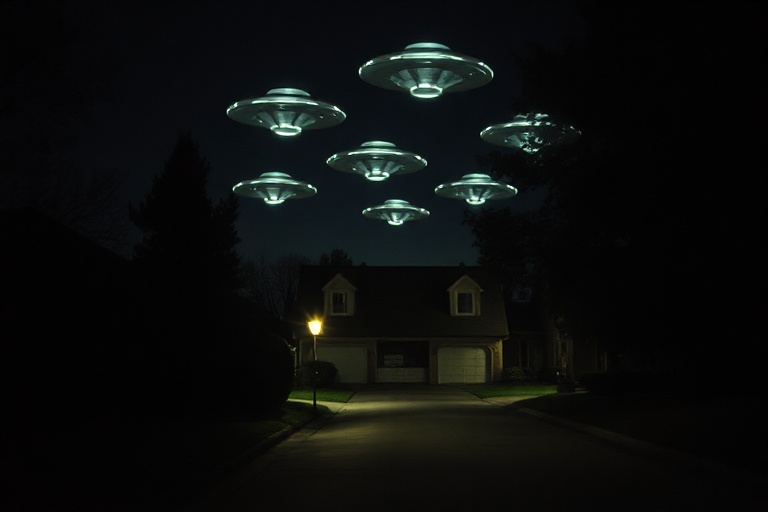
The fascination with unidentified flying objects has persisted for decades, evolving from fringe conspiracy theories into a subject of serious government scrutiny. What was once dismissed as pseudoscience now commands attention from astronomers, military personnel, and lawmakers alike. Recent disclosures and declassified documents have thrust UFO sightings back into the public consciousness, raising questions about what might be lurking beyond our atmosphere.
While skepticism remains widespread, a growing body of evidence—including radar data, eyewitness testimonies, and now official acknowledgments—suggests that not all UFO encounters can be easily explained. This shift in perception has prompted researchers to revisit old cases while maintaining rigorous standards for verification. The line between credible reports and sensationalism continues to blur, but one thing is certain: the conversation is far from over.
Documented Cases That Defy Simple Explanations
Some of the most compelling UFO sightings have been documented by trained observers, including pilots, law enforcement, and military personnel. These cases stand out not just for their strangeness, but for the consistency of details across multiple independent accounts. The 2004 Nimitz incident off the coast of California remains one of the most scrutinized events in modern ufology.
During a training exercise, Navy pilots encountered a craft that exhibited flight characteristics beyond known human technology. Described as a Tic Tac-shaped object, it moved at impossible speeds without any visible propulsion. The incident was later corroborated by radar data and infrared footage, though the Pentagon has never provided a definitive explanation. Similar reports from commercial pilots over the years suggest that this may not be an isolated event.
Another notable case occurred in 1977 when the Chilean Air Force tracked an unidentified object for over an hour using radar and visual confirmation. The object, described as metallic and emitting no sound, moved erratically before vanishing from all sensors simultaneously. Such cases challenge conventional explanations, leaving room for speculation about potential non-human origins.
When the Government Acknowledges the Unexplained
The U.S. government’s shifting stance on UFOs has been one of the most significant developments in recent years. After decades of denial, the Pentagon confirmed the existence of the Advanced Aerospace Threat Identification Program (AATIP) in 2017, a secret initiative dedicated to studying unidentified aerial phenomena. This revelation was followed by the release of three declassified videos showing encounters between Navy pilots and unknown objects, which were later authenticated by the Pentagon.
The creation of the All-domain Anomaly Resolution Office (AARO) in 2022 further institutionalized the study of UFOs within the Department of Defense. Unlike previous investigations, which often dismissed reports as sensor errors or misidentifications, AARO has taken a more methodical approach. While most cases have been attributed to mundane explanations—such as drones, weather balloons, or atmospheric phenomena—some remain unresolved.
This new transparency has led to bipartisan calls for further investigation. In 2023, Congress held its first public hearing on UFOs in over 50 years, featuring testimony from former intelligence officials and military witnesses. The hearing highlighted the need for standardized reporting protocols and better data collection, signaling a potential shift in how the government approaches these phenomena.
Common Misidentifications and How to Spot Them
Not all UFO sightings are evidence of extraterrestrial visitation. Many reports can be explained by natural or man-made phenomena, though they often appear otherworldly to casual observers. Understanding these common misidentifications is crucial for separating genuine mysteries from mundane explanations.
The following list outlines some of the most frequent sources of UFO reports:
- Planets and Stars: Bright celestial objects like Venus, Jupiter, or Sirius can appear to move or flicker due to atmospheric distortion, leading to reports of “hovering orbs.”
- Weather Balloons and Drones: High-altitude balloons, often used for meteorological research, can drift unpredictably and reflect sunlight in unusual ways.
- Aircraft and Satellites: Commercial flights, military aircraft, and even the International Space Station have been mistaken for UFOs due to their altitude and speed.
- Atmospheric Phenomena: Lenticular clouds, light pillars, and other rare weather events can create illusions of structured craft.
- Birds and Insects: Swarms of birds or insects can appear as a single moving object when viewed from a distance, especially at night.
Even with these explanations in mind, some cases defy easy categorization. The key to credibility lies in multiple corroborating sources, such as radar data, photographs taken from multiple angles, or independent eyewitness accounts. Without such evidence, most reports remain intriguing but inconclusive.
Why the UFO Phenomenon Persists Despite Skepticism
The persistence of UFO sightings, even in an era of advanced technology, speaks to something deeper than mere misidentification. Human psychology plays a significant role in how we perceive and interpret the unknown. The brain is wired to seek patterns, often filling in gaps with familiar shapes—whether it’s a flock of birds forming a geometric pattern or a distant light that resembles a spacecraft.
Cultural narratives also shape our expectations. Decades of science fiction have conditioned us to associate UFOs with little green men or advanced civilizations. This has led to a paradox where genuine anomalies are either dismissed outright or sensationalized beyond reason. The result is a landscape where credible reports are often drowned out by fringe theories and conspiracy narratives.
Yet, the most compelling cases often come from individuals with no prior interest in UFOs. A 2021 study published in the journal Scientific Reports analyzed 20 years of military pilot sightings and found that many reports came from highly trained observers who had no reason to fabricate their experiences. Their accounts described objects with flight characteristics that defy the laws of physics as we understand them.
This suggests that the UFO phenomenon may not be about little green men after all. Instead, it could be pointing to gaps in our scientific knowledge—perhaps new physics, advanced propulsion systems, or even natural phenomena we have yet to discover. The reluctance to engage with these possibilities stems not from a lack of evidence, but from a reluctance to challenge established paradigms.
The Future of UFO Research: Challenges and Opportunities
As interest in UFOs grows, so too do the challenges facing researchers. One of the biggest obstacles is the lack of standardized reporting protocols. Unlike other scientific fields, ufology lacks a centralized database where verified cases can be cataloged and studied. This makes it difficult to identify patterns or trends over time.
Another challenge is the stigma associated with UFO research. Many scientists and academics avoid the topic due to its association with pseudoscience and conspiracy theories. This has created a self-perpetuating cycle where serious researchers are discouraged from pursuing the subject, leaving the field dominated by enthusiasts and opportunists.
However, there are reasons for optimism. The rise of citizen science initiatives, such as the Sky Hub project, has democratized data collection. Using smartphones and inexpensive equipment, volunteers around the world are contributing to a growing repository of UFO reports. Meanwhile, organizations like the Scientific Coalition for UAP Studies (SCU) are working to bring scientific rigor to the field.
Technological advancements also offer new avenues for investigation. High-resolution cameras, AI-powered image analysis, and improved radar systems could help distinguish between genuine anomalies and mundane explanations. The key will be fostering collaboration between amateur researchers, scientists, and government agencies to ensure that credible reports are not lost in the noise.
Conclusion: A Phenomenon Worth Taking Seriously
The UFO phenomenon is no longer a fringe topic confined to late-night talk shows and obscure documentaries. It has entered the mainstream, thanks in large part to government transparency and the tireless efforts of researchers who refuse to dismiss the unknown. While many sightings can be explained, others remain tantalizingly unresolved, demanding further investigation.
What makes the current moment unique is the opportunity for genuine progress. For the first time in history, we have the technology, the institutional support, and the public interest to tackle these mysteries head-on. Whether the answers lie in advanced technology, natural phenomena, or something more profound, the pursuit of truth is itself a worthwhile endeavor.
As we move forward, it is essential to approach the subject with both curiosity and skepticism. Rigorous standards must be upheld, and sensationalism must be avoided. Only then can we hope to separate fact from fiction and uncover the reality behind the UFO phenomenon.