When comparing Morocco and Madagascar, two of Africa’s most distinctive nations, the contrasts are as striking as the parallels. Both countries boast rich cultural heritages, diverse ecosystems, and growing international profiles. Yet they diverge sharply in geography, economy, and global positioning. This analysis explores their unique identities, recent developments, and the forces shaping their futures.
Morocco, with its Mediterranean and Atlantic coastlines, serves as a bridge between Africa and Europe. Its economy thrives on tourism, agriculture, and a burgeoning automotive industry. Madagascar, by contrast, is an island nation in the Indian Ocean, known for biodiversity and natural resources. While Morocco enjoys relative stability and infrastructure investment, Madagascar faces challenges like political instability and environmental degradation. These differences frame a compelling comparison of two nations on distinct trajectories.
Economic Landscapes: Contrasting Models of Growth
Morocco’s economy is one of Africa’s most diversified, driven by manufacturing, services, and agriculture. The country has positioned itself as a regional leader in industries like automotive and aerospace, hosting major international firms such as Renault and Boeing suppliers. Tourism also plays a pivotal role, with destinations like Marrakech and Casablanca drawing millions annually. In 2023, Morocco’s GDP grew by 3.5%, supported by infrastructure projects like the Noor Ouarzazate solar plant, one of the world’s largest.
Madagascar’s economy, while rich in potential, remains heavily reliant on agriculture and extractive industries. Vanilla, cloves, and nickel are among its top exports, but inconsistent governance and weak infrastructure hinder growth. The World Bank reports that over 75% of the population lives on less than $2.15 per day. Unlike Morocco, Madagascar struggles to attract foreign investment outside its extractive sectors. However, sectors like ecotourism and IT services are slowly gaining traction, particularly in eco-lodges and digital nomad communities.
Both nations face climate-related challenges. Morocco invests heavily in renewable energy, aiming for 52% renewable electricity by 2030. Madagascar, vulnerable to cyclones and droughts, is investing in climate adaptation with support from international partners. These contrasting approaches highlight different priorities: Morocco focuses on industrialization and energy transition, while Madagascar emphasizes resilience and sustainable livelihoods.
Cultural and Political Dynamics: Stability vs Volatility
Morocco’s political system is characterized by constitutional monarchy and relative stability. King Mohammed VI has overseen gradual reforms since 2000, including women’s rights advancements and greater press freedoms. The country maintains strong diplomatic ties with Europe, the U.S., and African nations, positioning itself as a mediator in regional conflicts. Its media landscape is vibrant, with outlets like TelQuel and Le Matin offering critical journalism within legal boundaries.
Madagascar, by contrast, has experienced recurrent political crises since independence in 1960. The 2009 coup and subsequent instability disrupted economic progress and donor relations. While the current government has restored some stability, corruption and weak institutions remain obstacles. Civil society is active but fragmented, and protests occasionally erupt over governance and living standards. Media freedom is constrained by political pressures, with journalists facing harassment and legal threats.
Culturally, both nations celebrate rich traditions. Morocco’s blend of Arab, Berber, and European influences is reflected in its music, cuisine, and architecture. Traditional crafts like zellige tilework and embroidery are UNESCO-recognized. Madagascar’s culture is a fusion of Austronesian, African, and French influences, seen in its music (e.g., salegy), cuisine (like romazava stew), and unique biodiversity-inspired folklore. Yet, while Morocco leverages its cultural heritage for global appeal, Madagascar’s potential remains underutilized due to infrastructure gaps.
Tourism: Two Very Different Experiences
Morocco’s tourism sector is a well-oiled machine, with over 13 million visitors in 2023. The country offers a mix of imperial cities, desert adventures, and coastal resorts. Cities like Fes and Marrakech are cultural hubs, while the Atlas Mountains and Sahara Desert attract adventure travelers. The government’s “Tourism Vision 2030” plan aims to double arrivals by focusing on luxury, wellness, and digital nomad visas.
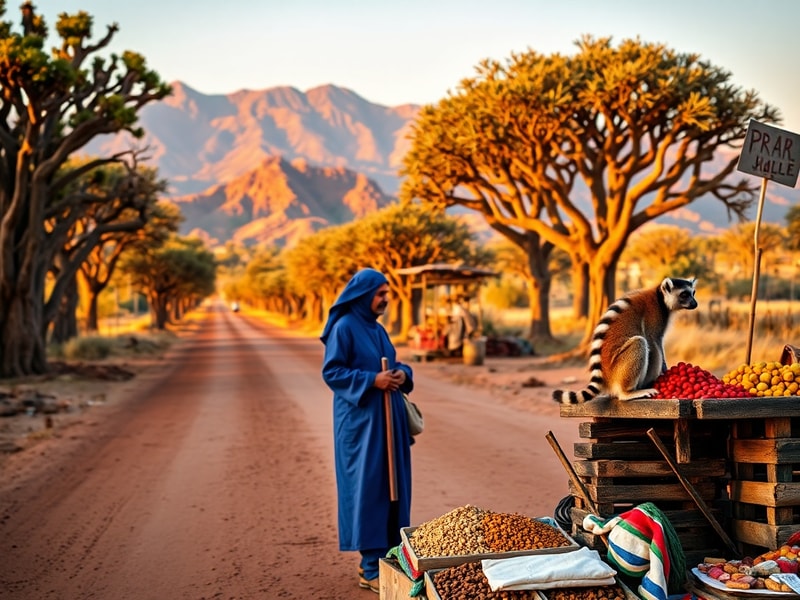
Madagascar’s tourism is niche but growing, centered on ecotourism and wildlife. The Avenue of the Baobabs and Andasibe-Mantadia National Park are iconic destinations. However, limited flight connections, poor roads, and safety concerns deter mass tourism. The government is working to improve accessibility, including a new visa-on-arrival system, but challenges persist. Unlike Morocco, Madagascar’s tourism model emphasizes authenticity over infrastructure.
For travelers seeking convenience and diversity, Morocco is the clear choice. For those pursuing off-the-beaten-path adventures, Madagascar offers unparalleled biodiversity. Both countries, however, face the dual challenge of balancing tourism growth with environmental and cultural preservation.
Regional Influence and Global Standing
Morocco punches above its weight in African and global affairs. It is a non-permanent member of the UN Security Council (2023–2024) and a key player in the African Union, rejoining in 2017 after a 33-year absence. The country also hosts the annual African Nations Championship football tournament and is a major advocate for African climate action. Its proximity to Europe gives it strategic importance in migration, trade, and security.
Madagascar’s global footprint is smaller but growing. It is a member of the Southern African Development Community (SADC) and the African Union, though its influence is limited by internal challenges. The country plays a critical role in marine biodiversity conservation, hosting 5% of the world’s species. International NGOs like Conservation International and WWF are active in Madagascar, supporting conservation and community development projects.
Economically, Morocco benefits from trade agreements like the U.S.-Morocco Free Trade Agreement and its advanced status with the EU. Madagascar, while part of the African Continental Free Trade Area (AfCFTA), struggles to integrate due to infrastructure deficits. Both countries, however, are increasingly turning to China for investment, with Morocco hosting major Chinese industrial projects and Madagascar receiving infrastructure loans.
Environmental Challenges and Conservation Efforts
Morocco is a regional leader in climate action, with ambitious renewable energy targets and reforestation programs. The country has also pioneered desalination projects to address water scarcity. However, desertification and coastal erosion remain concerns, particularly in the south. The government’s “Green Morocco Plan” supports sustainable agriculture and rural development.
Madagascar is a global biodiversity hotspot, home to lemurs, baobabs, and thousands of endemic species. Yet, it also faces severe environmental threats. Deforestation, driven by slash-and-burn agriculture and illegal logging, has reduced forest cover by nearly 40% since the 1950s. The government has launched initiatives like the “Durban Vision” to triple protected areas, but enforcement is weak. International partnerships are critical, with organizations like the Lemur Conservation Foundation working alongside local communities.
Climate change exacerbates both nations’ challenges. Morocco’s droughts and heatwaves threaten agriculture, while Madagascar’s cyclones and coastal erosion endanger livelihoods. Both countries are investing in adaptation strategies, but the scale of the crisis demands greater global support.
Conclusion: Divergent Paths, Shared Aspirations
Morocco and Madagascar represent two sides of Africa’s potential and challenges. Morocco’s strategic location, economic diversification, and political stability position it as a continental leader. Its ability to balance tradition with modernity offers a model for other African nations. Madagascar, with its unparalleled natural wealth and resilient people, holds immense promise but requires stronger governance and investment to realize it.
Both countries are at crossroads. Morocco’s focus on industrialization and renewable energy could inspire a new era of sustainable growth. Madagascar’s path hinges on stabilizing its institutions and leveraging its ecological uniqueness. For observers, the comparison underscores the diversity of African experiences—where progress is possible but never guaranteed.
As Africa’s global profile rises, Morocco and Madagascar will continue to play distinct roles. Whether in climate action, cultural diplomacy, or economic innovation, their stories reflect the continent’s broader narrative: a blend of resilience, creativity, and untapped potential.