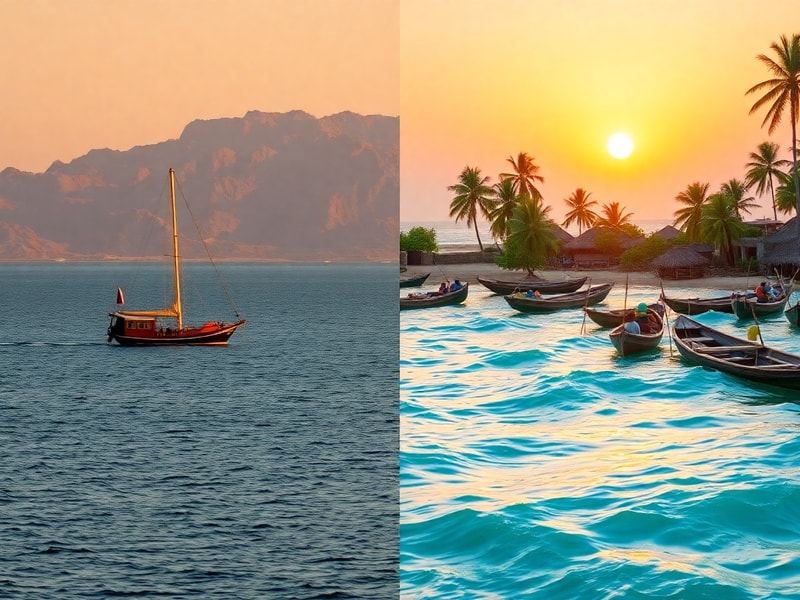
Oman and Mozambique, two nations separated by geography but united by their unique cultural and economic landscapes, offer fascinating contrasts. While one sits on the southeastern coast of the Arabian Peninsula, the other stretches along the southeastern coast of Africa. Both countries boast rich histories, diverse ecosystems, and evolving economic strategies that shape their global roles.
Geography and Climate: Contrasts in Terrain and Weather
Oman’s terrain is dominated by arid deserts, rugged mountain ranges like the Al Hajar Mountains, and a 1,700-kilometer coastline along the Arabian Sea and Gulf of Oman. The country experiences a hot desert climate, with temperatures soaring above 40°C in summer and minimal rainfall. In contrast, Mozambique features a longer coastline of 2,500 kilometers along the Indian Ocean, vast fertile plains, and tropical rainforests. Its climate is humid and warm year-round, with a distinct wet season from October to April.
The geographical differences extend to their natural resources. Oman is rich in oil and natural gas, with reserves that have fueled its economy for decades. Mozambique, on the other hand, is blessed with fertile soil, mineral deposits like coal and titanium, and significant offshore natural gas reserves discovered in the past decade. These resources are transforming Mozambique into one of Africa’s fastest-growing economies.
Economic Landscapes: From Oil to Emerging Markets
Oman’s economy has long relied on its hydrocarbon sector, which accounts for roughly 80% of its government revenue. The country has made efforts to diversify through tourism, logistics, and manufacturing, but oil remains central to its financial stability. In 2023, Oman’s GDP was approximately $110 billion, with a growth rate of 4.3%, supported by rising oil prices and increased gas production.
Mozambique, with a GDP of about $15 billion, is a different story. While it remains one of the poorest countries in the world, its economic outlook is improving. The discovery of massive natural gas fields off its northern coast has positioned it to become one of the top LNG exporters globally by 2030. However, challenges such as political instability, infrastructure gaps, and debt crises have slowed progress. The country’s economic growth rate of 3.7% in 2023 reflects both potential and persistent hurdles.
Both nations are investing in infrastructure. Oman’s tourism sector, particularly in Muscat and Salalah, is expanding with new resorts and cultural sites. Mozambique is focusing on port development in Maputo and Nacala to facilitate trade and energy exports. Yet, while Oman leverages its strategic location for logistics and trade, Mozambique’s potential lies in its untapped natural wealth and agricultural output.
Key Economic Indicators (2023 Estimates)
- Oman: GDP $110B, GDP per capita $22,000, Unemployment 17%, Inflation 1.7%
- Mozambique: GDP $15B, GDP per capita $450, Unemployment 24%, Inflation 10.3%
Cultural and Historical Tapestries
Oman’s history is marked by maritime trade, Islamic heritage, and the legacy of the Ibadi sect, which distinguishes it from its Sunni and Shia neighbors. The country’s forts, such as Bahla Fort and Nizwa Fort, are UNESCO World Heritage Sites that reflect its architectural and cultural depth. Oman’s society is relatively homogeneous, with a strong emphasis on tribal traditions and Islamic values. The government promotes a moderate form of Islam and has invested in education and healthcare, resulting in a literacy rate of 95%.
Mozambique’s history is a blend of Bantu migrations, Portuguese colonial rule (1498–1975), and a civil war that ended in 1992. The country’s culture is a fusion of African traditions and Portuguese influences, evident in its music, cuisine, and architecture. Maputo, the capital, is known for its colonial-era buildings and vibrant arts scene. Mozambique’s literacy rate stands at 60%, lower than Oman’s but improving through government and NGO-led education initiatives. The country is also home to more than 20 ethnic groups, each contributing to its rich cultural mosaic.
Political Stability and Global Relations
Oman has maintained a reputation for political stability in a volatile region. Sultan Haitham bin Tariq, who ascended to the throne in 2020, has pursued cautious reforms, including anti-corruption measures and economic diversification. Oman maintains neutral foreign policies, acting as a mediator in regional conflicts and maintaining strong ties with both Western and Gulf states. Its strategic location near the Strait of Hormuz makes it a key player in global energy security.
Mozambique, meanwhile, has faced significant political challenges. The civil war left deep scars, and recent insurgencies in the northern Cabo Delgado province have displaced hundreds of thousands. The government, led by President Filipe Nyusi, has struggled to maintain security and attract investment. However, the discovery of natural gas has drawn international attention, with companies like TotalEnergies and ExxonMobil investing billions. The country’s political stability remains fragile, but the potential economic benefits of its gas sector could drive long-term change.
Both countries are members of the United Nations and the African Union (Mozambique) or the Gulf Cooperation Council (Oman). Oman is also part of the Arab League and has observer status in the African Union, reflecting its bridging role between regions. Mozambique, as a Portuguese-speaking nation, maintains strong ties with Lusophone countries and is a member of the Commonwealth.
Future Outlook: Opportunities and Challenges
Oman’s future hinges on its ability to diversify its economy beyond oil. The government’s Vision 2040 plan aims to reduce oil’s share of GDP to 10% by 2040, focusing on tourism, mining, and logistics. The country’s youth unemployment rate of 15% remains a concern, but initiatives in vocational training and entrepreneurship are slowly making an impact. Oman’s neutrality and stable governance make it an attractive destination for foreign investors seeking a foothold in the Gulf.
For Mozambique, the path forward is more complex. The gas boom offers a lifeline, but the country must address corruption, infrastructure deficits, and security threats. The IMF and World Bank have provided financial support, but debt sustainability remains a pressing issue. If managed well, Mozambique could transition from a low-income country to a middle-income economy within a decade. However, the risks of mismanagement and conflict could derail progress.
Both nations face environmental challenges. Oman is grappling with water scarcity and desertification, while Mozambique is vulnerable to cyclones and rising sea levels. Climate change poses a threat to Mozambique’s agricultural sector, which employs 70% of the workforce. Oman, despite its arid climate, is investing in desalination and renewable energy projects, including solar farms. Mozambique, with its abundant sunlight and water resources, has the potential to develop hydroelectric and solar power, but investment is needed.
Top 3 Economic Drivers for Each Nation
- Oman:
- Oil and natural gas production
- Tourism (especially eco-tourism and cultural tourism)
- Logistics and port services
- Mozambique:
- Natural gas exports (expected to begin in 2027)
- Agriculture (cashews, shrimp, and cotton)
- Mining (coal, titanium, and gemstones)
Conclusion: Two Paths, Shared Aspirations
Oman and Mozambique are at different stages of development, but both are navigating the challenges of economic transformation, political stability, and environmental sustainability. Oman’s strengths lie in its stability, strategic location, and gradual reforms, while Mozambique’s future is tied to its natural resources and the government’s ability to harness them responsibly. Despite their differences, both countries share a commitment to progress and a desire to improve the lives of their citizens.
As Oman diversifies its economy and Mozambique taps into its gas reserves, the world will watch closely. Success in either nation could serve as a model for other resource-rich countries facing similar challenges. For now, Oman remains a beacon of stability in the Gulf, while Mozambique holds the promise of an economic renaissance. Their stories are a reminder that progress is possible, even in the face of adversity.
Whether through Oman’s serene deserts or Mozambique’s lush landscapes, both countries offer lessons in resilience, adaptation, and hope for the future.