Lawsuit Aims to Block UFC Fight at the White House
“`html
Legal Challenge Targets UFC Event at Iconic White House Location
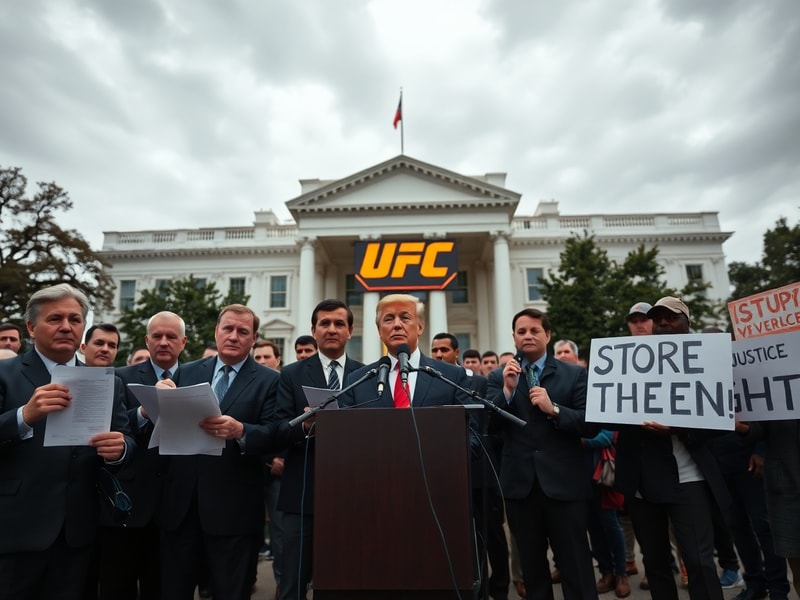
The Ultimate Fighting Championship (UFC) has faced its share of controversies over the years, but a recent lawsuit seeks to halt what would be one of the most unconventional fight venues in the organization’s history. A coalition of activists and local residents has filed a legal challenge to prevent a planned UFC event from taking place in the East Room of the White House, an unprecedented move that blurs the lines between sports entertainment and political symbolism.
The lawsuit, filed in the U.S. District Court for the District of Columbia, argues that hosting a mixed martial arts (MMA) event in such a historically significant space violates federal regulations governing the use of government property. The plaintiffs, including a group advocating for the preservation of presidential landmarks, claim that the commercialization of the White House undermines its dignity and public purpose. Their concerns extend beyond logistics—they question whether the event aligns with the values of a nation that has long treated the White House as a unifying symbol rather than a venue for spectacle.
How the Fight for the White House Venue Unfolded
The push for a UFC event at the White House began with whispers in early 2024, when promoters floated the idea of a high-profile pay-per-view (PPV) card tied to a major political milestone. Speculation grew after UFC President Dana White hinted at the possibility during a podcast interview, suggesting that the event could serve as a celebration of American resilience—or simply as a headline-grabbing stunt. By May, reports confirmed that negotiations were underway between the UFC and the National Park Service, which manages the White House and its surrounding grounds.
Opponents of the plan quickly mobilized. A coalition formed within days, led by historian groups and civic organizations that argued the White House was never intended to host combat sports. Their legal filing cites the Commemorative Works Act and the National Park Service Management Policies, both of which restrict the use of federal property for commercial activities that conflict with its primary purpose. The lawsuit demands an injunction to block the event, pending a full environmental and cultural impact review.
Cultural Clash: Sports, Politics, and Public Perception
The debate over this UFC event reflects broader tensions between entertainment and tradition in American culture. The White House has hosted concerts, including performances by the Marine Band, but those events were framed as patriotic or ceremonial. MMA, by contrast, is often associated with Las Vegas-style excess, pay-per-view buys, and a fanbase that thrives on spectacle. Critics argue that bringing the sport into the White House would normalize the commercialization of public institutions, setting a precedent that could extend to other historic venues.
Globally, the reaction has been mixed. In Europe, where combat sports often carry a stigma due to their association with underground fighting, the idea has drawn criticism from cultural commentators who see it as a crass American export. Meanwhile, in countries where MMA enjoys mainstream acceptance—such as Brazil, Japan, or Russia—the controversy is viewed through a different lens. Some international fans argue that the White House event could elevate the sport’s global profile, while others dismiss it as a gimmick that distracts from more pressing issues.
The lawsuit also raises questions about the role of sports in diplomacy. Could a UFC event at the White House be seen as a soft-power tool, akin to a cultural exchange? Or does it risk trivializing the office of the presidency? These questions are particularly relevant in an era where sports and politics increasingly intersect, from athlete activism to state-sponsored sporting events.
What Happens Next? Legal and Logistical Hurdles
The court’s response to the lawsuit will likely hinge on two key factors: the strength of the plaintiffs’ legal arguments and the UFC’s ability to demonstrate that the event serves a public good. The plaintiffs have already filed for an emergency injunction, which could delay or cancel the event if granted. Their legal team argues that the UFC’s commercial interests do not outweigh the historic and symbolic value of the White House.
If the lawsuit fails, the UFC could still face logistical challenges. The East Room, while spacious, was not designed for a combat sports event. The flooring, lighting, and crowd control systems would require significant modifications, raising safety and accessibility concerns. The National Park Service would also need to approve any structural changes, adding another layer of bureaucracy to an already contentious process.
The timeline for a resolution remains unclear. If the case proceeds to a full hearing, it could take weeks or even months to reach a verdict. In the meantime, the UFC has remained tight-lipped about contingency plans, though industry insiders suggest they are exploring alternative venues in the Washington, D.C. area.
A Broader Conversation About Sports and Public Spaces
Regardless of the lawsuit’s outcome, the debate over the White House UFC event underscores a growing tension: Who controls the narrative around public spaces? Should historic landmarks be treated as neutral ground, or do they carry an inherent responsibility to reflect certain values? The answers are not simple, and they extend far beyond MMA.
Consider other recent controversies, such as the push to host a Formula 1 race in Central Park or the debate over naming stadiums after corporate sponsors. These cases reveal a society grappling with the balance between progress and preservation. The UFC’s White House event may seem like an outlier, but it is part of a larger conversation about how we use—and sometimes exploit—our shared cultural heritage.
For now, the plaintiffs remain steadfast in their opposition. “This isn’t about sports,” said one of the lead attorneys in the case. “It’s about protecting the sanctity of the places that define us as a nation.” Whether their efforts succeed or fail, their challenge forces us to confront uncomfortable questions about where we draw the line between entertainment and reverence.
—
Conclusion: The Fight Isn’t Over
The lawsuit targeting the UFC’s White House event is more than a legal battle—it is a referendum on the role of sports in public life. As the case unfolds, it will force policymakers, fans, and athletes to reconsider what is acceptable in spaces meant to symbolize national identity. The outcome may set a precedent for future events, shaping how we engage with our most iconic locations.
For now, the East Room remains silent, its chandeliers unlit and its marble floors untouched by the roar of a crowd. But the conversation it has sparked is only beginning.
—