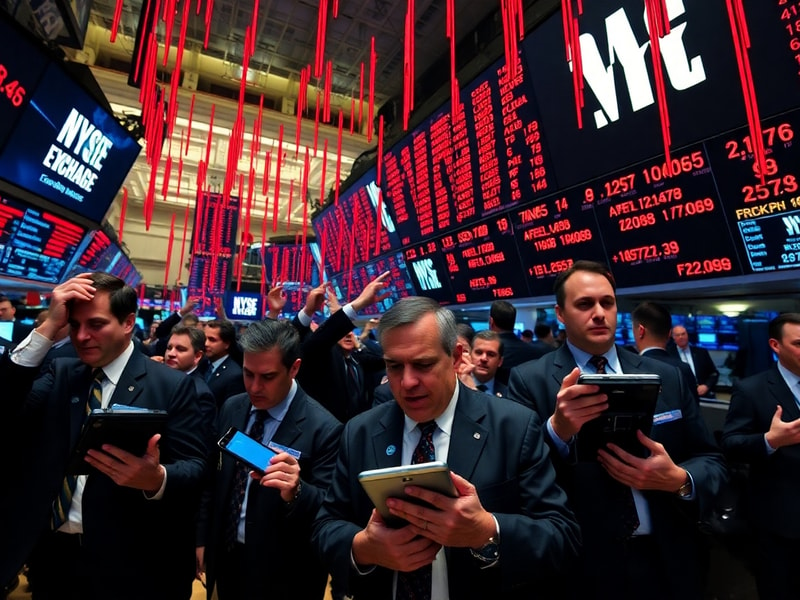
The tech-heavy Nasdaq Composite index experienced another volatile trading session, with major technology stocks leading declines amid growing concerns over valuation pressures and Federal Reserve policy signals. The selloff, which has now extended for three consecutive weeks, reflects a broader reassessment of growth prospects in the sector. Investors are recalibrating portfolios as macroeconomic headwinds collide with earnings realities.
Leading decliners included shares of Nvidia, which fell more than 6% on Tuesday, dragging down the entire semiconductor group. The company’s recent rally had been fueled by optimism around AI demand, but profit-taking and broader market caution have set in. Similarly, Apple and Microsoft each retreated over 3%, contributing to the Nasdaq’s 2.1% drop. This marks the index’s worst weekly performance since mid-April.
Market Drivers Behind the Tech Selloff
Several interrelated factors are converging to pressure tech valuations. First, interest rate volatility has increased following recent Federal Reserve commentary suggesting a more hawkish stance than previously expected. Higher borrowing costs reduce the present value of future earnings, particularly for high-growth tech companies that rely on long-term investment cycles.
Second, earnings season has revealed mixed results. While some firms like Meta reported strong ad revenue growth, others such as Tesla and IBM disappointed investors with weaker-than-expected guidance. Analysts now warn that the “growth at any cost” era may be ending, as profitability and capital discipline take precedence.
The third factor is sector rotation. Institutional investors are reallocating capital from high-beta growth stocks into value-oriented sectors such as energy, utilities, and consumer staples. This shift is supported by improving economic data, including rising consumer confidence and stable inflation readings, which reduce the urgency for aggressive monetary easing.
Key Tech Stocks Most Affected
The selloff has not been uniform, with certain segments underperforming more than others. Below are some of the hardest-hit companies and sectors so far in May:
- Semiconductors: Nvidia (-14% MTD), AMD (-11% MTD), and Qualcomm (-9% MTD) have led declines due to concerns over AI infrastructure spending peaking.
- Cloud and Software: Salesforce (-12% MTD), Adobe (-10% MTD), and ServiceNow (-8% MTD) are facing slower enterprise spending amid budget freezes.
- Consumer Tech: Apple (-7% MTD) has been impacted by iPhone demand concerns in China and India, while Amazon (-6% MTD) faces margin pressure in its cloud and retail segments.
- Social Media: Meta (-8% MTD) remains volatile despite strong earnings, as investors question the sustainability of its AI-driven ad platform growth.
Investor Sentiment and Risk Management
Retail and institutional investors alike are showing signs of caution. Margin debt levels have declined for two straight months, according to FINRA data, indicating reduced leverage in portfolios. Meanwhile, put options activity on major tech ETFs like the QQQ has surged, with volumes reaching their highest since March.
Financial advisors are increasingly recommending diversification strategies that include dividend-paying tech stocks and value stocks with strong cash flows. “The tech sector is not broken, but the easy money has been made,” said Sarah Chen, portfolio manager at Vista Wealth Partners. “We’re advising clients to focus on companies with clear paths to profitability, not just top-line growth.”
Exchange-traded fund flows tell a similar story. While the Technology Select Sector SPDR Fund (XLK) saw outflows of $450 million last week, the Vanguard Information Technology ETF (VGT) recorded inflows as investors sought broader exposure with lower concentration risk.
Long-Term Outlook: Separating Signal from Noise
Despite short-term turbulence, many analysts remain constructive on the tech sector’s long-term prospects. The global digital transformation—spanning AI, cloud computing, cybersecurity, and fintech—continues to accelerate. According to Gartner, worldwide IT spending is projected to reach $5.1 trillion in 2024, up 8% from last year.
However, the market is now distinguishing between companies that can monetize innovation and those that cannot. “This is a market that rewards execution over hype,” said David Kim, tech analyst at Global Equity Research. “We’re seeing a return to fundamentals, which is healthy after years of speculative excess.”
Investors should also consider geopolitical risks, particularly U.S.-China tensions around semiconductor exports and AI governance. Export controls on advanced chips to China have already affected supply chains and could limit revenue growth for companies like Nvidia and Lam Research in key markets.
Another wildcard is the upcoming U.S. presidential election. While tech policy has historically been bipartisan in its support for innovation, regulatory scrutiny—especially around antitrust and data privacy—could intensify regardless of the outcome. Companies with robust compliance frameworks may gain a competitive edge.
What’s Next for Tech Investors?
For those holding tech positions, discipline will be essential. Consider the following actionable steps:
- Review Portfolio Allocation: Ensure no single stock or subsector exceeds 5–7% of total equity exposure. Consider rebalancing if tech weight has drifted above target.
- Focus on Free Cash Flow: Prioritize companies with strong and growing free cash flow margins, as these are better positioned to weather higher rates and economic downturns.
- Diversify Across Cap Sizes: Mid-cap and small-cap tech firms often offer innovation at lower valuations than mega-cap tech leaders.
- Monitor Earnings Quality: Look beyond headline revenue and net income. Pay attention to operating margins, R&D efficiency, and guidance credibility.
- Use Options Strategically: For long-term holders, selling covered calls on high-conviction tech names can generate income during consolidation phases.
While volatility may persist, history suggests that technology remains one of the most resilient sectors over multi-year horizons. The current pullback could present an opportunity for patient investors to build positions in quality names at more attractive valuations.
As always, diversification and risk management should guide decisions. For deeper analysis on sector trends and stock picks, visit our Analysis and Technology sections on Dave’s Locker.
The tech selloff is not a signal of sector failure, but a reminder that markets are cyclical. Those who adapt their strategies to changing conditions may emerge stronger when the next growth cycle begins.