Few actors have left an imprint on cinema as indelible as Alain Delon. Born on November 8, 1935, in Sceaux, France, he rose from a troubled adolescence to become one of Europe’s most magnetic leading men. With piercing blue eyes, a chiseled jawline, and an effortless aura of danger, Delon didn’t just act—he embodied a new kind of masculinity on screen. His career spanned six decades, during which he became synonymous with French cool, starring in films that ranged from psychological thrillers to romantic dramas.
The Rise of a Star: From Obscurity to Stardom
Delon’s early life was marked by instability. His parents divorced when he was four, and he was raised by foster families and attended a series of boarding schools. By 16, he had already run away to Marseille, where he enlisted in the French Navy. His military service ended abruptly when he was discharged for insubordination, but it was during this time that he began modeling—an entry point into the world of glamour that would soon lead to acting.
His first major film role came in 1957 with When the Sea Rises (French: Le Feu aux poudres), though it was his appearance in René Clément’s Purple Noon (1960) that catapulted him to international fame. Playing the charming yet morally ambiguous Tom Ripley, Delon delivered a performance so compelling that it cemented his status as a leading man. The film’s success opened doors for collaborations with some of Europe’s most visionary directors, including Luchino Visconti, Michelangelo Antonioni, and Jean-Luc Godard.
By the mid-1960s, Delon had become a global star, his name synonymous with European sophistication. His off-screen life—marked by high-profile romances, friendships with figures like Brigitte Bardot and Jean-Paul Belmondo, and a reputation for living dangerously—only added to his mystique. He wasn’t just an actor; he was a cultural icon, a man who blurred the lines between fiction and reality.
The Delon Persona: Style, Substance, and Screen Presence
What set Delon apart wasn’t just his looks, though they were undeniable. It was his ability to convey depth with minimal dialogue. His characters were often enigmatic, walking a fine line between hero and antihero. Whether playing a doomed criminal in The Leopard (1963), a disillusioned detective in Le Samouraï (1967), or a tormented lover in Borsalino (1970), Delon brought a quiet intensity that made every role unforgettable.
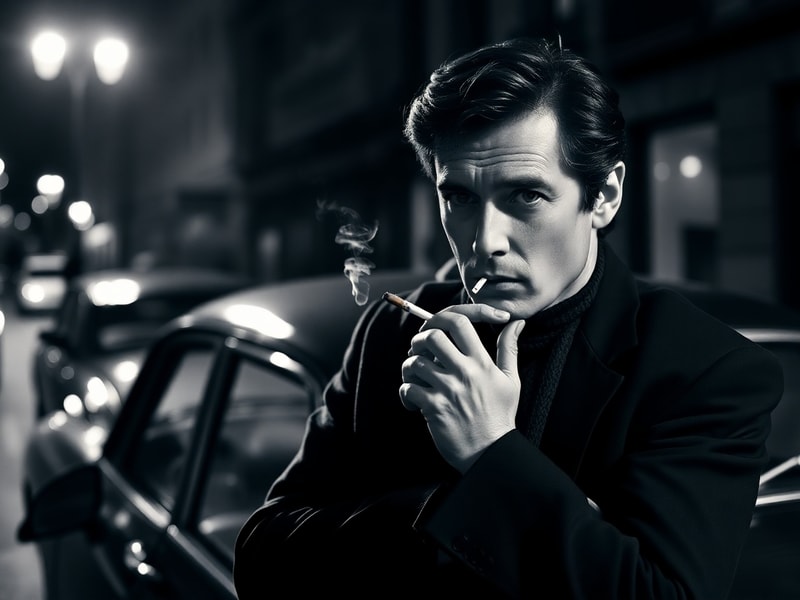
His fashion sense was just as influential. Delon popularized the style décontracté—effortless elegance with a hint of rebellion. Tailored suits, open-collar shirts, and a cigarette dangling from his lips became his trademark. Designers like Yves Saint Laurent cited him as an inspiration, and his influence can still be seen in modern menswear.
Delon’s collaborations with directors were pivotal in shaping his legacy. Visconti’s The Leopard showcased his ability to convey aristocratic decay with heartbreaking nuance. In Le Samouraï, directed by Jean-Pierre Melville, Delon played Jef Costello, a hitman whose stoic demeanor and meticulous routines made him one of cinema’s most iconic assassins. The film’s minimalist aesthetic and Delon’s understated performance turned it into a cult classic.
A Selection of Alain Delon’s Most Iconic Roles
- The Leopard (1963) – As Prince Fabrizio Salina in Luchino Visconti’s adaptation of Giuseppe Tomasi di Lampedusa’s novel, Delon embodied the fading grandeur of the Sicilian aristocracy.
- Le Samouraï (1967) – His role as Jef Costello, a contract killer living in a world of silence and precision, remains a benchmark for cinematic cool.
- Borsalino (1970) – A stylish gangster film where Delon starred alongside Jean-Paul Belmondo, playing a dapper criminal in 1930s Marseille.
- The Driver (1978) – A neo-noir thriller where Delon played a getaway driver caught in a deadly game of cat and mouse.
Beyond the Screen: Delon’s Private Life and Public Persona
Delon’s personal life was as dramatic as any of his film roles. His relationships with women—including Romy Schneider, Mireille Darc, and Dalida—were tabloid staples. His marriage to French model Nathalie Barthélémy in 1987 lasted until her death in 2023, and the couple had two children, Anouchka and Alain-Fabien. Despite his public persona as a ladies’ man, Delon was fiercely private, rarely granting interviews about his personal life.
His political views also sparked debate. A staunch conservative, Delon was vocal in his support for law and order, often aligning himself with right-wing figures. In 2008, he publicly endorsed Nicolas Sarkozy’s presidential campaign, a move that drew both praise and criticism. His unapologetic stance on issues like immigration and national identity reflected a worldview that contrasted sharply with the progressive ideals of many of his peers.
In his later years, Delon became a symbol of nostalgia for a bygone era of cinema. Though he largely stepped away from acting in the 2000s, his influence endured. Younger actors, from George Clooney to Ryan Gosling, have cited him as a benchmark for masculine charisma on screen.
The Legacy of Alain Delon: A Timeless Icon
Delon’s impact on cinema is immeasurable. He wasn’t just a star; he was a force of nature who shaped the very idea of what a leading man could be. His films continue to be studied and celebrated, and his influence can be seen in everything from modern thrillers to fashion.
In 2019, at the age of 83, Delon made a rare public appearance at the Cannes Film Festival, where he was honored with a special screening of Le Samouraï. The event was a reminder of his enduring appeal, a man who had transcended generations. Even now, his films are frequently referenced in pop culture, from Quentin Tarantino’s homages to the resurgence of neo-noir aesthetics.
Delon’s legacy is one of style, substance, and an unshakable presence. He proved that charisma isn’t just about looks—it’s about the ability to captivate an audience with a glance, a gesture, or a perfectly tailored suit. In an era where actors often prioritize social media over craft, Delon’s career stands as a testament to the power of cinema to create legends.
For those looking to explore his work, Dave’s Locker’s Entertainment section offers a curated selection of films that define Delon’s career. Whether you’re a longtime fan or a newcomer, his movies remain essential viewing.
Alain Delon didn’t just act in films—he became a part of cinema history. And that’s a role no one else could ever fill.