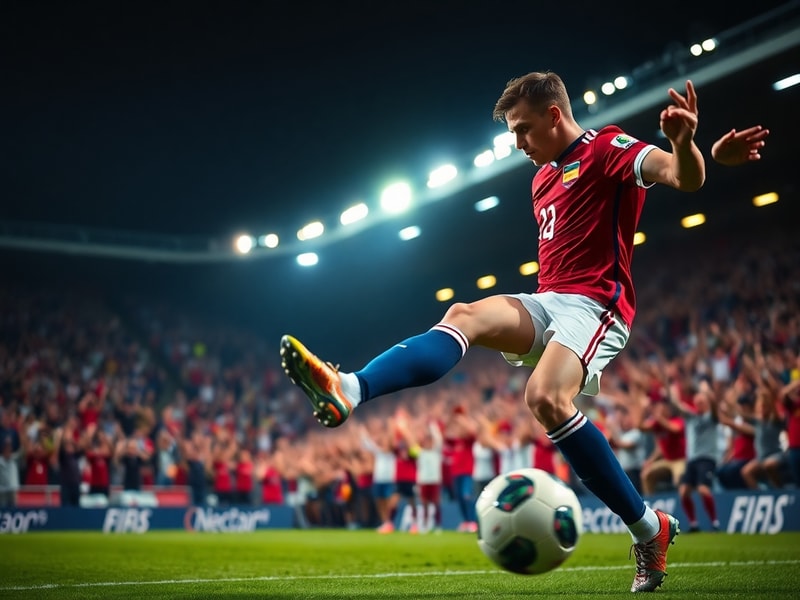
FIFA World Cup 2026 Qualifiers: A Global Race to the Biggest Stage
The journey to the FIFA World Cup has always been more than just a series of matches—it’s a global spectacle where nations compete not only for glory but for the chance to write their names into footballing history. The 2026 edition promises to be the most expansive yet, with 48 teams set to compete across three continents. This expansion means the qualifying process is longer, more competitive, and filled with narratives that transcend the pitch.
Already underway in various confederations, the qualifiers are uncovering fresh talent, testing the resilience of established powers, and offering smaller nations a rare platform on the world stage. From the high-altitude drama of South American qualifiers to the tightly contested battles in Europe and the unpredictable upsets in Africa and Asia, every confederation brings its own flavor to the tournament’s qualifying saga.
The Road to 48: How Qualification Works
With the number of participating teams nearly doubling from 32 to 48, FIFA has reshaped the qualifying landscape. The new format divides teams into 12 groups of four, with the top two from each group advancing to a knockout playoff stage. This structure ensures more matches and greater opportunities for teams that have historically struggled to qualify.
Each confederation receives a specific number of spots based on FIFA rankings and competitive balance. For example, Europe (UEFA) receives 16 places, Africa (CAF) 9, Asia (AFC) 8, South America (CONMEBOL) 6, North America (CONCACAF) 6, and Oceania (OFC) 1, with the remaining two decided through intercontinental playoffs. This system reflects both fairness and ambition, giving smaller federations a clearer path to the World Cup.
- UEFA (Europe): 12 groups of four teams; top two from each group advance directly. The 12 group winners automatically qualify, while the runners-up enter playoffs.
- CAF (Africa): Nine groups of six teams; group winners advance to a final knockout stage, with four winners qualifying directly and two entering playoffs.
- AFC (Asia): Eight groups of five or six teams; group winners advance to a second round, with the top 12 teams entering a final round of four groups. The two best group runners-up from the final round qualify directly, with the rest entering playoffs.
- CONMEBOL (South America): A single round-robin league where the top six teams qualify directly, and the seventh-place team enters a playoff.
- CONCACAF (North America): Nine groups in the first round, followed by a league stage with six teams. The top three qualify directly, while the fourth-place team enters a playoff.
- OFC (Oceania): A single round-robin tournament; the winner advances to an intercontinental playoff.
Cultural Narratives and Underdog Stories
Beyond the tactical battles and tactical innovations, the qualifiers are rich with cultural stories that resonate far beyond the stadiums. In Africa, nations like Cape Verde, Guinea-Bissau, and Tanzania are defying expectations, fielding teams that play with flair and determination reflective of their vibrant cultures. These teams often rely on players based in European leagues, whose journeys from local fields to global arenas inspire millions back home.
In Asia, the rise of Japan, South Korea, and Australia continues, but the emergence of Thailand, Vietnam, and the Philippines as competitive forces signals a shift in the balance of power. These teams are building football cultures rooted in community, resilience, and tactical adaptability, challenging the traditional dominance of Saudi Arabia and Qatar.
Europe remains the heartland of tactical sophistication, where nations like Belgium, France, and England field squads packed with global superstars. Yet even here, stories of redemption and renewal emerge. Italy, the 2020 European champions, missed out on the 2022 World Cup and is now rebuilding with a new generation, while the Netherlands seeks to recapture its golden-era identity under a fresh coaching philosophy.
Controversies, Challenges, and the Human Element
The qualifying campaign is not without its controversies. In South America, the pressure on traditional giants like Argentina and Brazil is immense, with fans and pundits alike scrutinizing every result. The absence of stars like Lionel Messi or Vinícius Jr. for key matches can shift the balance of entire campaigns. Meanwhile, in CONCACAF, the dominance of the United States, Mexico, and Canada is being tested by the rapid development of Costa Rica, Jamaica, and even smaller nations like Curaçao.
Logistical challenges also play a role. Travel distances in South America and Oceania can be brutal, with teams enduring grueling flights and time-zone changes. In Africa, political instability and economic constraints often disrupt preparation, forcing coaches to adapt on the fly and rely on local talent rather than imported expertise.
Yet, it is the human element that truly defines these qualifiers. Players like Ecuador’s Kevin Rodríguez, who scored a crucial goal against Chile, or Morocco’s Amine Adli, who has become a talisman for his national team, embody the dreams of millions. Their stories are not just about football—they are about identity, perseverance, and the power of sport to unite communities.
What’s at Stake: Beyond the Trophy
The stakes extend beyond mere qualification. For many nations, reaching the World Cup is a matter of national pride and a catalyst for development. Hosting rights for 2026 are shared by the United States, Canada, and Mexico, meaning the qualifiers are also a dress rehearsal for the tournament’s infrastructure, fan experience, and cultural integration.
Moreover, the expanded format offers smaller nations a rare opportunity to shine. For example, the Faroe Islands in Europe or Bhutan in Asia are not expected to advance, but their participation fosters grassroots growth and inspires future generations. These journeys, though often ending in defeat, are vital to the global growth of the game.
As the qualifiers progress, the anticipation builds not only for the teams that will qualify but for the stories they will bring to the world stage. Will a first-time qualifier emerge as the tournament’s breakout star? Could a traditional powerhouse stumble, paving the way for a historic upset? The answers lie in the matches yet to be played, the goals yet to be scored, and the dreams yet to be realized.
For fans of football around the world, the qualifiers are a reminder of why the sport is so deeply cherished. It is not just about the destination—it’s about the journey, the struggles, the triumphs, and the unbreakable spirit of competition.
The FIFA World Cup 2026 qualifiers are more than a precursor to the tournament; they are a celebration of football’s global reach, its cultural power, and its ability to bring the world together—one match, one goal, one story at a time.